
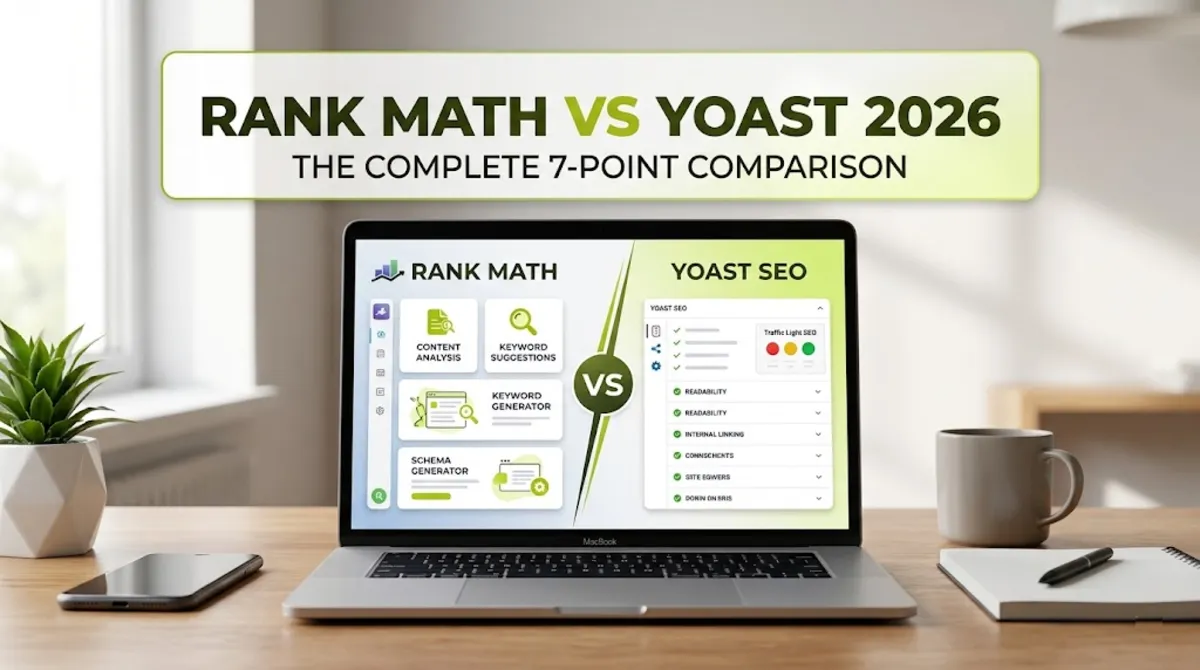
- In the Rank Math vs Yoast decision, Rank Math offers far more in its free tier, while Yoast wins on simplicity and readability coaching.
- Rank Math Free includes 5 focus keywords, redirects, 404 monitoring, and 18+ schema types. Yoast Free gives 1 focus keyword and the best readability analysis.
- Rank Math is cheaper for multiple sites, with Pro covering unlimited personal sites. Yoast charges per site plus add-ons.
- Both handle the SEO fundamentals identically well, so in Rank Math vs Yoast the plugin itself does not change your rankings.
- Choose Rank Math for maximum free features, and Yoast for simplicity, readability, and a longer track record.
In the Rank Math vs Yoast comparison for 2026, Rank Math packs far more into its free version, including redirects, more schema types, and five focus keywords, while Yoast wins on a simpler interface, superior readability analysis, and a longer track record. Both are excellent and handle core SEO identically, which is what makes the Rank Math vs Yoast call about fit. This Rank Math vs Yoast guide breaks down exactly where each one wins so you can choose confidently.
After setting up both plugins on client sites in 15+ countries, here is my honest take before the details. Neither plugin will rank your site for you, they are tools that help you implement good SEO, not a shortcut to the top. I use Rank Math on most builds for its free feature depth, but Yoast is a genuinely strong choice, and for some people it is the better one. Here is the fair, side-by-side Rank Math vs Yoast breakdown.
The Quick Verdict
If you want the short answer to the Rank Math vs Yoast question: choose Rank Math if you want the most features without paying, and choose Yoast if you value simplicity, readability coaching, and a decade-plus track record. Both nail the fundamentals, so the Rank Math vs Yoast decision is about fit, not about one being broadly better.
The one-line summary for each:
- Rank Math gives away features that competitors charge for, making it the value leader, especially if you run more than one site.
- Yoast is the established veteran, with the cleanest beginner experience, the best readability analysis, and enormous institutional trust.
Pro tip: Do not agonize over this choice as if your rankings depend on it. They do not. Both plugins produce sitemaps, meta tags, and schema that look identical to Google. Pick the one whose workflow fits how you actually work, and spend your real energy on content and strategy.
That said, the differences are real and worth understanding. The Rank Math vs Yoast differences start with what you get for free.
Free Features Compared
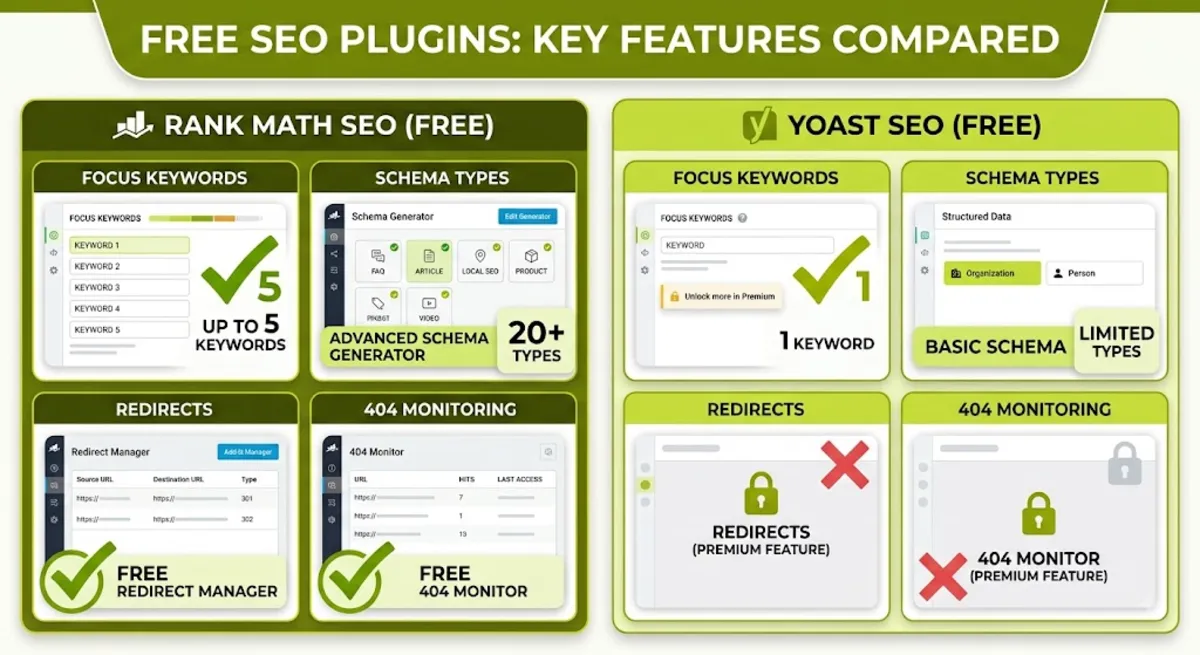
The biggest difference in the Rank Math vs Yoast comparison is what each gives you for free. Rank Math is famous for bundling premium-level features into its free tier, while Yoast reserves more of them for its paid plans. For budget-conscious site owners, this gap is the headline.
| Free feature | Rank Math | Yoast |
|---|---|---|
| Focus keywords per post | Up to 5 | 1 |
| Schema types | 18+ built in | Basic |
| Redirect manager | Included free | Premium only |
| 404 monitor | Included free | Premium only |
| Local and WooCommerce schema | Included free | Paid add-ons |
| Readability analysis | Good | Best in class |
Two free-tier differences matter most in practice. First, Rank Math includes a full redirect manager and 404 monitoring for free, which Yoast puts behind Premium. Second, Rank Math’s broader free schema coverage, including LocalBusiness and WooCommerce, matters more than ever, because structured data is how AI answer engines understand and cite your pages, not just how you earn old rich results.
Where Yoast quietly wins: its readability analysis is the strongest in the category. If you work with writers who are not SEO specialists, Yoast’s clear, coaching-style feedback on sentence length, passive voice, and structure is genuinely useful, and something Rank Math matches only partially.
Features are only half the experience, though. How each plugin feels to use matters just as much.
Ease of Use
On ease of use, the Rank Math vs Yoast difference is a classic trade-off: Yoast is simpler and gentler for beginners, while Rank Math is more powerful but exposes more settings. Both offer a setup wizard and the familiar visual scoring, so neither is hard, they just aim at slightly different users.

How they compare day to day:
- Yoast keeps the interface minimal and guided, with its well-known traffic-light system giving instant, beginner-friendly feedback. There is less to configure and less to get wrong.
- Rank Math uses a modular system, so you switch on only the features you need. It is clean and modern, but the sheer number of options can feel like more to learn at first.
- Both provide a step-by-step setup wizard, Google Search Console connection, and clear on-page scoring, so getting started is straightforward either way.
Pro tip: Rank Math’s modular design is underrated. Because you can turn off modules you do not use, you can keep the plugin lean and the admin uncluttered, which also avoids loading code you do not need. If the settings feel overwhelming, disable what you are not using and the interface simplifies fast.
Ease of use often comes down to budget too, which brings us to price.
Pricing in 2026
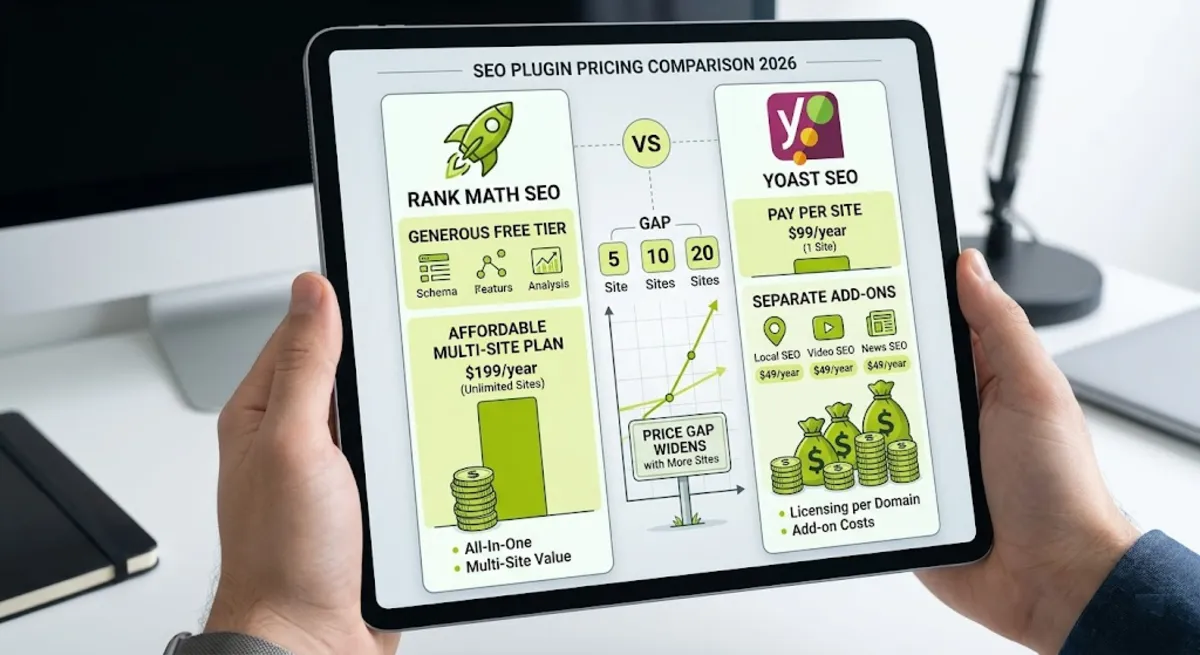
Pricing is where the Rank Math vs Yoast gap widens the most, especially if you manage more than one site. In Rank Math vs Yoast, the two use different pricing philosophies: Rank Math leans on a generous free tier with affordable multi-site plans, while Yoast charges per site and sells add-ons separately. You can compare current tiers on Rank Math’s pricing page.
| Plan | Rank Math | Yoast |
|---|---|---|
| Free tier | Very generous | Solid basics |
| Entry paid plan | From roughly $59 to $99 per year | Around $99 to $119 per site per year |
| Multiple personal sites | Covered by one Pro plan | Paid per site |
| Client sites | Business plan around $199 per year | Per site, plus add-ons |
| Local and WooCommerce | Free or in Pro | Separate paid add-ons |
For a single site, the practical cost is closer than it looks, both land near the hundred-dollar mark for premium. The gap explodes when you add sites. Rank Math’s Pro covers unlimited personal sites under one license, while Yoast’s per-site model multiplies quickly, and its Local and WooCommerce features cost extra on top of Premium. For agencies and anyone running several sites, that difference is substantial.
Pricing aside, 2026 is really about how each plugin is handling AI. That is where the newest differences live.
AI and 2026 Features
Both plugins added AI features, and in the Rank Math vs Yoast race, they took different paths: Rank Math built strategic content optimization, while Yoast leaned into generative writing and AI brand monitoring. This is the fastest-moving part of the Rank Math vs Yoast comparison.
How each approaches AI in 2026:
- Rank Math’s Content AI analyzes top-ranking pages for your keyword and recommends word count, headings, and related terms, a strategic, research-led approach, plus tools to generate copy.
- Yoast’s AI focuses on generating titles and meta descriptions, and its AI Brand Insights tracks how your brand appears in AI search answers.
- Rank Math’s forward-looking extras include
llms.txtsupport to help AI crawlers understand your site, and a tracker for AI-driven search traffic.
These AI additions matter because search is shifting toward AI answers, and both companies clearly know it. Rank Math’s edge here is its structured-data breadth and AI-crawler features, which feed the entity and schema signals AI engines rely on. Yoast’s edge is brand monitoring, useful if you specifically want to watch your presence in AI results.
Worth noting for 2026: the same schema and clarity that help traditional SEO now also drive AI citations. Rank Math’s broader free schema support and llms.txt feature give it a slight practical advantage for AI visibility, though good content remains the real driver in either plugin.
With every angle covered, the real question is which one fits you.
Which Should You Choose?
The Rank Math vs Yoast choice comes down to what you value: maximum free features and multi-site value point to Rank Math, while simplicity, readability, and institutional trust point to Yoast. In the Rank Math vs Yoast decision, neither is a wrong answer, and both will serve a well-run site well.
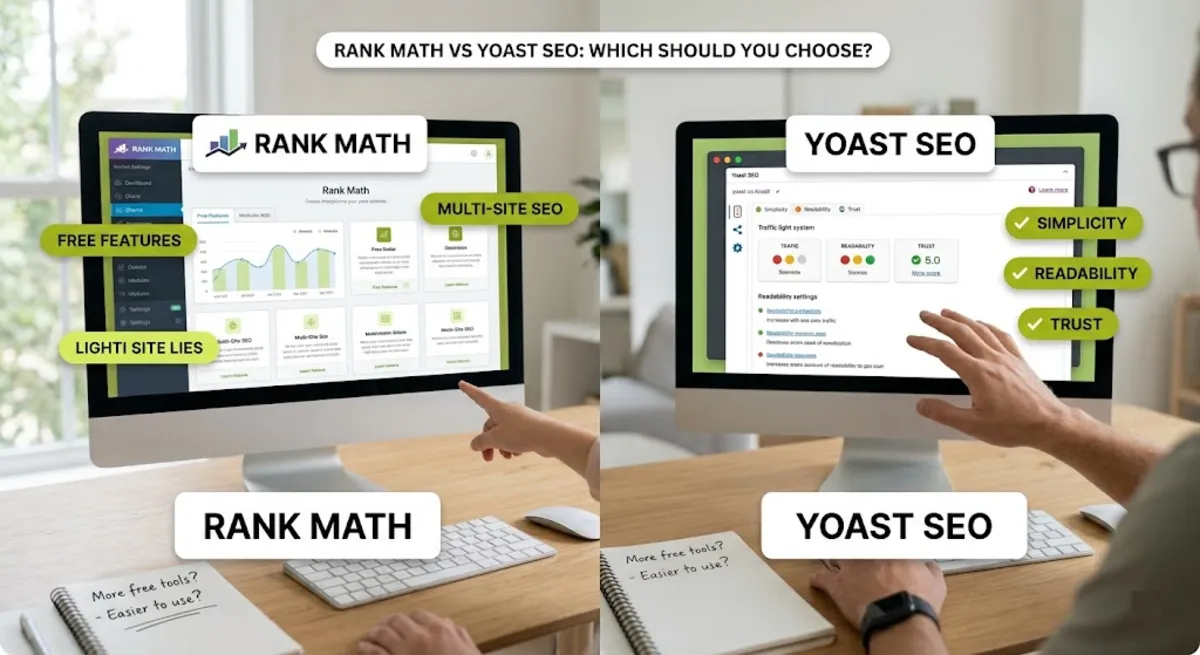
A simple way to settle Rank Math vs Yoast:
- Choose Rank Math if you want maximum features at minimum cost, run multiple sites, need free local or WooCommerce schema, or want the broadest AI and schema toolkit.
- Choose Yoast if you value a simple traffic-light interface, work with writers who need readability coaching, want a fifteen-year track record, or are already running Yoast happily.
- Either is fine if you run a single site and just want solid, reliable on-page SEO, since both deliver that comfortably.
My own default is Rank Math, mainly for the free feature depth and the multi-site value across client work, and its one-click importer makes switching from Yoast painless. But if a client’s team is already trained on Yoast and happy, I leave it, because switching a working setup for marginal gains adds risk without much reward.
Want the right SEO plugin set up and configured properly?
I install, configure, and optimize Rank Math or Yoast so it is working for you from day one, not just installed. See my WordPress and SEO service.
What Most People Get Wrong
The biggest mistake in the Rank Math vs Yoast debate is believing the plugin choice affects your rankings. It does not. As agencies managing hundreds of sites confirm, no SEO plugin has a direct effect on search position, your content, authority, technical performance, and strategy do. Both plugins produce sitemaps and meta tags that look identical to Google.

Here is the observation from client work. People obsess over getting the green light, and then treat it like a ranking score. It is not. The traffic-light system in either plugin is a helpful checklist of on-page basics, not a measure of whether you will rank. I have seen green-light pages that never rank and orange-light pages that rank first, because relevance, experience, and authority decide it, not a plugin’s internal score. Use the light as a reminder, not a target.
The second trap is running two SEO plugins at once, or switching constantly. Running Rank Math and Yoast together causes conflicts, since they perform the same functions, so pick one and fully deactivate the other. And switching plugins every time a new comparison article appears adds migration risk for marginal gains. Choose deliberately, set it up well, then leave it alone and focus on content.
When you are unsure which plugin fits, or a migration needs to be done without losing settings, that is where getting it set up properly the first time pays off.
Switching plugins or setting one up and worried about losing rankings?
I handle plugin migration and configuration cleanly, so nothing breaks and your SEO settings carry over. See my WordPress and SEO service or book a free call.
Frequently Asked Questions
Is Rank Math better than Yoast in 2026?
It depends on your needs. Rank Math offers significantly more in its free tier, including redirects, more schema types, and five focus keywords, and is cheaper across multiple sites. Yoast wins on simplicity, the best readability analysis, and a longer track record. Both handle core SEO equally well, so the better plugin is the one that fits your workflow.
Does the SEO plugin I choose affect my rankings?
No, not directly. Both Rank Math and Yoast produce sitemaps, meta tags, and schema that look identical to Google, and no SEO plugin has a direct effect on ranking position. Your content quality, authority, technical performance, and strategy determine rankings. The plugin is a tool to help you implement SEO, not a ranking factor in itself.
Is Rank Math’s free version really enough?
For most small sites and solo owners, yes. Rank Math Free includes up to five focus keywords, a redirect manager, 404 monitoring, 18-plus schema types, LocalBusiness and WooCommerce schema, and Search Console integration. Many sites never need to upgrade. You would move to Pro mainly for advanced analytics, keyword tracking, or Content AI, which most early-stage sites do not require.
Can I switch from Yoast to Rank Math without losing SEO?
Yes. Rank Math includes a one-click importer that brings over your Yoast titles, meta descriptions, focus keywords, and settings during setup. The process is designed to preserve your existing SEO data. After importing and confirming everything transferred correctly, fully deactivate and delete Yoast so the two plugins do not conflict.
Which is better for beginners?
Yoast is often gentler for absolute beginners, thanks to its minimal, guided interface and famous traffic-light feedback. Rank Math is also beginner-friendly with its setup wizard, but exposes more options, which some find powerful and others find busy. If simplicity is your priority, Yoast edges it; if you want room to grow, Rank Math suits.
Can I run both Rank Math and Yoast together?
No. Running two SEO plugins that perform the same functions causes conflicts, including duplicate meta tags and schema errors. Choose one, and fully deactivate and delete the other. If you are migrating, import your settings into the new plugin first, verify them, and only then remove the old one to avoid any gap.
Which is better for AI search visibility?
Both are investing in AI, but Rank Math has a slight practical edge, with broader free schema support, llms.txt for AI crawlers, and an AI-search traffic tracker. Yoast offers AI Brand Insights to monitor your presence in AI answers. That said, the biggest driver of AI visibility is clear, structured, genuinely helpful content, not the plugin.
Should I hire someone to set up my SEO plugin?
Consider it if you are migrating between plugins, configuring advanced schema, or want the setup done right without risking your existing rankings. Proper configuration, not just installation, is where an SEO plugin earns its value. My WordPress and SEO service covers plugin setup, migration, and full configuration.
Conclusion
The honest answer to Rank Math vs Yoast in 2026 is that both are excellent, and the right pick depends on what you value. Choose Rank Math for the most features at the lowest cost, better multi-site value, free local and WooCommerce schema, and the broadest AI and schema toolkit. Choose Yoast for a simpler interface, the best readability coaching, and a fifteen-year track record. Above all, remember the thing most comparisons bury: neither plugin ranks your site, your content and strategy do. Pick the one that fits how you work, set it up properly, never run both at once, and then put your real effort where rankings are actually won. Start by trying Rank Math’s free version, since it costs nothing to see whether its feature depth fits you.
Ready to get your SEO plugin working, not just installed?
I set up, migrate, and optimize Rank Math or Yoast so it earns its place on your site. Book a free call or browse my recent project portfolio.
This article was last reviewed and updated in June 2026 to reflect current Rank Math and Yoast features, pricing, and AI capabilities.
