

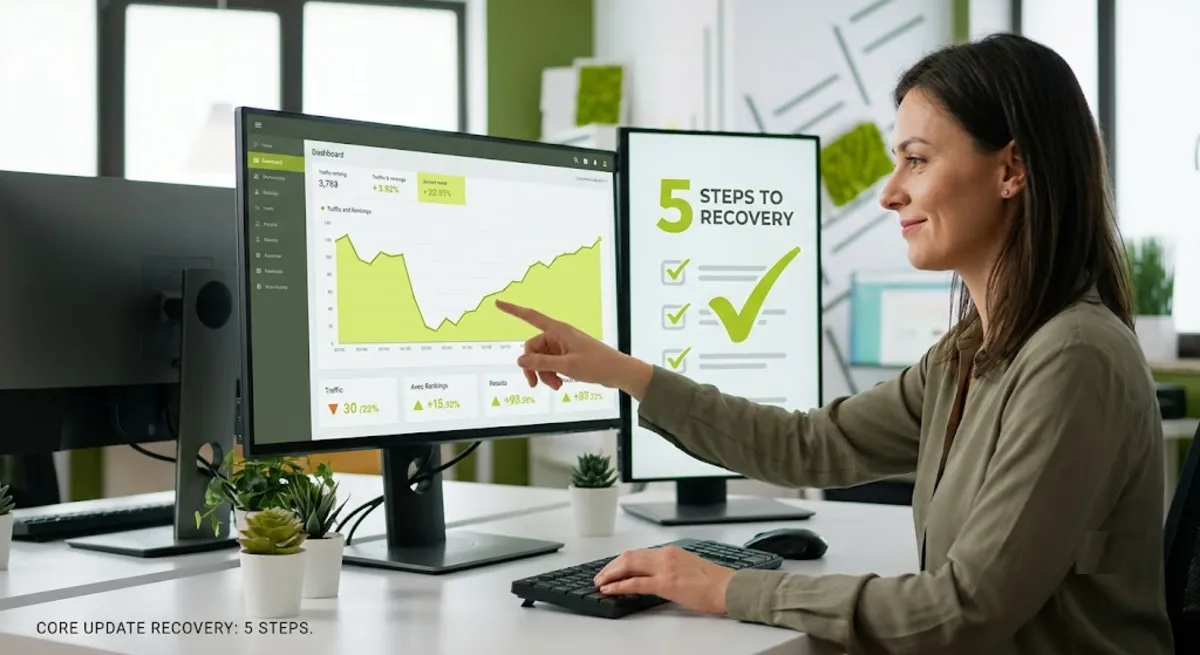
- To recover from a Google core update, improve your site’s overall helpfulness and trust, since a drop is a re-rating, not a penalty with a single fix.
- A core update is not a manual action. There is no button to un-press and no specific action that guarantees recovery.
- Confirm you were hit by matching your traffic drop to the official rollout dates, then diagnose which pages and queries fell.
- Recovery usually takes weeks to months and often only confirms at the next core update, when Google re-scores the whole web.
- Do not panic-delete pages or just change dates. Raise real quality, add first-hand experience, and fix thin content.
To recover from a Google core update, you improve your site’s overall helpfulness, expertise, and trust, then wait for Google to re-assess it, usually at the next core update. There is no single fix, because a core update is not a penalty. It is a broad re-rating of which content best serves each query. This guide gives you the honest, step-by-step path back.
After helping clients through core update drops for clients in 15+ countries, here is the reframe that matters most. Stop looking for the one thing to undo. A core update did not flag a rule you broke, it re-decided that other pages now serve searchers better than yours. Recovery is not about reversing a penalty, it is about becoming the better answer again. Here is exactly how to do that.
The Hard Truth About Recovery
The hard truth about a Google core update is that there is no specific action to reverse it, because it is not a penalty or a manual action. Google states plainly that a drop may not mean anything is wrong with your pages, and that there are no specific fixes to make. Other content simply serves the query better now.
Google’s own analogy explains it well: imagine a friend asks for your top restaurant list. Your 2019 list was not wrong, but the world changed, new places opened, old favorites slipped, so a fresh, better list looks different. A Google core update is Google refreshing its list. Your page did not necessarily get worse, the competition and the assessment got better.
Pro tip: Reframe recovery from “how do I undo this” to “how do I become the best result again.” That shift changes everything you do next. You stop hunting for a magic fix and start genuinely improving your content, which is the only thing that actually moves rankings back after a core update.
With that Google core update mindset set, the process is methodical. It starts with confirming what actually happened.
Step 1: Confirm You Were Actually Hit
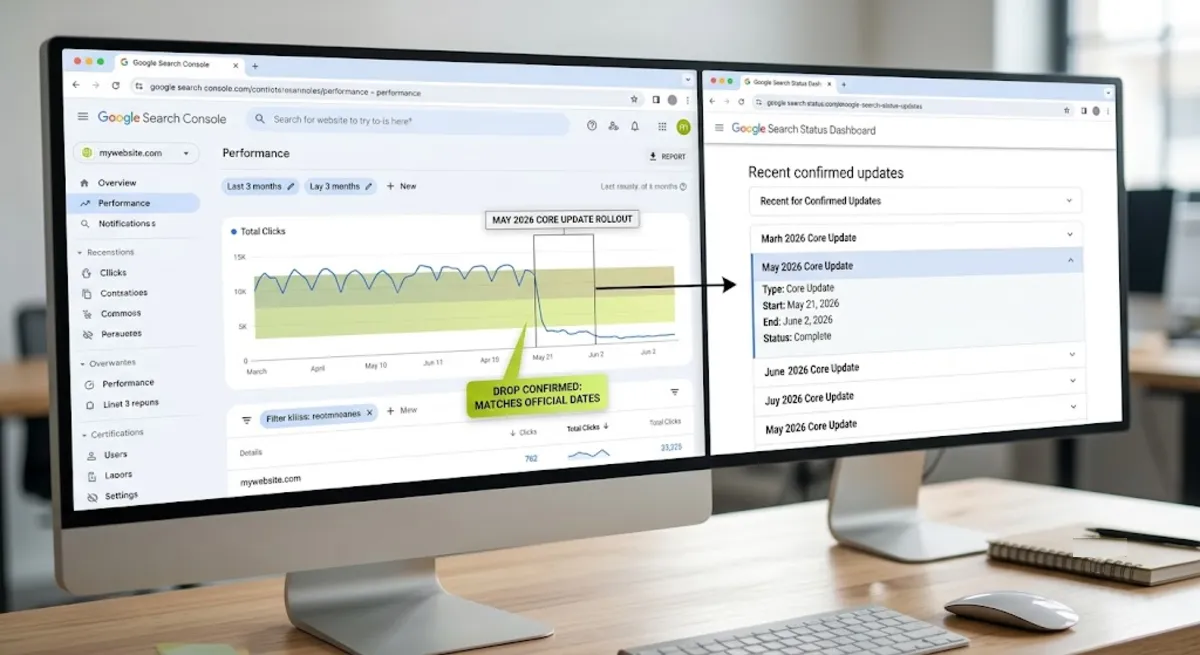
Before you change anything, confirm your traffic drop actually lines up with a Google core update, because not every dip is core-update-related. Match the timing of your decline against the official rollout dates, and rule out seasonality, tracking errors, or a separate technical problem first.
How to confirm it properly:
- Check the official dates. Use Google’s Search Status Dashboard to get the confirmed start and end dates of the core update.
- Wait for the rollout to finish. Rankings swing wildly mid-rollout. Wait until the Google core update completes, then about a week more, before judging anything.
- Match the timing. In Search Console, see whether your drop began within the rollout window, not before or after.
- Rule out other causes. Confirm it is not seasonality, a tracking bug, a manual action, or a technical error like a broken deployment.
Once you have confirmed a core update caused the drop, you need to know exactly what fell.
Step 2: Diagnose What Dropped
Diagnosing a Google core update drop means segmenting your Search Console data to see exactly which pages, queries, and content types lost visibility. A Google core update rarely hits a site evenly, so the pattern of what dropped tells you where the quality problem lives.
Segment your data to find the pattern:
- By page. Identify which specific URLs lost the most clicks and impressions, and look for what they have in common.
- By query. Separate branded from non-branded terms, and note which topics or intents fell hardest.
- By content type. See whether the damage clusters in one section, such as thin blog posts, old pages, or a particular template.
- By search type. Check whether the drop is in Web Search, Images, Video, or News, since that narrows the cause.
Then study the pages now outranking you. What do they cover that you do not? What first-hand experience, depth, or trust signals do they show that your page lacks? A Google core update recovery is fundamentally about closing that quality gap, so you have to see it clearly before you can close it.
Pro tip: Look for a thin-content pattern across the whole site. Since March 2024, the helpful content signal works site-wide, so a pile of low-value pages can drag down even your strong ones. Sometimes the fix for your best page is improving or removing the weak pages around it.
With a clear diagnosis, you can make the improvements that actually earn rankings back.
Step 3: Improve Helpfulness and Trust
You recover from a Google core update by genuinely improving the helpfulness, expertise, and trustworthiness of your content, guided by what your diagnosis revealed. This is the real work, and per Google’s helpful content guidance, it is about people-first quality, not chasing the algorithm.

The improvements that drive Google core update recovery:
- Add first-hand experience. Original data, real examples, screenshots, and lived insight are what now separate winners from generic content.
- Deepen or consolidate thin content. Improve pages that lack substance, and consolidate or remove near-duplicates that dilute your site.
- Strengthen E-E-A-T signals. Clear authorship, credentials, accurate facts, and a trustworthy, transparent site.
- Match search intent better. Restructure pages to answer the actual question behind the query, more completely than the competition.
- Fix technical quality. Address Core Web Vitals and other issues, since they act as a tie-breaker between otherwise comparable pages.
The 2026 reality: per Google’s Search Essentials, E-E-A-T now matters well beyond health and finance topics, and first-hand experience is the durable differentiator. Whether content was written with AI help does not matter to Google, only whether it is genuinely helpful and backed by real expertise.
Once the improvements are live, the hardest part begins: waiting the right way.
The Recovery Timeline
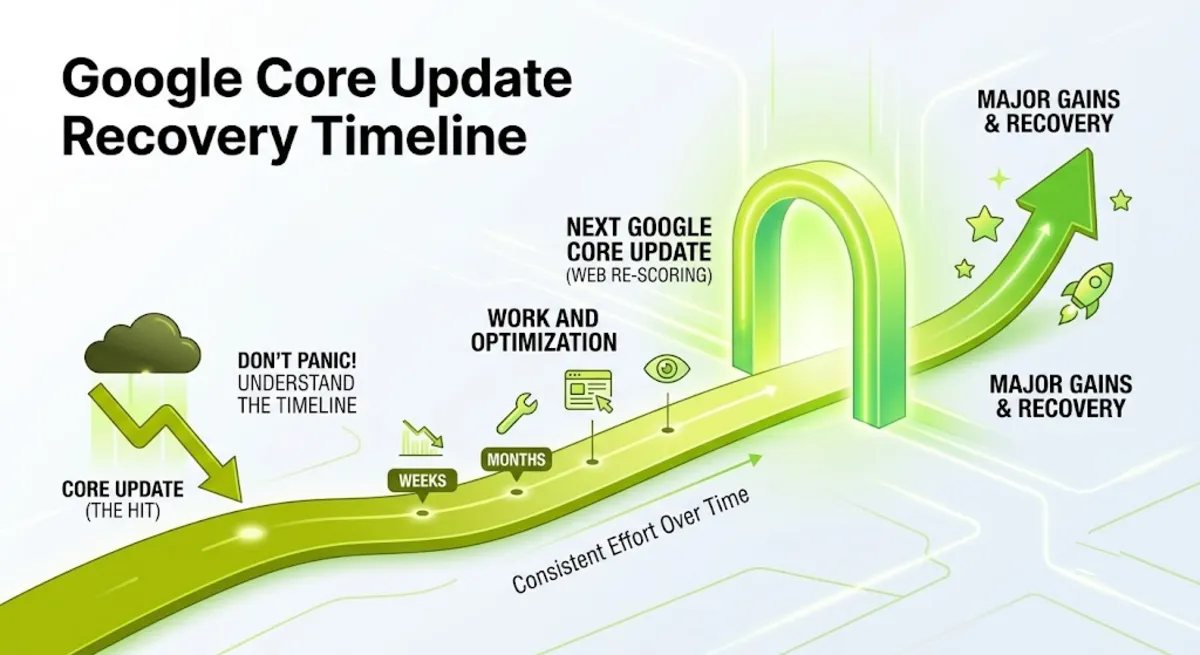
Recovery from a Google core update usually takes weeks to months, and the biggest gains often appear only at the next Google core update, when Google re-scores the whole web. Understanding this Google core update timeline keeps you from panicking and undoing good work too early.
| Phase | What happens |
|---|---|
| During rollout | Heavy fluctuation. Do not react. Wait for the confirmed end date plus a week. |
| Weeks after fixes | Small, gradual movement is possible as Google re-crawls and re-assesses improved pages. |
| Next core update | The most significant recovery, when Google re-rates the whole landscape and confirms your improvements. |
Google confirms that after you make improvements, it can take days but often several months for its systems to learn and confirm your site is now better as a whole. Partial recovery between updates does happen, since Google re-crawls continuously, but the full re-rating typically lands at the next broad Google core update. In 2026, core updates have been arriving roughly every couple of months, so that next evaluation window is rarely far away.
Knowing all this, here is where people sabotage their own recovery.
Hit by a core update and not sure what actually dropped?
I diagnose exactly what a core update hit, then build a prioritized recovery plan focused on real quality gains. See my WordPress and SEO service.
What Most People Get Wrong
The biggest mistake after a Google core update is panicking and making drastic changes to pages that were performing well. Google explicitly advises against changing content that is still doing fine. Ripping apart your site in a panic often removes the very pages holding up your remaining traffic, turning a setback into a self-inflicted disaster.
Here is the observation from client work. The three self-inflicted wounds I see most are panic-deleting content instead of improving it, changing publish dates without materially updating the content, and keyword-stuffing or adding manipulative internal links to look “optimized.” All three either do nothing or actively hurt. Google can tell a date change from a real update, and thin tricks are exactly what a Google core update is designed to catch.
The second trap is chasing a single “recovery hack.” Every Google core update spawns a wave of posts promising the one tactic that fixes everything. There is no such tactic, because there is no single problem. The right fix depends entirely on your diagnosis: a title rewrite helps if the title was weak, a content refresh helps if the page was stale, a technical fix helps if crawling was broken. Evidence first, then the fix.
When a Google core update drop is severe and you cannot tell what is dragging the site down, that is where an experienced diagnosis turns panic into a clear plan.
Traffic gone after an update and every “fix” list contradicts the last?
I diagnose what actually dropped and build a real recovery roadmap, no panic, no hacks. See my WordPress and SEO service or book a free call.
Frequently Asked Questions
How long does it take to recover from a Google core update?
Usually weeks to months. Small, gradual improvements can appear within weeks as Google re-crawls your improved pages, but the most significant recovery often lands at the next core update, when Google re-scores the whole web. For sites in sensitive niches, full recovery can take six to twelve months of sustained quality work.
Is a Google core update a penalty?
No. A core update is a broad re-assessment of which content best satisfies each query across the whole web, not a manual action against your site. A penalty is a specific action for breaking Google’s rules. With a core update, nothing may be wrong with your pages, other content simply serves the query better now.
Can I recover before the next core update?
Partial recovery is possible, since Google re-crawls and re-assesses continuously, so genuine improvements can lift some pages between updates. However, the full re-rating typically confirms at the next broad core update, when Google re-scores the entire landscape. Make your improvements promptly so they are in place before that next evaluation window.
What actually helps recovery?
Genuinely improving your site’s helpfulness, expertise, and trust. That means adding first-hand experience and original insight, deepening or consolidating thin content, strengthening authorship and trust signals, matching search intent more completely, and fixing technical issues like Core Web Vitals. There is no single trick, recovery follows real, site-wide quality improvement.
Should I delete the pages that dropped?
Rarely, and never in a panic. Improving or consolidating pages is almost always better than deleting them. Only remove content that is genuinely low-value, irrelevant, or duplicative, since that can lift your site’s overall quality signal. Deleting pages that still serve users, or that support other rankings, usually does more harm than good.
Does changing the publish date help recovery?
No, not on its own. Google can distinguish a genuine content update from a mere date change, and restamping dates without real improvement can look manipulative. Update the date only when you have made a material improvement to the content itself. The improvement is what matters, not the timestamp.
Does E-E-A-T matter for core update recovery?
Yes, and increasingly so. Recent core updates have extended E-E-A-T expectations well beyond health and finance to nearly all content. First-hand experience, clear expertise, and trust signals are now central to recovery. Demonstrating real, lived knowledge that generic or AI-only content cannot fake is one of the most durable ways to earn rankings back.
Should I hire someone to recover from a core update?
Consider it when the drop is large, the cause is unclear, or generic fix lists are not moving the needle. Diagnosing exactly what a core update hit, and prioritizing the improvements that will actually earn rankings back, is where experience pays off. My WordPress and SEO service covers full core update diagnosis and recovery.
Conclusion
Recovering from a Google core update is not about finding a button to un-press, because there is no penalty to reverse. It is about becoming the better answer again. Confirm the Google core update drop against the official rollout dates, diagnose exactly which pages and queries fell, then genuinely improve your site’s helpfulness, first-hand experience, and trust, guided by what your diagnosis shows. Then wait the right way, small gains may come in weeks, but the real recovery usually confirms at the next Google core update. Above all, do not panic-delete pages or chase one-tactic “hacks.” Start today by confirming the rollout dates in Google’s Search Status Dashboard and segmenting your Search Console data to see exactly what dropped. Clear diagnosis is the first real step back.
Ready to turn a core update drop into a comeback?
I diagnose what hit you and build a real, prioritized recovery plan. Book a free call or browse my recent project portfolio.
This article was last reviewed and updated in June 2026 to reflect current Google core update behavior and recovery guidance.