
- Most sites do not need a fully custom WordPress theme, a lean base theme plus light customization covers a lot of real projects.
- You do need a custom WordPress theme for a distinctive brand, strict performance needs, custom features, real scale, or built-in accessibility.
- The real enemy for most sites is not pre-built versus custom, it is the bloated multipurpose theme you fight forever.
- Many people who ask actually mean a customized pre-built theme, not one coded from scratch.
- Decide by your design, performance, functionality, and growth needs, not by what sounds premium.
Most sites do not need a fully custom WordPress theme. A lightweight base theme like GeneratePress or Kadence, plus some customization, covers a large share of real projects. You need a custom WordPress theme when your site demands a unique brand, strict performance, custom functionality, real scale, or accessibility built in. Here is an honest way to decide, from someone who builds them for a living.
I build custom WordPress themes for clients in 15+ countries, so you might expect me to say yes, everyone needs one. I will not, because it is not true. Plenty of sites are better served by a good lightweight theme, and I have talked people out of custom builds they did not need. But some sites genuinely require custom work, and using a template there is a costly mistake too. Here is where the line actually sits.
The Short Answer
No, most sites do not need a fully custom WordPress theme, but some absolutely do, and choosing wrong in either direction costs you. The honest answer depends on what your website needs to achieve, not on which option sounds more professional or more affordable.
Here is the split in one view:
- You probably do not need custom if your site is fairly standard, your budget is tight, a good template design works, and you want to launch fast.
- You probably do need custom if your brand is distinctive, performance drives revenue, you need unique features, you are scaling, or accessibility is built in from the start.
- Most sites land in the middle, best served by a lean base theme with focused customization rather than a full custom build or a bloated premium theme.
Pro tip: Ask what your site needs to do before you ask what to build it with. A brochure site for a local service and a scaling e-commerce brand have completely different answers, and the same advice cannot serve both. Match the tool to the job, not to a general rule.
Before you can decide, it helps to clear up what a custom WordPress theme even is, because the term confuses almost everyone.
What Custom Actually Means
A custom WordPress theme is one coded from scratch for your specific site, which is different from a customized pre-built theme, a ready-made theme you style to your liking. Most people who ask this question actually mean the second thing, and confusing the two leads to wrong decisions.
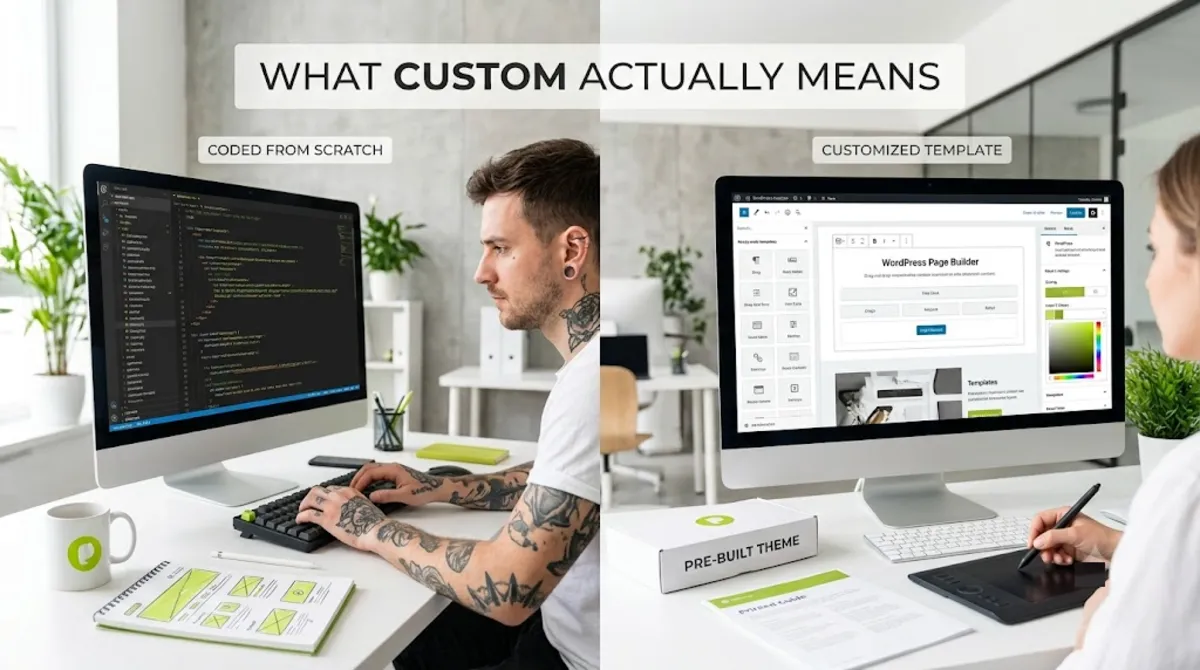
There is a spectrum here, and knowing where you sit matters:
- Pre-built theme. A ready-made theme you install and configure, from free options to premium ones, styled through settings.
- Customized pre-built theme. A lightweight base theme you extend with a child theme, custom CSS, or blocks, giving a tailored look on a proven foundation.
- Custom WordPress theme. A theme coded from scratch in PHP, HTML, and CSS, giving total control over every line of markup and how the site behaves.
The distinction matters because the middle option, a lean theme thoughtfully customized, gives many sites most of the benefit of custom at a fraction of the cost. When someone says they want a custom WordPress theme, they often really want their site to look unique and load fast, which a customized base theme can deliver without a full ground-up build.
Worth clarifying up front: a truly custom theme means custom code, custom templates, and full control, at a higher cost and timeline. A customized pre-built theme means a proven, lightweight foundation styled to your brand, faster and cheaper. Knowing whether you need a custom WordPress theme or a customized one is the first real decision.
With that cleared up, here is when a full custom build is genuinely unnecessary.
When You Do Not Need One
You do not need a custom WordPress theme when your site is fairly standard, your budget is limited, and a quality lightweight theme with light customization will do the job well. For a large share of sites, you simply do not need a custom WordPress theme, and that is exactly the situation.
A custom WordPress theme is overkill, and a good, fast base theme is the right call, when:
- Your site is standard. A brochure site, a blog, a portfolio, or a straightforward small-business site rarely needs custom code to look and perform well.
- Your budget is tight. A lightweight theme costs little to nothing, versus several thousand dollars and up for a full custom build.
- A template design works. If a clean, professional look serves your goals, you do not need a bespoke design to succeed.
- You want to launch fast. A base theme gets you live in days, not the weeks a custom build takes.

Modern lightweight themes are genuinely excellent. Options like GeneratePress and Kadence add very little code, load fast, and give you real design control, and a good native block theme can hit near-perfect performance out of the box. For most standard sites, this route delivers a fast, clean, professional result without the cost or timeline of custom development.
That said, there are clear situations where a template will hold you back, and custom is the right investment.
When You Do Need One
You do need a custom WordPress theme when your site has a distinctive brand, strict performance requirements, custom functionality, real scale, or accessibility that must be built in from the start. In these cases, a template becomes a ceiling you keep hitting.
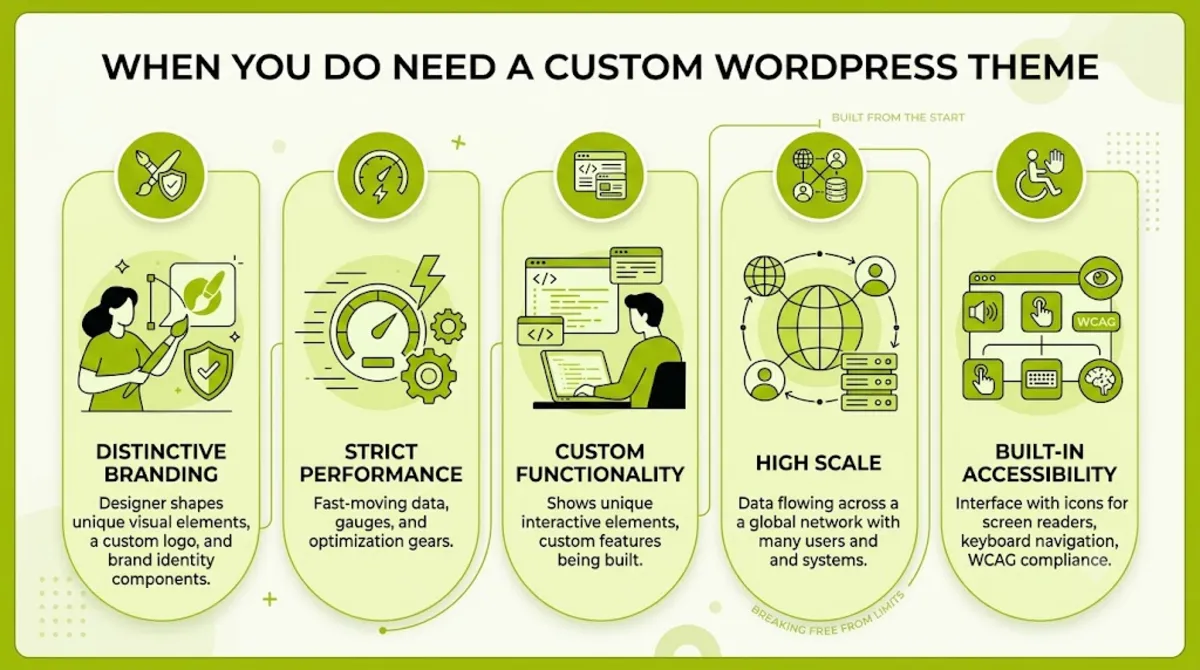
A custom WordPress theme earns its cost when you have:
- A distinctive brand. If you have invested in a visual identity, and a template cannot express it, custom lets the site be a true extension of your brand.
- Strict performance needs. When speed directly drives revenue, a lean custom theme loads only what each page needs and passes Core Web Vitals more easily than a feature-heavy template.
- Custom functionality or content structures. Unique features, integrations, or content types that no off-the-shelf theme supports call for custom code.
- Real scale. A growing store or high-traffic site avoids the plugin conflicts and performance debt that a stretched template accumulates.
- Accessibility from the ground up. Accessibility is easier to build into a custom theme from the start than to retrofit onto a template, and it is a rising legal and reputational concern.
A useful signal: if you find yourself fighting a template, adding plugins to force behavior it does not support, layering workaround code, and stripping out features you do not use, that friction is telling you the template no longer fits. At that point, custom is usually cheaper over time than continuing to fight.
Pro tip: On accessibility, be precise. The 2026 ADA Title II rule that gets cited applies to government entities, not private businesses, and its compliance dates were pushed to 2027 and 2028. But web accessibility lawsuits against private sites keep rising and courts reference WCAG, so building it in is smart risk management, just not a blanket legal mandate for every business.
For most people, though, the real answer is neither extreme, but the ground in between.
The Middle Ground Most Sites Want
The best fit for most sites is the middle ground between a template and a custom WordPress theme: a lightweight base theme customized to your brand, which gives you most of the speed and control of custom at a fraction of the cost. You rarely have to choose between a bare template and a full custom build.
Here is why this works so well. A lean theme like GeneratePress, Kadence, or a good block theme gives you a fast, clean, well-coded foundation. A developer then extends it with a child theme, custom styling, and blocks or patterns to match your brand and add what you need. You get a tailored, fast, unique-enough site on a proven base, without paying to reinvent the foundation from scratch.
| Approach | Best for |
|---|---|
| Pre-built theme, lightly configured | Simple, standard sites on a tight budget. |
| Lean theme, customized by a developer | Most business sites wanting speed, brand fit, and value. |
| Fully custom theme | Distinctive brands, custom features, performance-critical, or scaling sites. |
The practical sweet spot: for the majority of business sites, a lean base theme customized by a developer beats both a cheap DIY template setup and an unnecessary full custom build. It is fast, owned, brand-fitting, and cost-effective, which is why it is what I recommend most often.
To place yourself on this spectrum, run through a short set of honest questions.
How to Decide
To decide whether you need a custom WordPress theme, answer five honest questions about your design, performance, features, growth, and budget. Your answers point clearly toward a template, a customized base theme, or a full custom build.
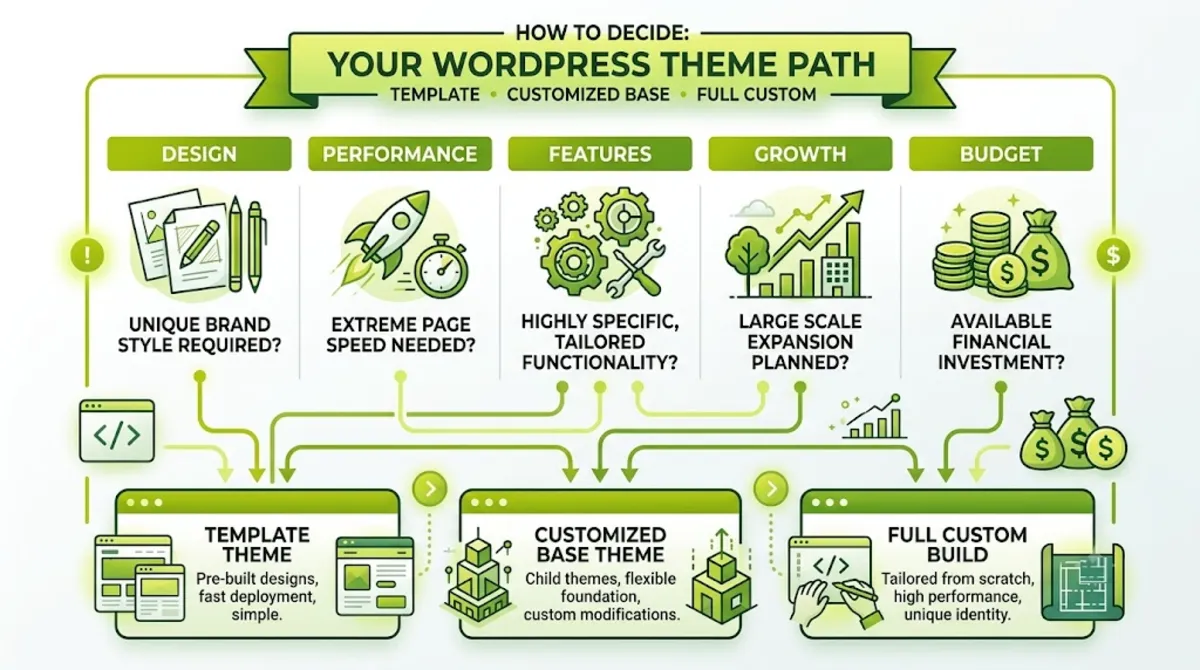
Ask yourself:
- Is my design genuinely unique? If a template look works, you likely do not need custom. If your brand demands something no template can express, you might.
- Does performance drive my revenue? If milliseconds affect sales or rankings meaningfully, custom or a lean block theme is worth it.
- Do I need custom features? Unusual functionality, integrations, or content types push you toward custom code.
- Am I scaling? A site expected to grow significantly benefits from a foundation built to scale rather than a stretched template.
- What is my real budget and timeline? Custom costs more upfront and takes longer, which has to fit your situation.
If most of your answers point to standard, budget-conscious, and soon, you do not need a custom WordPress theme, a lightweight one fits. If they point to unique, performance-critical, feature-rich, and scaling, custom is worth it. And if you are somewhere in between, which most sites are, a customized lean theme is very likely your answer.
Not sure where your site lands?
I will give you an honest recommendation, template, customized base theme, or custom build, based on your goals, not on selling you the biggest package. See my WordPress and SEO service.
What Most People Get Wrong
The biggest mistake around whether you need a custom WordPress theme is treating it as custom-is-always-better versus custom-is-always-overkill. Both are wrong. The right answer is situational, and the costly errors happen at both extremes.
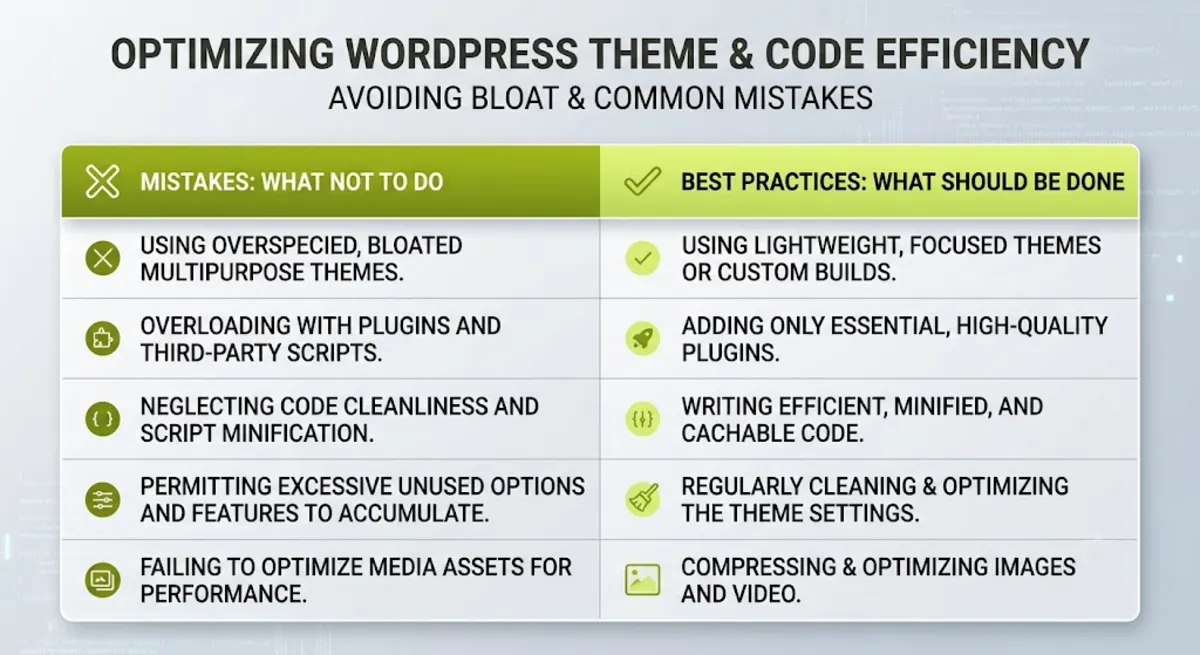
Here is the pattern I see. Some people buy a full custom build for a simple site that a lean theme would serve perfectly, overspending on something they will not use. Others go the opposite way and grab a cheap, feature-stuffed multipurpose theme, then spend the next two years fighting its bloat, slow load times, and settings they do not need. Both chose without honestly asking whether they needed a custom WordPress theme and matching the tool to the job.
The real enemy for most sites is not the pre-built versus custom question at all, it is the bloated multipurpose theme. These themes bundle hundreds of features and a page builder to please everyone, and the result is heavy code that hurts performance and is hard to maintain. A lean base theme, or a focused custom build, both beat a bloated all-in-one theme. If you take one thing away, let it be that: avoid bloat, whichever route you choose.
When you want that honest, situation-specific call made for your site, that is exactly where experienced guidance helps.
Want an honest answer instead of a sales pitch?
I will tell you plainly whether your site needs custom, a customized lean theme, or just a good template, and build whichever is right. See my WordPress and SEO service or book a free call.
Frequently Asked Questions
Do I really need a custom WordPress theme?
Usually not. Most sites, blogs, portfolios, and standard small-business sites, are well served by a lightweight theme with some customization. You need a custom WordPress theme when your site has a distinctive brand, strict performance requirements, custom features, real scale, or accessibility built in. The honest answer depends on what your site must do, not on what sounds more professional.
What is the difference between a custom and a customized theme?
A custom WordPress theme is coded from scratch for your specific site, giving total control at a higher cost. A customized theme is a pre-built theme you style and extend to your liking on a proven foundation. Most people who ask actually want the second, their site to look unique and load fast, which a customized lean theme can deliver without a full ground-up build.
How much does a custom WordPress theme cost?
A full custom WordPress theme typically runs from several thousand dollars into the tens of thousands, depending on complexity, and takes weeks to build. A quality lightweight theme costs from free to a few hundred dollars. A customized lean theme sits in between. For most sites, the middle option delivers the best value, most of the benefit of custom at a fraction of the cost.
Are lightweight themes like GeneratePress good enough?
For a large share of sites, yes. Themes like GeneratePress and Kadence add very little code, load fast, and offer real design control, and a good native block theme performs superbly out of the box. Paired with focused customization, they deliver a fast, clean, professional site. You would move to full custom mainly for a distinctive brand, custom features, or performance at scale.
Is a custom theme better for SEO and speed?
A well-built custom theme has a structural speed advantage, because it loads only the code each page needs and produces clean markup, which helps Core Web Vitals and rankings. But a lean base theme also performs excellently, while a bloated multipurpose theme is the real SEO and speed problem. The key is avoiding bloat, which both a lean theme and a good custom build do.
When is a custom theme worth the investment?
When a template becomes a ceiling. If you are fighting a theme, adding plugins to force behavior it does not support, and stripping out unused features, that friction signals a custom build would serve you better. It is also worth it for a distinctive brand, custom functionality, high traffic, or when performance directly drives revenue. Otherwise, a lean theme is usually the smarter spend.
Should I avoid multipurpose themes?
For most sites, yes. Multipurpose themes bundle hundreds of features and often a page builder to appeal to everyone, which means heavy code your site loads whether you use it or not. That hurts performance and complicates maintenance. A lean base theme, or a focused custom build, both outperform a bloated all-in-one theme. Lean beats loaded regardless of which route you choose.
Can a developer help me decide?
Yes, and a good one will give you an honest answer rather than upselling. The right recommendation depends on your design, performance, feature, and growth needs, and an experienced developer can quickly place your site on that spectrum. My WordPress and SEO service includes honest guidance on whether you need custom, a customized theme, or a template.
Conclusion
So, do you need a custom WordPress theme? For most sites, honestly, no, you do not need a custom WordPress theme, a lightweight one with focused customization will serve you beautifully and cost far less. But if your site has a distinctive brand, strict performance needs, custom functionality, real scale, or accessibility that must be built in, then custom is a genuine investment worth making, and a template will only hold you back. The trap to avoid at all costs is the bloated multipurpose theme that tries to do everything and does none of it well. Decide by your actual needs, design, performance, features, growth, and budget, and the right path becomes clear. And if you are unsure, that middle ground, a lean theme customized to your brand, is very likely your best answer. The goal is a fast, owned, professional site that fits your goals, not the most expensive build you can buy.
Ready for a straight answer and a site built the right way?
I recommend honestly and build whichever fits, template, customized lean theme, or full custom. Book a free call or browse my recent project portfolio.
This article was last reviewed and updated in June 2026 to reflect current WordPress themes, block themes, and Core Web Vitals guidance.