
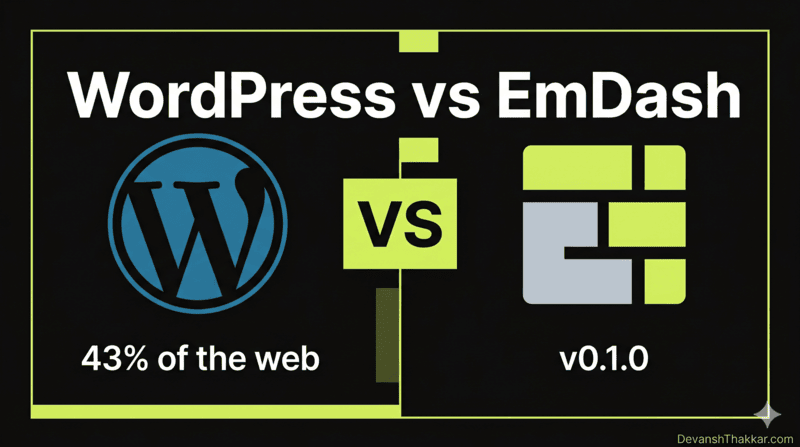
The EmDash vs WordPress conversation started on April 1, 2026, when Cloudflare launched EmDash, an open-source CMS it calls the “spiritual successor to WordPress.” Built entirely in TypeScript by AI coding agents in 60 days, EmDash promises sandboxed plugin security, serverless architecture, and native AI agent support. The WordPress community immediately split into two camps: “WordPress is dead” and “this changes nothing.”
Both are wrong. WordPress developer Devansh Thakkar has built 100+ WordPress sites across 15+ countries and has spent the past two weeks evaluating EmDash’s codebase, architecture, and real-world readiness. This is the honest EmDash vs WordPress comparison from a developer who builds with WordPress daily. EmDash gets some things genuinely right. It also cannot replace WordPress for any production business today, and will not be able to for years. Here is exactly why.
What Is EmDash?
EmDash is an open-source content management system built by Cloudflare and released under the MIT license on April 1, 2026 as a v0.1.0 developer preview. It is written entirely in TypeScript, uses the Astro web framework for themes, and is designed to run on Cloudflare Workers (serverless) or any Node.js server.
The core pitch: WordPress was built in 2003 for a PHP-and-MySQL world. EmDash is built for 2026, where sites run on edge networks, plugins should be sandboxed for security, and AI agents need programmatic access to manage content. According to Cloudflare, EmDash shares no code with WordPress and was rebuilt “from the ground up.” Understanding what EmDash actually is and is not is essential before diving into the EmDash vs WordPress comparison below.
EmDash vs WordPress: The Full Comparison
Here is the EmDash vs WordPress comparison that matters for anyone making a real business decision. Not hype, not fear. Just facts as of April 2026:
| Factor | WordPress | EmDash |
|---|---|---|
| Market Share | 43% of all websites | 0% (zero production sites) |
| Version | 7.0 (20+ years of releases) | v0.1.0 (developer preview) |
| Language | PHP + JavaScript | TypeScript |
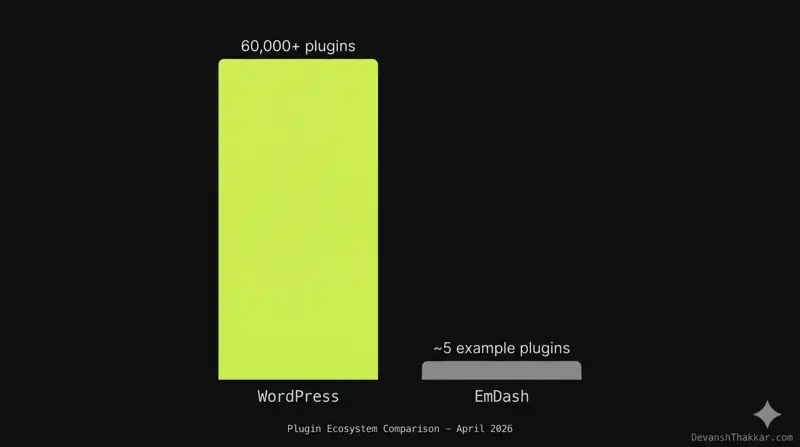
| Plugins | 60,000+ (WordPress.org alone) | A handful of example plugins |
| Themes | Thousands (free + premium) | Starter templates only |
| E-commerce | WooCommerce (millions of stores) | None |
| Page Builders | Elementor, Divi, Bricks, Gutenberg | None |
| SEO Tools | Rank Math, Yoast, AIOSEO | Basic built-in SEO only |
| Plugin Security | Plugins get full system access (risky) | Sandboxed isolates with declared permissions (better) |
| AI Integration | WordPress 7.0 Connectors API + AI Client | Built-in MCP server + Agent Skills |
| Hosting | Any PHP host ($3-50/month) | Cloudflare Workers (optimized) or Node.js |
| Developer Pool | Millions of PHP/WordPress developers | Near zero (TypeScript/Astro required) |
| Migration Path | N/A (you are already here) | WordPress exporter exists but requires manual mapping for ACF, CPTs, WooCommerce |
| Content Editor | Block editor (Gutenberg), Classic editor | Admin panel (functional but sparse) |
| Community | WordCamps, forums, 20 years of documentation | GitHub repo, early contributors |
| License | GPL v2 | MIT |
Pro Tip: When a new CMS launches with headlines about replacing WordPress, look at one number: how many production sites run on it today. EmDash’s answer is zero. WordPress’s answer is hundreds of millions. Architecture matters, but ecosystem is what lets you actually build a business website. – Devansh Thakkar, WordPress Developer
Where EmDash Is Genuinely Better Than WordPress
This is not a dismissal of EmDash. In the EmDash vs WordPress comparison, EmDash makes genuinely better architectural decisions in several areas. Ignoring these would be dishonest:
Plugin Security
This is EmDash’s strongest argument and the one area where the EmDash vs WordPress comparison genuinely favors EmDash. WordPress plugins run with full access to the database, filesystem, and network by default. A single malicious or poorly coded plugin can compromise your entire site. Cloudflare cites that 96% of WordPress security vulnerabilities originate from plugins, and that number is directionally accurate.
EmDash plugins run in isolated V8 sandboxes called Dynamic Workers. Each plugin must declare exactly what permissions it needs in a manifest (database read, database write, media upload, network access). If a plugin does not declare a permission, it physically cannot perform that action. This is a fundamentally better security model.
Serverless Architecture
EmDash scales to zero when idle and spins up on demand. There is no server to manage, no PHP version to upgrade, no MySQL database to optimize. For high-traffic sites with spiky patterns, this can deliver sub-100ms TTFB globally without caching plugins or CDN configuration.
AI-Native Design
EmDash ships with a built-in MCP (Model Context Protocol) server, meaning AI tools like Claude and ChatGPT can interact with your site directly: creating content, uploading media, managing schemas, and building plugins programmatically. It also includes Agent Skills and a CLI for programmatic site management.
WordPress 7.0 added similar capabilities (Connectors API, AI Client), but they are retrofitted onto a 20-year-old architecture. EmDash was designed for AI from the start.
Where WordPress Still Dominates (and Will for Years)
Architecture is necessary but not sufficient. In the EmDash vs WordPress decision, what matters for a business owner is not which CMS has cleverer engineering. It is which CMS lets you build, launch, and grow a website that makes money. On every practical metric, WordPress wins by a margin that EmDash cannot close in months, possibly not even in years:
No WooCommerce Equivalent
EmDash has zero e-commerce functionality. No product catalog, no shopping cart, no payment gateway integration, no order management, no shipping rules, no tax calculations, no subscriptions, no memberships. The EmDash GitHub repo confirms this is not on the near-term roadmap. WordPress powers millions of online stores through WooCommerce with thousands of extensions for payments (Stripe, PayPal), shipping (ShipStation, EasyPost), subscriptions, bookings, and marketplaces. If your site sells anything, EmDash is not an option. Period.
No Plugin Ecosystem
WordPress has 60,000+ plugins on WordPress.org alone, plus thousands of premium plugins. Contact forms (Gravity Forms, WPForms), SEO (Rank Math, Yoast), caching (LiteSpeed Cache, WP Rocket), security (Wordfence, Sucuri), analytics (MonsterInsights), email marketing (Mailchimp, FluentCRM). EmDash has a handful of example plugins. You cannot build a production website on example plugins.
No Page Builders
Non-technical business owners edit their WordPress sites using Elementor, Divi, Bricks, or Gutenberg’s block editor. EmDash has no visual page builder. Editing content requires understanding the admin panel and, for themes, writing Astro components in TypeScript. This is not accessible to the average business owner.
No Developer Pool
There are millions of WordPress developers worldwide. You can hire one in any country, at any price point, on any platform. EmDash requires TypeScript and Astro expertise. The number of developers who can build an EmDash site today is effectively zero outside of Cloudflare’s own team and early open-source contributors.
No Migration Path
EmDash includes a WordPress content exporter, but it converts HTML to Portable Text (structured JSON). Custom post types, Advanced Custom Fields data, WooCommerce products, and page builder layouts do not transfer. In any practical EmDash vs WordPress migration, you are rebuilding everything from scratch.
Pro Tip: When clients ask me about EmDash, I give the same answer I give about every new CMS: “Can you name 10 production business websites running on it?” If you cannot, it is not ready for your business. EmDash is a v0.1.0 developer preview. It is interesting technology for engineers to evaluate. It is not a platform for businesses to bet on. – Devansh Thakkar, WordPress Developer
WordPress 7.0 Closes the Gaps EmDash Targets
The timing of EmDash’s launch is notable. WordPress 7.0 ships with native AI infrastructure that directly addresses two of EmDash’s selling points. This narrows the EmDash vs WordPress gap on AI capabilities specifically:
| EmDash Advantage | WordPress 7.0 Response |
|---|---|
| Built-in MCP server for AI agents | Connectors API + AI Client for Claude, Gemini, OpenAI |
| Agent Skills for programmatic management | Abilities API for standardized AI capabilities |
| AI-generated content and metadata | AI Experiments plugin with title, excerpt, and alt text generation |
| TypeScript-first modern stack | Block editor already runs on React/JavaScript |
The one area WordPress 7.0 does not address is plugin security. WordPress plugins still run with full system access. This is WordPress’s genuine architectural weakness, and it is the one area where EmDash’s approach is objectively superior. However, proper WordPress security practices (keeping plugins updated, using reputable plugins only, running Wordfence or Sucuri, limiting plugin count) mitigate this risk effectively for the vast majority of sites.
Should You Switch from WordPress to EmDash?
No. Not today, and not in 2026. Here is the decision framework Devansh Thakkar recommends to clients asking about the EmDash vs WordPress question:
- You run a WordPress site that works. Keep it. Update to WordPress 7.0 when ready. Maintain plugins. Optimize performance. Your site is fine.
- You are building a new site in 2026. Build it on WordPress. The ecosystem, developer pool, and tool availability are unmatched. EmDash will not have a usable ecosystem for at least 2-3 years, optimistically.
- You are a developer evaluating new tech. Clone the EmDash repo, run the demo, explore the architecture. The sandboxed plugin model is genuinely interesting. But do not recommend it to clients for production use.
- You run a WooCommerce store. EmDash is not even in the conversation. There is no e-commerce layer, no payment processing, no order management. WordPress + WooCommerce is the only open-source e-commerce platform with the depth your store needs.
- You are already on Cloudflare’s ecosystem (Workers, R2, D1). EmDash is the one scenario where early exploration makes sense, because it integrates natively with infrastructure you already pay for. But “explore” is not “migrate production.”
What EmDash Means for the Future of WordPress
The EmDash vs WordPress story is not really about EmDash replacing WordPress. It is about WordPress being pushed to evolve. And that is already happening:
- WordPress 7.0’s AI infrastructure is a direct response to the demand for AI-native CMS capabilities
- Plugin security discussions have intensified in the WordPress community since EmDash highlighted the 96% vulnerability statistic
- Performance expectations are rising as serverless and edge-native architectures become mainstream
- The block editor continues evolving toward a more app-like editing experience
Competition makes WordPress better. EmDash, Cloudflare’s resources, and the attention this launch generated will push WordPress core developers to address long-standing issues faster. That is good for everyone who builds on WordPress.
The Bottom Line: EmDash vs WordPress in April 2026
EmDash has better security architecture. WordPress has everything else. For any business making a practical decision today, the EmDash vs WordPress answer is clear: WordPress is the platform to build on. EmDash is the platform to watch.
If you need a WordPress site built, optimized, or maintained, Devansh Thakkar delivers clean, fast, SEO-optimized work across WooCommerce development, speed optimization, bug fixing, and ongoing maintenance. 250+ projects, 100% Upwork job success, 15+ countries served.
Book a call or send a message. Your WordPress site is not going anywhere. Let’s make it faster, more secure, and higher-converting.
Pro Tip: The best response to “should I worry about EmDash?” is to make your WordPress site so well-built that the CMS underneath it becomes irrelevant. Fast load times, proper SEO, clean code, secure plugins, and a conversion-focused design. That is what matters. Not which CMS is trending on Hacker News this week. – Devansh Thakkar, WordPress Developer
Frequently Asked Questions
What is EmDash?
EmDash is an open-source CMS launched by Cloudflare on April 1, 2026 as a “spiritual successor to WordPress.” It is written in TypeScript, uses the Astro framework for themes, and runs on Cloudflare Workers or any Node.js server. It is currently a v0.1.0 developer preview with no production sites, no plugin ecosystem, and no e-commerce functionality.
Should I switch from WordPress to EmDash?
No. EmDash is a v0.1.0 developer preview with zero plugins, zero themes beyond starter templates, no WooCommerce equivalent, no page builders, and no community support. Switching a business site from WordPress to EmDash today means rebuilding everything from scratch on unproven software. Keep your WordPress site maintained and monitor EmDash over the next 2-3 years.
Is EmDash more secure than WordPress?
EmDash’s plugin security model is genuinely better than WordPress by design. Each EmDash plugin runs in a sandboxed V8 isolate with explicitly declared permissions. WordPress plugins run with full database and filesystem access by default. However, proper WordPress security practices (updated plugins, Wordfence/Sucuri, limiting plugin count) mitigate this risk effectively for most sites.
Does EmDash support WooCommerce or e-commerce?
No. EmDash has zero e-commerce functionality: no product catalog, no shopping cart, no payment gateways, no order management. WordPress powers millions of online stores through WooCommerce. If your site sells anything, EmDash vs WordPress is not even a comparison. WordPress is the only option.
How does EmDash compare to WordPress for SEO?
In the EmDash vs WordPress SEO comparison, WordPress wins decisively. WordPress has mature SEO tools (Rank Math, Yoast, AIOSEO) with schema markup, XML sitemaps, breadcrumbs, redirect managers, and content analysis. EmDash has basic built-in SEO only. For any business that depends on search traffic, WordPress’s SEO ecosystem is years ahead of EmDash.
Can I migrate my WordPress site to EmDash?
EmDash includes a WordPress content exporter, but it converts HTML to Portable Text (structured JSON). Custom post types, ACF fields, WooCommerce data, and page builder layouts do not transfer automatically. Migration would require rebuilding the entire site from scratch.
What did Cloudflare build EmDash with?
Cloudflare built EmDash in 60 days using AI coding agents. It is written entirely in TypeScript, uses Astro for themes, Kysely for database abstraction (supports SQLite, D1, PostgreSQL), and S3-compatible storage for media. It runs natively on Cloudflare Workers but can also run on any Node.js server.
Does WordPress 7.0 have AI features like EmDash?
Yes. WordPress 7.0 (April 2026) includes the Connectors API for managing AI provider keys (OpenAI, Claude, Gemini), the AI Client for sending prompts from any plugin, and the Abilities API for standardized AI features. This significantly narrows the EmDash vs WordPress gap on AI capabilities, giving WordPress native AI without requiring a platform switch.
Is EmDash free?
Yes. EmDash is open-source under the MIT license. The CMS itself is free. Hosting on Cloudflare Workers has its own pricing (free tier available, paid plans for production use). Running EmDash on your own Node.js server is free beyond your server costs.
What does a WordPress developer think about EmDash?
WordPress developer Devansh Thakkar views EmDash as interesting technology with a genuinely better security architecture, but not a practical WordPress alternative for businesses in 2026. The plugin sandbox model is worth watching. The lack of ecosystem, WooCommerce, page builders, and developer pool makes it unsuitable for production use today. The honest advice: keep building on WordPress, keep your site secure and optimized, and monitor EmDash’s progress over the next 2-3 years.