
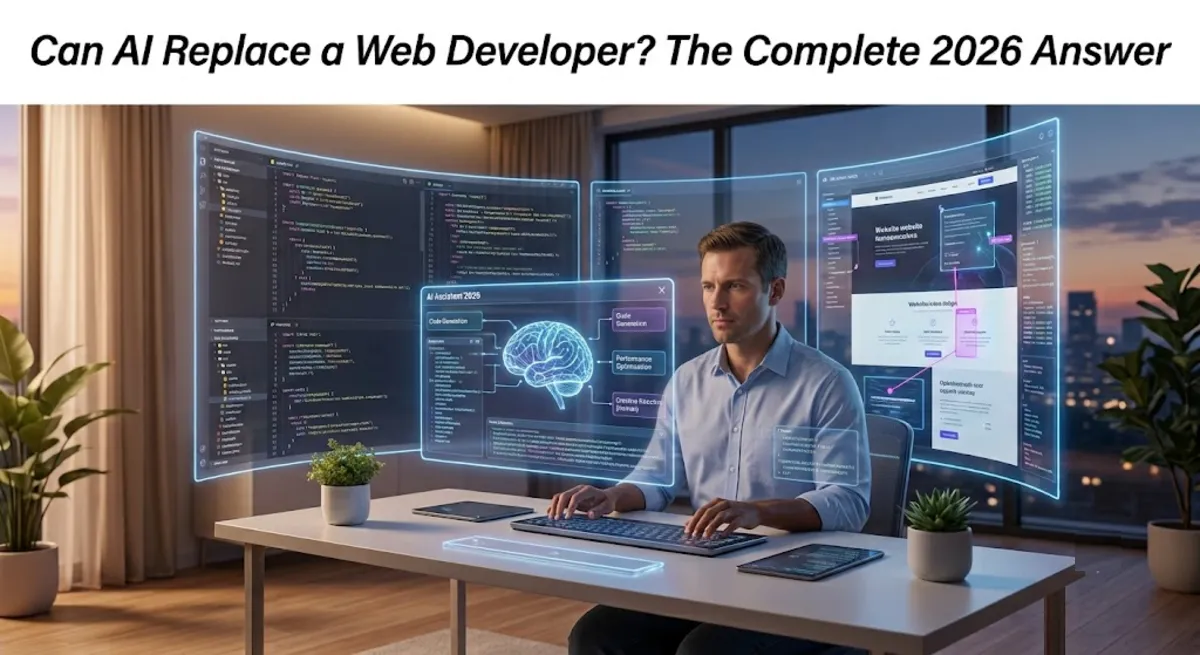
- AI cannot fully replace a web developer in 2026, but it is reshaping the job around judgment, architecture, and review.
- AI is excellent at generating code, boilerplate, and prototypes, and now writes a large share of production code.
- It still cannot own architecture, security, complex debugging, business understanding, or accountability.
- US Bureau of Labor Statistics data still projects web developer job growth through 2034, with AI augmenting developers.
- The winning approach is a developer who uses AI well, not AI alone or a developer who ignores it.
AI cannot fully replace a web developer in 2026, but it is transforming the role from writing code by hand to directing, reviewing, and architecting. AI now generates code, builds prototypes, and handles repetitive work impressively, yet it still cannot own the judgment, security, debugging, and accountability real projects demand. Here is the honest, evidence-based picture of what AI can and cannot do.
After using AI tools daily in my own builds, and being hired to fix websites that AI generated for people without a developer, I see both sides of this clearly. AI is genuinely powerful, and it has changed how I work. But the idea that it can replace a web developer for real client work does not survive contact with a real project. Let me show you exactly where the line sits, honestly, in both directions.
The Short Answer
No, AI cannot replace a web developer for real projects, but it can replace certain tasks, and whether AI can replace a web developer entirely is a different question from whether it changes the job. Anyone claiming AI can replace a web developer entirely is selling hype, and anyone claiming AI is useless for development is in denial. The truth sits in between, and it is more useful than either extreme.
Here is the honest split in one view:
- AI can replace the repetitive parts: boilerplate code, simple snippets, first-draft layouts, and throwaway prototypes.
- AI cannot replace the judgment parts: architecture, security, debugging strange production issues, understanding a business, and being accountable when it matters.
- The job is shifting from typing code toward directing AI, reviewing its output, and owning the decisions AI cannot make.
Pro tip: The most useful question is not whether AI can replace a web developer, but which parts of the work AI does well and which still need a human. Once you see that split clearly, both the hiring decision and the “should I just use AI” decision get much easier to make.
To draw that line fairly, start with an honest look at how capable AI actually is now.
What AI Can Actually Do Now
In 2026, AI can do far more than autocomplete, it generates entire features from a prompt, edits across files, runs tests, and builds working prototypes, which is why most professional developers now use it daily. This is a real capability leap, and pretending otherwise is a mistake.

The current reality is genuinely impressive. Agentic tools can take a one-line instruction and produce working code with tests, iterate until it passes, and navigate large codebases. Adoption reflects this: surveys put AI coding tool use among professional developers around 77 to 90 percent, and AI now writes a substantial and rising share of code. For a business owner, that means simple sites and prototypes really can be spun up fast and cheaply.
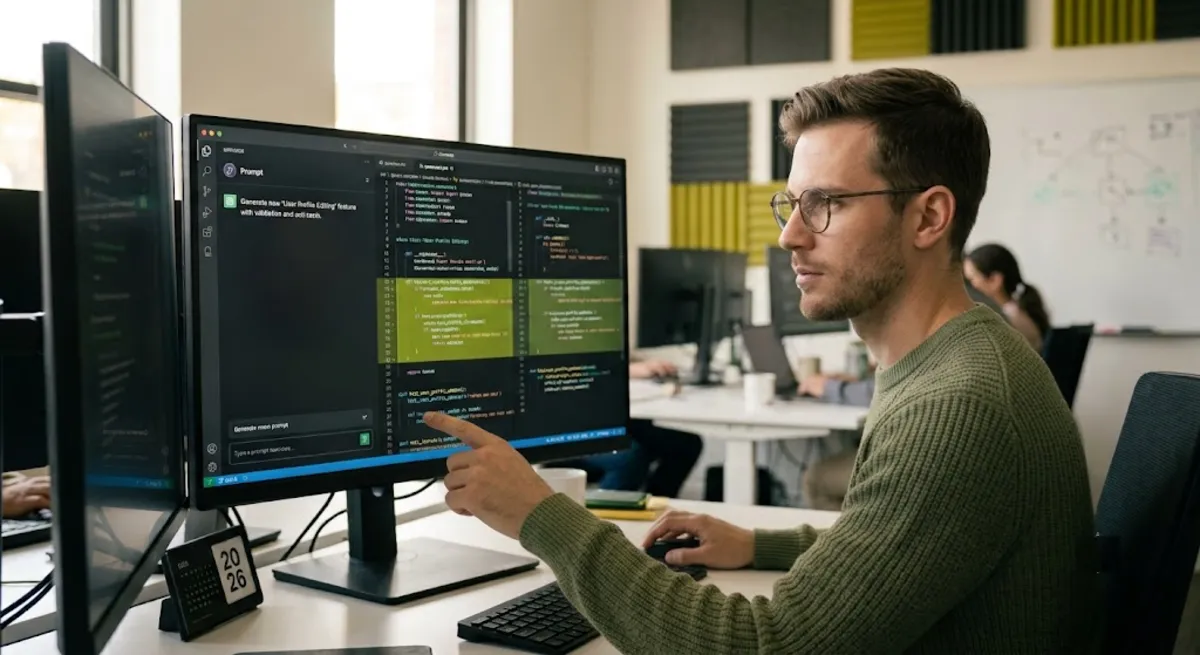
Where AI genuinely shines today:
- Boilerplate and repetitive code, the predictable scaffolding that used to eat hours.
- First-draft layouts and components, turning a description or design into a starting point quickly.
- Explaining and drafting fixes, acting as a fast research assistant for errors and unfamiliar code.
- Prototypes and simple sites, getting something functional on screen in a fraction of the old time.
The honest read: AI is excellent at coding’s version of paperwork, the repeatable, well-trodden parts. That is real value, and it is exactly why developers who use it ship far faster. The question is what happens when a project needs more than well-trodden code, which is where the picture changes.
Because the moment a project leaves the beaten path, a different set of skills takes over.
What AI Still Cannot Do
AI still cannot replace a web developer on the things that actually decide a project: architecture, security, debugging complex systems, understanding business goals, and taking accountability. These are not edge cases, they are the core of professional development, and they are where AI consistently falls short.
The gap between generating code and engineering a real website is wide. Writing a snippet is not the same as deciding how an entire system should fit together, why one approach will scale and another will collapse, or what a client actually needs versus what they asked for. Consider what a real build demands that shows why AI cannot replace a web developer:
| What real projects need | Why AI cannot own it |
|---|---|
| Architecture and scaling decisions | Requires judgment about trade-offs AI cannot weigh in context. |
| Security hardening | Demands understanding real threats and accountability for gaps. |
| Debugging strange production issues | Needs intuition across systems, not pattern-matched snippets. |
| Understanding business goals | Turns vague human intent into the right technical decisions. |
| Accountability for the result | Someone has to own it when the site breaks or gets breached. |
That last row matters most. When a site goes down before a launch, leaks customer data, or quietly tanks conversions, AI does not answer for it, a developer does. Accountability is not a feature you can prompt for, and it is a core reason real projects need a human in charge, not just a code generator.
Pro tip: Directing AI well actually requires more fundamentals, not fewer. To review what AI hands back, catch its mistakes, and make the architectural calls, you need to understand the craft deeply. Giving instructions to an AI without that foundation is like handing blueprints to a builder who cannot read them.
Nowhere is that gap more visible than in the sites people build with AI alone.
The Hidden Cost of AI-Only Sites
Websites built entirely by AI, with no developer, tend to look fine on the surface while hiding real problems underneath, which is exactly the work I most often get hired to fix. The demo-to-production gap is where AI-only projects quietly fall apart.

Here is the pattern I see repeatedly. Someone generates a site that looks great in a demo, then real users arrive and the cracks show: an edge case nobody handled, a security gap nobody spotted, performance that collapses under real traffic, or a layout that breaks on a device no one tested. AI produced something that works in the happy path, another sign it cannot fully replace a web developer, but real websites live in the unhappy paths, and that is precisely the 20 percent AI struggles with most.
The common hidden costs of an AI-only build include:
- Security holes that a non-developer never sees until something is exploited.
- Bloat and poor performance that hurt Core Web Vitals and search rankings.
- Unhandled edge cases that break for real users in ways a demo never revealed.
- No real strategy, a site that exists but does not serve any clear business goal.
None of this means AI is the villain. It means the job is changing, not disappearing.
How AI Is Changing the Job
The question of whether AI can replace a web developer misses the point: AI is redrawing the job, shifting it from writing raw code toward architecting, directing AI, and reviewing output. Whether AI can replace a web developer is really a question about which tasks move to AI, and the data points to evolution, not mass replacement.
The evidence is reassuring for skilled developers. The US Bureau of Labor Statistics still projects web developer employment to grow through 2034, faster than the average across all occupations, and its own analysis frames AI as a tool that augments developers, helping them build, test, and document code, rather than eliminating the role. At the same time, the market is clearly shifting: senior developers who wield AI ship dramatically faster, while routine, junior-level tasks are the most exposed.
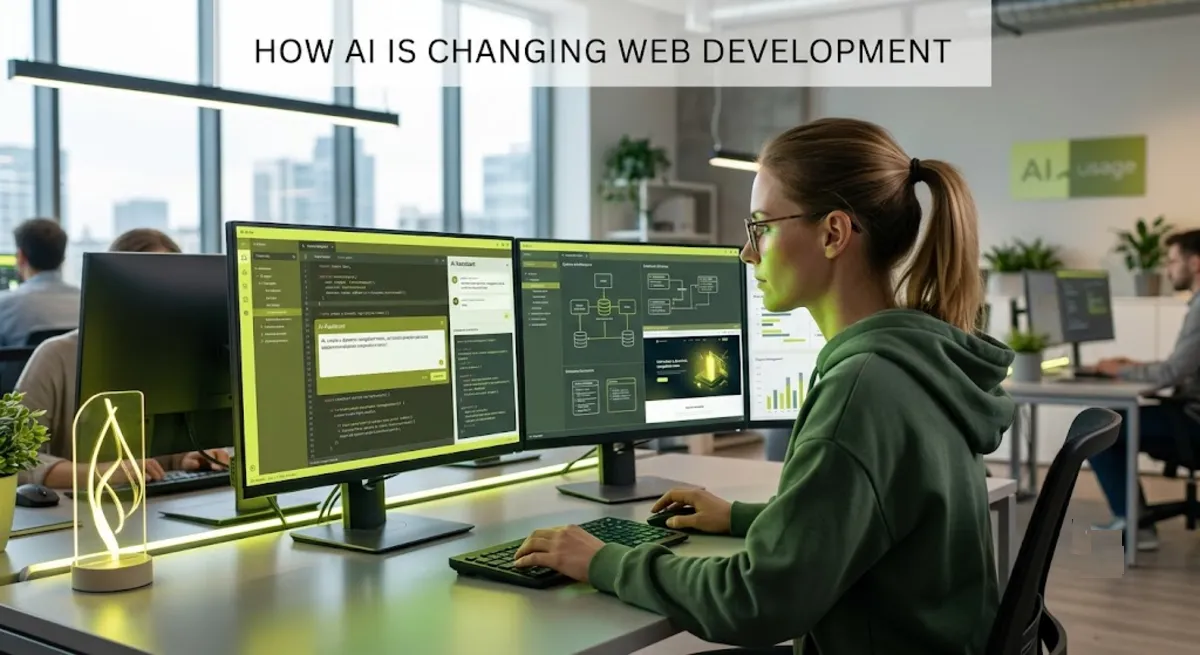
That shift changes what the job actually is:
- Less typing, more directing. Time moves from writing boilerplate to instructing AI and shaping what it produces.
- More reviewing and judgment. The developer becomes the reviewer who catches AI’s mistakes and owns the decisions.
- Higher leverage on fundamentals. Architecture, security, and performance knowledge matter more, because that is what AI cannot supply.
All of which leads to the practical question you probably came here to answer.
Want a developer who uses AI to build faster, without the AI-only pitfalls?
I combine AI-assisted speed with the judgment, security, and performance work AI cannot do. See my WordPress and SEO service.
What Most People Get Wrong
The biggest mistake in the “can AI replace a web developer” debate is treating it as all-or-nothing, either AI does everything or it does nothing. Both extremes lead to bad decisions. The reality is a split: AI owns some tasks, humans own others, and knowing which is which is the whole game.

Here is what I watch people get wrong. Some assume AI can replace a web developer outright and makes them obsolete, so, sure that AI can replace a web developer, they build a business-critical site with no developer, then pay more later to fix what broke. Others dismiss AI entirely and fall behind developers who ship far faster with it. Both misread the situation. The costly error is not picking the wrong side, it is thinking there are only two sides.
The second common mistake is trusting AI-generated code blindly. AI is confident even when it is wrong, and it will happily produce code with subtle security flaws, performance problems, or bugs that only surface under real conditions. Without a skilled human to review it, that confidence is a liability. The value is not in generating code, it is in judging it, and that judgment is exactly what cannot be automated away.
When your site actually matters to your business, that human judgment is what you are really paying for.
Have an AI-built site with problems, or want it built right the first time?
I fix AI-generated sites and build new ones with the judgment AI cannot provide. See my WordPress and SEO service or book a free call.
Frequently Asked Questions
Can AI replace a web developer in 2026?
No, not for real projects. AI can replace specific tasks like boilerplate code, simple layouts, and prototypes, but it cannot replace the architecture, security, complex debugging, business understanding, and accountability that professional development requires. The job is shifting toward directing and reviewing AI rather than disappearing, and skilled developers remain in strong demand.
What can AI actually do in web development?
Quite a lot. Modern AI tools generate features from a prompt, write boilerplate and tests, edit across files, explain errors, and build working prototypes and simple sites quickly. Most professional developers now use AI daily, and it writes a large share of code. It is genuinely powerful for the repetitive, well-trodden parts of building a website.
What can AI not do that a developer can?
AI cannot own system architecture and scaling decisions, security hardening, debugging strange production issues, translating business goals into the right technical choices, or accountability when something breaks. These require judgment, intuition, and responsibility that AI does not have. They are the core of professional development, not edge cases, which is why a human stays essential.
Are AI-built websites safe to use for a business?
Not without expert review. AI-only sites often look great in a demo but hide security gaps, performance problems, unhandled edge cases, and no real strategy. These issues are invisible to a non-developer until they surface as a breach, a ranking drop, or lost sales. For a business-critical site, have a developer review or build it.
Will AI reduce web developer jobs?
The data suggests transformation, not collapse. The US Bureau of Labor Statistics still projects web developer employment growth through 2034, faster than average, and frames AI as augmenting developers. That said, routine junior-level tasks are most exposed, while developers who use AI well are more productive and in demand. The role is changing shape rather than vanishing.
Should I learn to code if AI can write it?
Yes, arguably more than before. Directing AI well requires strong fundamentals, you need to understand architecture, security, and best practices to review what AI produces and catch its mistakes. Without that foundation, you cannot tell good AI output from dangerous output. The skill is shifting from writing every line to judging and directing, which still demands real expertise.
Is it cheaper to use AI instead of hiring a developer?
It can look cheaper upfront and end up costing more. For a throwaway prototype, AI alone is fine. For a business site, an AI-only build often needs expensive fixes later for security, performance, and edge cases that a developer would have prevented. The cheapest real outcome is usually a developer who uses AI to work faster.
Should I hire a developer who uses AI?
Yes, that is the ideal in 2026. A developer who uses AI well gives you the speed of AI plus the judgment, security, and accountability AI lacks. You get faster delivery without the hidden risks of an AI-only build. My WordPress and SEO service combines AI-assisted development with professional oversight.
Conclusion
So, can AI replace a web developer? Not for anything that truly matters, and the honest answer is more useful than either the hype or the denial. AI is a genuinely powerful tool that generates code, builds prototypes, and handles the repetitive work faster than ever, and every good developer should be using it. But architecture, security, complex debugging, understanding your business, and being accountable for the result all still require a skilled human, and that is unlikely to change soon. The data agrees: developer demand remains strong, and AI is augmenting the role, not erasing it. The real shift is that the best outcome now comes from a developer who uses AI well, not from AI alone or a developer who ignores it. If your website matters to your business, that combination of AI speed and human judgment is exactly what you want building it.
Want the speed of AI with the judgment of a real developer?
I build with AI-assisted speed and the human expertise AI cannot replace. Book a free call or browse my recent project portfolio.
This article was last reviewed and updated in June 2026 to reflect current AI coding capabilities, developer employment data, and real-world project experience.