

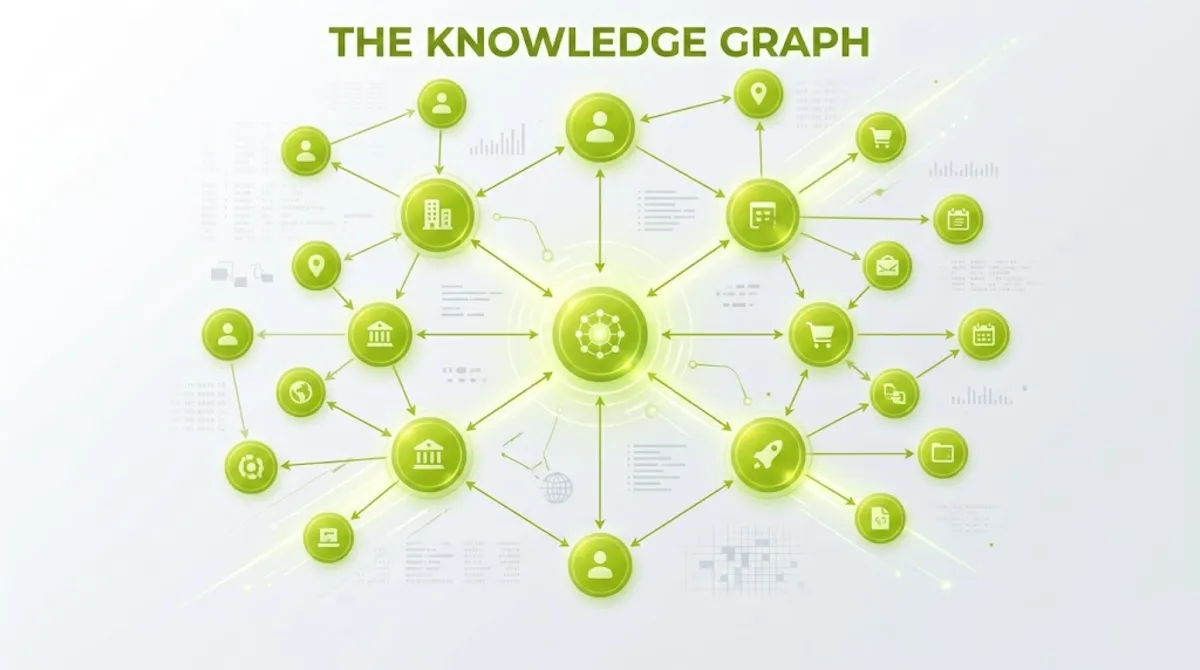
- Entity SEO is the practice of getting search engines and AI to recognize your brand, people, and topics as distinct things, not just strings of words.
- It shifts the focus from matching keywords to being understood as a defined entity in Google’s Knowledge Graph.
- You build it through clarity, consistency, connections via schema and sameAs, and corroboration from authoritative sources.
- In 2026, entity recognition is the prerequisite for AI Overview inclusion and citation by ChatGPT and Perplexity.
- You cannot force a Knowledge Panel. You earn recognition by being a clear, consistent, well-connected, corroborated entity.
Entity SEO is the practice of helping search engines and AI systems recognize your brand, people, products, and topics as distinct, well-defined entities rather than mere strings of keywords. Instead of optimizing a page to match a query, you build a clear, consistent, verifiable identity that Google’s Knowledge Graph and AI models can understand and trust. This guide explains how it works and how to do it.
After building SEO and content strategies for clients in 15+ countries, here is the shift that makes entity SEO finally click. Old keyword SEO asked, does this page rank for this keyword? Entity SEO asks a deeper question: entity SEO asks whether the search engine actually knows who you are, what you do, and why you should be trusted. Answer that entity SEO question well, and rankings and AI citations follow. Here is how the whole thing works.
What Is Entity SEO?
Entity SEO is the practice of optimizing your brand, people, and topics as recognized entities, distinct things with defined attributes and relationships, inside search engine knowledge graphs. An entity is any uniquely identifiable thing: a person, a company, a place, a product, or a concept. Entity SEO makes those things clear and verifiable to machines, which is the whole point of entity SEO.
Entity SEO as a discipline traces back to 2012, when Google launched the Knowledge Graph with the phrase “things, not strings.” Before that, search matched the letters in your query against the letters on a page. After it, Google began understanding the real-world things behind the words, and the connections between them. Entity SEO is how you make sure Google understands your things correctly, and it is why entity SEO now matters.
Pro tip: Think of an entity as a node in a giant map of the world. Your job in entity SEO is not to stuff keywords, but to make your node clearly defined and correctly connected to the right neighboring nodes, your industry, your topics, your people, so search engines place you accurately on that map.
The clearest way to grasp this is to compare it directly with the keyword SEO most people already know.
Entities vs Keywords
Entity SEO and keyword SEO solve different problems, and modern search needs both working together. Keyword SEO optimizes a single page to rank for a specific query. Entity SEO builds your overall identity so search engines and AI understand what your brand is and how it relates to everything else. In entity SEO, one is about pages and the other is about recognition.
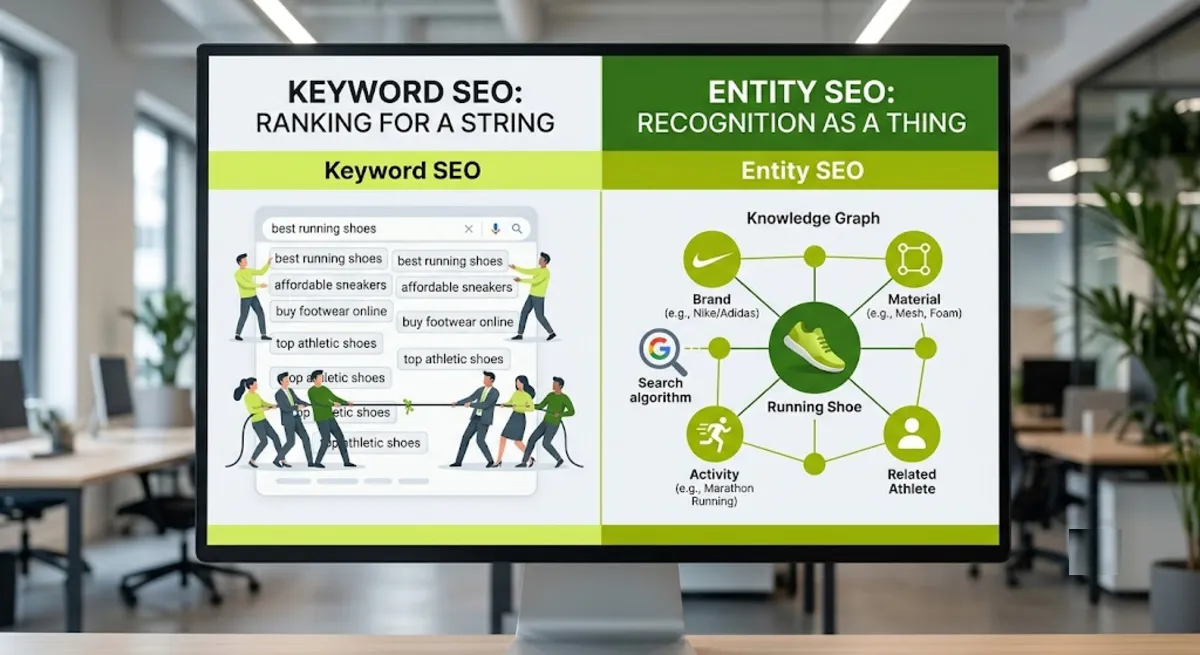
| Aspect | Keyword SEO | Entity SEO |
|---|---|---|
| Question it answers | Does this page rank for this query? | Does search know what this brand is? |
| Unit of focus | Pages and queries | Brands, people, topics as things |
| Main levers | Titles, headings, content, links | Schema, sameAs, consistency, mentions |
| Understood via | Text matching and relevance | The Knowledge Graph and relationships |
| AI search impact | Helps, but not enough alone | Often decides who gets cited |
The key point: they work together. Keyword SEO wins the individual query, while entity SEO builds the recognition that makes your pages more trusted and more citable across the board. A well-optimized page from an unknown entity increasingly loses to a page from a recognized one. So how does Google build that recognition?
How Google Understands Entities
Google understands entities through its Knowledge Graph, a vast database of things and the relationships between them. When Google is confident about an entity, it can show a Knowledge Panel, disambiguate similar names, and connect your brand to the right topics. Entity SEO is about feeding that Knowledge Graph clear, consistent signals, which is the core of entity SEO.
Google resolves entities using several inputs:
- Structured data. Schema markup on your site tells Google explicitly what a page and its subject are.
- Corroborating sources. Authoritative references like Wikipedia and Wikidata help Google verify an entity’s identity and facts.
- Consistent signals across the web. The same name, description, and details repeated across trusted platforms confirm who you are.
- Relationships. The other entities you are connected to, your industry, topics, people, place you in context.
- Natural language processing. Google reads your content to understand the entities it covers and how well.
Knowing the inputs, you can now work on them deliberately. Here is the practical playbook.
How to Do Entity SEO: The 4 Cs
You do entity SEO by working through four things I call the 4 Cs of entity SEO: Clarity, Consistency, Connections, and Corroboration. Together they take you from an ambiguous string to a recognized entity. Work them in order, since each one builds on the last.
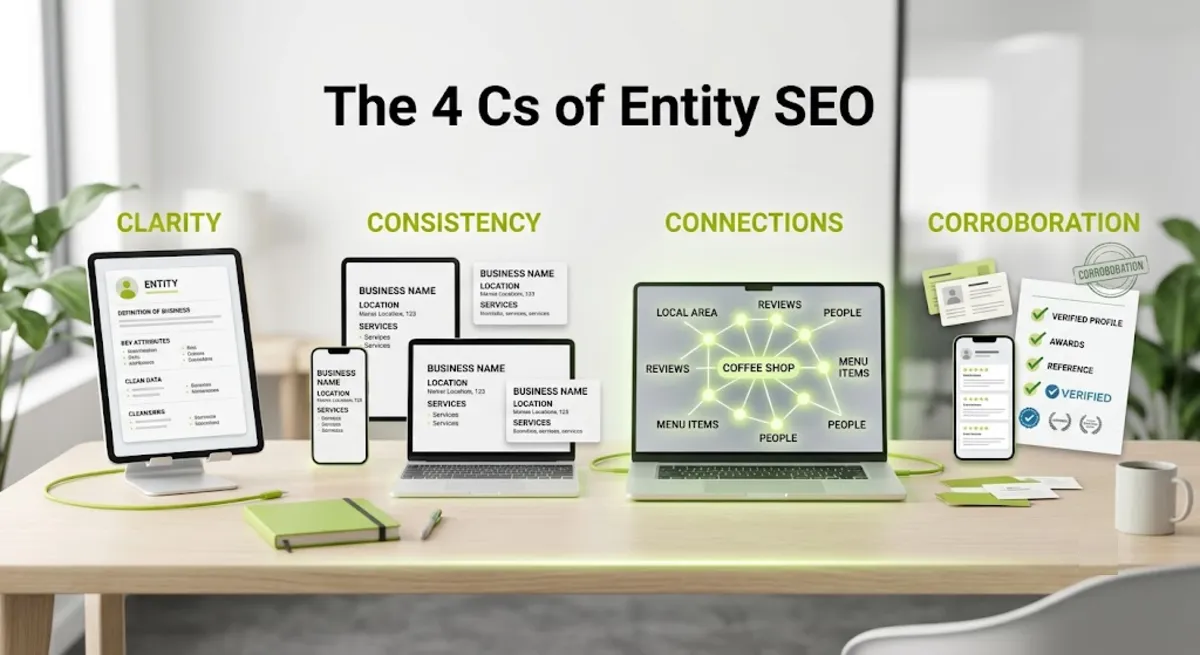
| The C | What to do |
|---|---|
| Clarity | Define your entity with a dedicated entity home, usually your About page, that clearly states who you are and what you do. |
| Consistency | Use the exact same name, description, and key facts everywhere, on your site and every external profile. |
| Connections | Add Organization and Person schema with a sameAs array linking to your authoritative profiles. |
| Corroboration | Earn a Wikidata entry, trusted mentions, and profiles that independently confirm your identity and facts. |
The highest-value starting point is the combination of a clear entity home, an Organization schema block with a complete sameAs array, and a Wikidata entry. That trio is low-cost, often an afternoon of work, yet it dramatically improves Google’s ability to resolve who you are. Third-party mentions and, where you qualify, a Wikipedia presence are more powerful but slower to build.
Pro tip: The sameAs property is the connective tissue of entity SEO, so it is worth getting right. In your Organization or Person schema, list the URLs of your profiles on Wikidata, LinkedIn, Crunchbase, and your main social platforms. This explicitly tells Google that all these profiles are the same entity as you, resolving ambiguity in one step.
All of this matters more than ever, because a new set of systems now depends on it.
Entity SEO in the AI Era
Entity SEO is now essential for AI search, because AI answer engines pick who to cite based on entity recognition before almost anything else. ChatGPT, Perplexity, and Google AI Mode cannot verify an unfamiliar brand, so they lean on recognized entities with validated facts and clear relationships. If AI does not recognize you as an entity, it will not cite you.

This is the biggest reason entity SEO has moved from a nice-to-have to a genuine priority. AI systems are built on entity relationships, so they favor sources they can identify and trust. Recent industry analysis found that branded mentions across the web correlate far more strongly with AI citations than traditional backlinks do, which means entity signals now outweigh link signals for AI visibility. In entity SEO, a page that clearly names and defines the entities in its topic is far more citable than one that simply repeats a keyword.
Understanding all this is one thing. Avoiding the common traps is what makes it work.
Want your brand recognized as an entity by Google and AI?
I build the schema, sameAs, and consistency signals that turn your site into a recognized entity. See my WordPress and SEO service.
What Most People Get Wrong
The biggest mistake in entity SEO is thinking entity SEO is just adding Organization schema and waiting for a Knowledge Panel to appear. Schema is one signal of several, and the panel is an output you cannot request. Treating entity SEO as a single technical task misses the point: it is about building a coherent, corroborated identity across the whole web, not ticking one box.
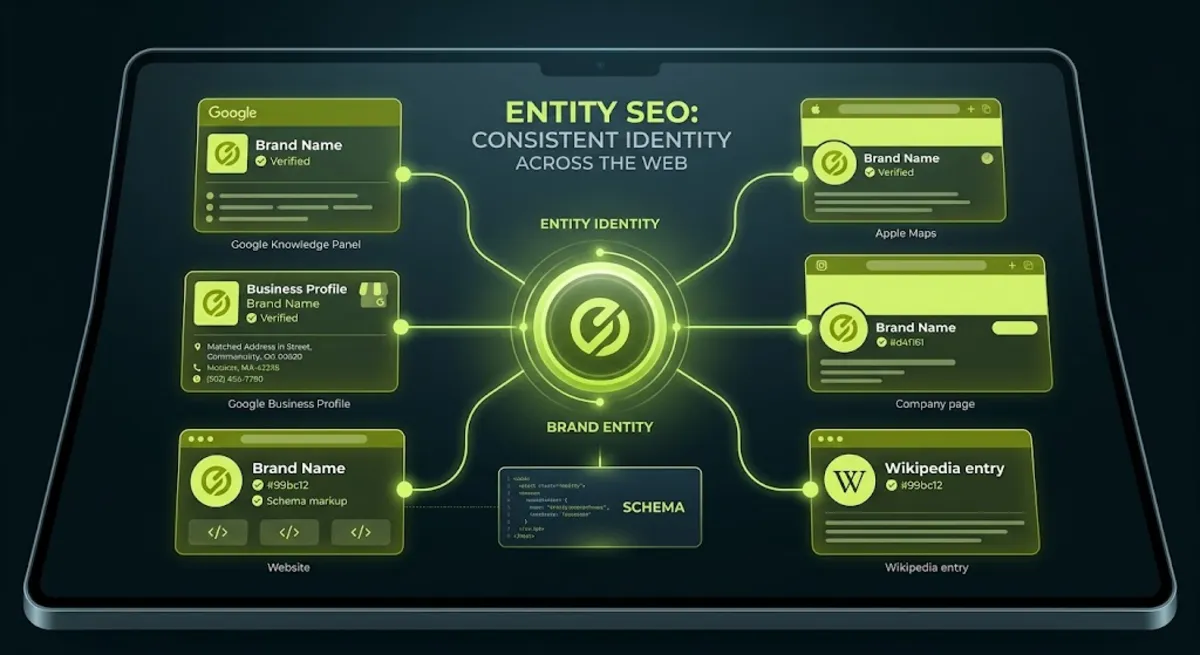
Here is the observation from client work. The single most common reason Google and AI hedge on a brand is inconsistency. The name is written three ways, the description differs on every profile, the facts do not match across platforms. When the signals disagree, search engines cannot confidently resolve the entity, so they stay vague, and vague entities do not get Knowledge Panels or AI citations. Fixing consistency is unglamorous, and it is often the highest-impact entity SEO work a brand can do.
The second trap is chasing a Knowledge Panel as if it were the goal. It is a symptom of a well-understood entity, not a lever you pull. Focus on the causes, clarity, consistency, connections, and corroboration, and the visible results follow. And do not ignore ambiguity: if your brand name is shared with other well-known things, you have to work harder to distinguish your entity from theirs.
When your brand is not being recognized and you are not sure which signals are missing or conflicting, that is where an experienced entity audit pays for itself.
Not getting recognized or cited, and not sure why?
I audit and fix your entity signals, schema, sameAs, consistency, and corroboration, so Google and AI know exactly who you are. See my WordPress and SEO service or book a free call.
Frequently Asked Questions
What is entity SEO in simple terms?
Entity SEO is the practice of getting search engines and AI to recognize your brand, people, and topics as distinct, well-defined things rather than just strings of keywords. Instead of only optimizing pages to rank, you build a clear, consistent, verifiable identity that Google’s Knowledge Graph and AI models can understand and trust.
What is an entity in SEO?
An entity is any uniquely identifiable thing, a person, company, place, product, or concept, with its own attributes and relationships. Google stores entities and their connections in the Knowledge Graph. Entity SEO makes your entities clear and correctly connected, so search engines understand exactly what you are and how you relate to related topics.
How is entity SEO different from keyword SEO?
Keyword SEO optimizes a page to rank for a specific query, using titles, content, and links. Entity SEO builds your overall identity so search engines and AI understand what your brand is and how it connects to everything else, using schema, sameAs, consistency, and mentions. They complement each other, and modern search needs both.
How do I start with entity SEO?
Start with three low-cost, high-impact moves: create a clear entity home such as a detailed About page, add Organization or Person schema with a complete sameAs array linking your authoritative profiles, and create a Wikidata entry. Then keep your name, description, and facts perfectly consistent across every platform where your brand appears.
Does entity SEO help with AI search and citations?
Yes, significantly. AI answer engines like ChatGPT, Perplexity, and Google AI Mode pick who to cite based on entity recognition, since they cannot verify unfamiliar brands. Recent analysis shows branded mentions correlate more strongly with AI citations than backlinks do, so strong entity signals are now central to being visible in AI search.
Can I get a Google Knowledge Panel through entity SEO?
You can influence it, but you cannot request or force one. A Knowledge Panel appears only when Google is confident about your entity. Strong, consistent signals, schema, sameAs, corroborating sources like Wikidata, and trusted mentions, increase that confidence. The panel is an output of good entity SEO, not something you submit for directly.
What is the sameAs property and why does it matter?
The sameAs property in schema markup is an array of URLs pointing to your brand’s or author’s profiles on authoritative platforms like Wikidata, LinkedIn, and Crunchbase. It explicitly tells Google that all these profiles refer to the same entity as you, resolving ambiguity and helping search engines connect and verify your identity.
Should I hire someone for entity SEO?
Consider it when your brand is not being recognized or cited, or when your entity signals are scattered across platforms and teams. The work spans structured data, content, and off-site consistency, which is easy to get wrong. My WordPress and SEO service covers entity audits and implementation.
Conclusion
Entity SEO is the shift from being a string of keywords to being a recognized thing, and that shift is what entity SEO delivers. It works through the 4 Cs: clarity about who you are, consistency of your identity everywhere, connections through schema and sameAs, and corroboration from authoritative sources like Wikidata. In 2026 this is no longer optional, because AI engines cite recognized entities first and pass over the rest. You cannot force a Knowledge Panel or shortcut the work, but you can start today with the highest-value moves: a clear entity home, Organization schema with a full sameAs array, and a Wikidata entry. Get your identity consistent everywhere, and both Google and AI will finally know exactly who you are.
Ready to become an entity Google and AI actually recognize?
I turn scattered signals into a clear, consistent, cited entity. Book a free call or browse my recent project portfolio.
This article was last reviewed and updated in June 2026 to reflect current Knowledge Graph and AI search behavior.