

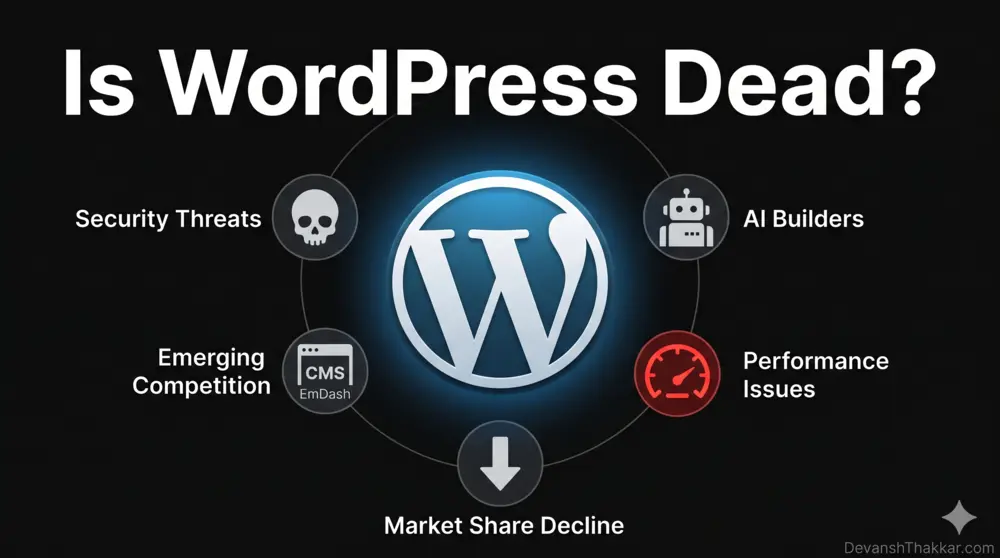
Is WordPress dead? Every year someone asks this question. In 2026, the evidence for asking it is stronger than it has ever been. WordPress market share dipped below 43% for the first time since 2022. Cloudflare launched EmDash as a “spiritual successor.” AI website builders can generate sites in 30 seconds. A supply chain attack backdoored 31 plugins affecting 400,000+ installations. WordPress 7.0 missed its April 9 release date and got pushed to May 20. Even the creator of Yoast SEO said WordPress is “overkill” for many small businesses.
So is WordPress dead? No. But pretending nothing has changed is equally wrong.
WordPress developer Devansh Thakkar has built 100+ websites on WordPress across 15+ countries with a 100% Upwork job success score. This is not a defense written by someone protecting a legacy investment. This is an honest assessment from a developer whose entire career depends on the answer to this question. The data says WordPress is not dying. It is being forced to evolve. And the evidence for that evolution is already shipping.
The Data: Is WordPress Dead or Dominant?
Before opinions, here are numbers. Every claim about whether WordPress is dead must contend with these facts from W3Techs and industry research:
| Metric | 2024 (Peak) | 2026 (Current) | Direction |
|---|---|---|---|
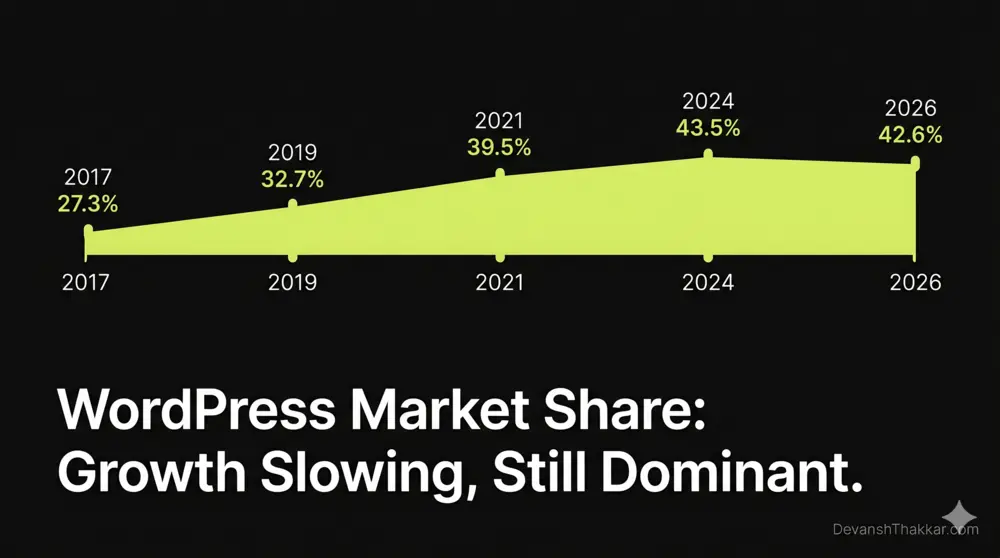
| Share of all websites | 43.5% | 42.6% | Slight decline (first since 2022) |
| CMS market share | 62% | 60.8% | Still more than all competitors combined |
| Total WordPress websites | ~500 million | ~475-595 million | Still massive |
| WordPress economy value | $541 billion | $596.7 billion | Growing |
| Free plugins | 59,000+ | 59,000+ | Stable |
| WooCommerce global store share | 36% | 36% | Largest open-source e-commerce |
| Security vulnerabilities (2025) | N/A | 11,334 | Up 42% year-over-year |
| Avg page load time | 3.2s | 3.4s | Worse (above Google’s 2.5s recommendation) |
The answer to “is WordPress dead” from the data alone: WordPress has slipped from its all-time peak, but it still powers more websites than every other CMS platform combined. A platform with a $596 billion economy, 60.8% CMS market share, and half a billion active installations is not dead. It is, however, at an inflection point.
Pro Tip: When someone tells you WordPress is dead, ask them one question: “What would you replace it with for a 200-product WooCommerce store that needs custom shipping rules, Stripe and PayPal integration, multilingual support, and SEO-optimized product pages?” They will not have an answer. Because nothing else combines the ecosystem depth, plugin availability, and developer pool that WordPress offers for complex projects. – Devansh Thakkar, WordPress Developer
5 Real Threats to WordPress in 2026
Dismissing the threats is what makes developers lose credibility. Devansh Thakkar takes each one seriously. These five forces are genuinely challenging WordPress, and understanding them is essential for any developer or business owner asking “is WordPress dead” in 2026:
Threat 1: Market Share Decline
WordPress market share dropped from 43.5% (mid-2025 peak) to 42.6% in early 2026. That 0.9% decline represents millions of websites. The decline is not dramatic, but it is the first sustained dip since WordPress began its dominance run in 2011. The sites leaving WordPress are primarily simple brochure sites moving to hosted platforms like Squarespace, Wix, and Framer, where maintenance is handled by the platform rather than the site owner.
Threat 2: AI Website Builders
AI builders like Wix ADI, Framer AI, Durable, and Hostinger AI Builder can generate a complete website in under 60 seconds. For the 30-40% of WordPress sites that are simple 3-5 page brochure sites with no e-commerce, no complex forms, and no SEO strategy, AI builders are a genuinely better option in 2026. They are faster, cheaper, and require zero maintenance. WordPress is losing this segment, and it will not get it back. For a deeper comparison, see the full AI website builder vs WordPress developer breakdown.
Threat 3: Plugin Security
This is WordPress’s most serious structural weakness. Plugin vulnerabilities rose 42% year-over-year in 2025, reaching 11,334 recorded vulnerabilities. In April 2026, the Essential Plugin supply chain attack backdoored 31 plugins affecting 400,000+ installations. The attacker purchased the plugin portfolio on Flippa and WordPress.org had no mechanism to flag the ownership transfer. This is not a bug. It is a gap in the WordPress.org ecosystem that has existed for 20 years and remains unfixed.
Cloudflare’s EmDash launched the same week with sandboxed plugin security as its primary selling point. Cloudflare cited that 96% of WordPress vulnerabilities come from plugins. The number is directionally accurate. This is the strongest argument anyone can make when asking “is WordPress dead.”
Threat 4: Performance Gap
The average WordPress site loads in 3.4 seconds. Google recommends under 2.5 seconds. Modern alternatives like Next.js (0.8s average) and Webflow (1.4s) load faster out of the box. WordPress’s performance problem is not the core software. It is the combination of themes, plugins, and page builders that add DOM weight, render-blocking scripts, and unoptimized database queries. A skilled developer can optimize any WordPress site to sub-2-second loads, but the default experience is slow. See the WordPress speed optimization service for what proper optimization involves.
Threat 5: WordPress 7.0 Delays
WordPress 7.0 was scheduled for April 9, 2026, during WordCamp Asia in Mumbai. It was delayed to late April after the real-time collaboration database architecture needed a rethink. Then it was delayed again to May 20. Returning to beta status after reaching Release Candidate is unprecedented in WordPress history. The delays signal that the WordPress core team is struggling to ship the collaborative features needed to keep WordPress competitive with real-time platforms like Notion, Google Docs, and the new generation of AI-native tools.
5 Reasons WordPress Is Not Dead (And Will Not Be for a Decade)
Each threat above is real. None is fatal. Here is why Devansh Thakkar still builds his entire career on WordPress, and why the answer to “is WordPress dead” is definitively no:
Reason 1: The $596 Billion Ecosystem
WordPress is not just software. It is an economy. According to recent WordPress statistics, the WordPress ecosystem generates $596.7 billion annually across themes, plugins, hosting providers, agencies, freelancers, training platforms, and SaaS tools built on WordPress. This includes companies like WP Engine, Automattic, SiteGround, Elementor, and thousands of smaller businesses. An ecosystem this large creates self-reinforcing network effects: more developers build for WordPress because more sites run WordPress because more developers build for WordPress. No competitor can replicate this overnight, or even in a decade.
Reason 2: WooCommerce Has No Equal
WooCommerce powers 36% of all online stores globally and processed an estimated $35 billion in gross merchandise volume in 2025. No AI builder, no EmDash, no hosted platform offers the same combination of open-source ownership, payment gateway flexibility (Stripe, PayPal, Square, Razorpay, and hundreds more), plugin extensibility (Subscriptions, Memberships, Bookings, Dynamic Pricing), and developer customizability. Shopify is WooCommerce’s closest competitor in e-commerce, but Shopify is a rented platform with monthly fees and limited customization. WooCommerce is owned by you.
Reason 3: WordPress 7.0 AI Integration
WordPress 7.0, shipping May 20, 2026, introduces native AI infrastructure that directly addresses the “not AI-native” criticism. The Connectors API lets you configure OpenAI, Anthropic Claude, or Google Gemini API keys once. The AI Client provides a consistent PHP API for sending prompts from any plugin. The Abilities API standardizes AI features like alt text generation and content summarization. WordPress is not ignoring AI. It is integrating AI into its core. For WooCommerce stores preparing for this update, see the WordPress 7.0 WooCommerce update guide.
Reason 4: Ownership and Portability
Every WordPress site is built on open-source code (GPL v2 license) that you own completely. Your content, your code, your database, your media files. You can host on any server, move to any provider, and modify any part of the codebase. This is fundamentally different from every hosted platform (Squarespace, Wix, Framer, Shopify) where you rent your site and lose everything if you cancel. For businesses building long-term digital assets, ownership is not a feature. It is a requirement.
Reason 5: The Developer Pool
Millions of developers worldwide know WordPress, PHP, and the WordPress ecosystem. You can hire a WordPress developer at any price point, in any country, on any platform. When EmDash, Webflow, or any other alternative asks you to rebuild your site on their platform, ask: “How many developers can I hire to maintain it?” For WordPress, the answer is unlimited. For EmDash in 2026, the answer is effectively zero outside Cloudflare’s own team.
Pro Tip: The platforms replacing WordPress for simple sites (Wix, Squarespace, Framer) are not threats to WordPress’s business. They are filtering out the sites that never needed WordPress in the first place. A 3-page brochure site for a local bakery does not need a CMS, a database, plugins, and monthly maintenance. Letting those sites leave WordPress makes the ecosystem healthier, not weaker. The sites that stay on WordPress are the ones that generate revenue, need custom functionality, and require real development. That is the market Devansh Thakkar serves, and it is growing. – Devansh Thakkar, WordPress Developer
What WordPress Must Fix to Stay Dominant
Saying “WordPress is not dead” is not the same as saying “WordPress has no problems.” These are the issues the WordPress core team and ecosystem must address to maintain dominance:
- Plugin security oversight. WordPress.org needs a mechanism to review, flag, or at minimum notify users when a plugin changes ownership. The Essential Plugin attack exploited a structural gap that has existed for 20 years.
- Default performance. A fresh WordPress installation with a popular theme and 10 common plugins should score 90+ on PageSpeed without manual optimization. The 3.4-second average load time is not competitive in 2026.
- Editor stability. The block editor (Gutenberg) has improved dramatically, but it still does not match the editing experience of purpose-built tools like Notion or Framer for non-technical users. WordPress 7.0’s collaboration features are a step forward, but the delays suggest the implementation is harder than expected.
- PHP perception. PHP powers WordPress and runs flawlessly at scale (Facebook ran on PHP for years). But the developer community perceives PHP as outdated compared to TypeScript, Go, and Rust. This perception affects which new developers learn WordPress vs modern frameworks.
Who Should Still Use WordPress in 2026?
If you are asking “is WordPress dead” because you are trying to decide whether to use it for your next project, here is the decision framework Devansh Thakkar uses with clients:
| Project Type | WordPress? | Why |
|---|---|---|
| WooCommerce store (any size) | Yes, absolutely | No alternative matches WooCommerce’s ecosystem depth |
| SEO-driven business website | Yes | Rank Math, schema control, site architecture flexibility are unmatched |
| Membership or course platform | Yes | LearnDash, MemberPress, and other plugins provide complete LMS functionality |
| Multi-language business site | Yes | WPML and Polylang with full translation workflows |
| Blog or content site with 100+ articles | Yes | Content management, categories, tags, and internal linking at scale |
| Simple 3-5 page brochure site | Maybe not | An AI builder or static site may be simpler and cheaper |
| Landing page or campaign site | Maybe not | Framer or Webflow may launch faster for temporary pages |
| Web application (SaaS, dashboard) | No | Use React, Next.js, or a proper application framework |
Why Devansh Thakkar Still Builds on WordPress
After 100+ projects, 5+ years, and clients across 15+ countries, Devansh Thakkar has evaluated every alternative. The answer to “is WordPress dead” from someone whose career depends on the platform: WordPress is the most versatile, most supported, and most business-ready CMS available in 2026. The threats are real. The ecosystem response is also real. WordPress 7.0 ships in weeks. The community is larger than any competitor’s entire user base.
This does not mean WordPress is perfect. It means no alternative combines the ecosystem, the developer pool, the plugin library, the e-commerce capabilities, and the ownership model that WordPress provides. When a better option exists for a specific project type (and sometimes it does), Devansh Thakkar recommends it. But for the businesses that need custom functionality, SEO, e-commerce, and long-term scalability, WordPress remains the right choice.
Pro Tip: The best response to “is WordPress dead” is not an argument. It is a fast, secure, well-built WordPress site that ranks on Google, converts visitors into customers, and loads in under 2 seconds on mobile. That is the answer no think piece or tweet can counter. Build better WordPress sites. That is the only defense this platform needs. – Devansh Thakkar, WordPress Developer
Need a WordPress Site That Proves the Platform Is Alive?
If you have decided that WordPress is the right platform for your project, or if you want a developer who builds WordPress sites that are fast, secure, and optimized, Devansh Thakkar delivers exactly that.
From WooCommerce stores to speed optimization to bug fixing and ongoing maintenance, every project is built on clean code, proper SEO architecture, and tested across devices. 100+ projects. 100% Upwork job success. 15+ countries. Built with Elementor, Bricks Builder, Divi, and custom code depending on what the project needs.
Book a call or send a message. WordPress is not dead. Your next project deserves a developer who proves it.
Frequently Asked Questions
Is WordPress dead in 2026?
No. WordPress powers 42.6% of all websites and holds 60.8% CMS market share, more than all other CMS platforms combined. Its market share dipped slightly from a 43.5% peak, but the $596 billion WordPress economy, 59,000+ plugins, and WooCommerce’s 36% e-commerce market share confirm that WordPress remains the dominant web platform.
Why do people say WordPress is dying?
Several factors fuel this narrative in 2026: market share dipped below 43% for the first time, AI builders can generate sites in seconds, the Essential Plugin backdoor exposed security gaps, EmDash launched as a “spiritual successor,” and WordPress 7.0 was delayed twice. Each concern is valid but none indicates WordPress is dying, only that it faces real competition for the first time.
Is WordPress still worth learning in 2026?
Yes. WordPress developer skills remain in high demand because 42.6% of the web runs on WordPress. The platform added native AI integration in 7.0, WooCommerce processes $35 billion in annual transactions, and millions of existing sites need ongoing development, maintenance, and optimization.
What is replacing WordPress?
For simple brochure sites: AI builders (Wix ADI, Framer AI, Squarespace). For web applications: React/Next.js frameworks. For bleeding-edge CMS: EmDash (v0.1.0, not production-ready). Nothing is replacing WordPress for WooCommerce stores, SEO-driven sites, membership platforms, or complex business websites requiring custom functionality and plugin ecosystems.
Is WordPress secure in 2026?
WordPress core is secure. Plugin security is the genuine vulnerability: 11,334 vulnerabilities were recorded in 2025, up 42% year-over-year, and the Essential Plugin backdoor in April 2026 affected 400,000+ installations. Proper security practices (limiting plugins, keeping everything updated, using Wordfence/Sucuri, auditing plugin ownership) mitigate the risk effectively.
Is WordPress too slow in 2026?
The average WordPress site loads in 3.4 seconds, above Google’s recommended 2.5 seconds. However, this is an ecosystem problem (heavy themes, too many plugins, unoptimized images), not a core software problem. A properly optimized WordPress site loads in under 2 seconds. Speed optimization is a standard part of professional WordPress development.
Should I switch from WordPress to EmDash?
No. EmDash is a v0.1.0 developer preview with zero production sites, zero plugins, no WooCommerce, and no page builders. Its plugin security architecture is genuinely better than WordPress, but it is years away from being a viable WordPress alternative for businesses. Keep your WordPress site maintained and monitor EmDash’s progress.
Will WordPress 7.0 save WordPress?
WordPress does not need “saving,” but 7.0 addresses key criticisms. It ships May 20, 2026 with native AI infrastructure (Connectors API, AI Client, Abilities API), real-time collaboration, and admin UI modernization (DataViews). These features close the gap with AI-native platforms and modernize the editing experience.
Is WooCommerce still the best e-commerce platform?
For open-source e-commerce with full ownership and unlimited customization, yes. WooCommerce powers 36% of all online stores and processed $35 billion in 2025. Shopify leads in hosted GMV but charges monthly fees and limits customization. WooCommerce’s combination of ownership, plugin ecosystem, and developer pool remains unmatched.
Should I hire a WordPress developer in 2026?
Yes, for any project requiring WooCommerce, custom functionality, SEO architecture, or ongoing maintenance. Devansh Thakkar is a top-rated WordPress developer with 100+ projects and 100% Upwork job success. Book a call to discuss your project requirements.