

- A technical SEO audit in 2026 checks crawlability, Core Web Vitals, structured data, the AI layer, and site architecture, in that order.
- Fix crawlability and indexation first, since nothing else matters if Googlebot and AI crawlers cannot reach your pages.
- Core Web Vitals now use INP, aim for LCP under 2.5s, INP under 200ms, and CLS under 0.1 on real-user data.
- Structured data and AI-crawler access are now core audit categories, because they decide whether AI engines cite you.
- Audit on a quarterly cadence, not after a traffic drop, so you catch regressions before they cost rankings.
A technical SEO audit in 2026 works through five layers in a set order: crawlability and indexation, Core Web Vitals and rendering, structured data, the new AI and AEO layer, and site architecture. The order matters, because a fast, well-structured page is worthless if crawlers cannot reach it. This technical SEO audit checklist walks each layer with clear pass marks, plus the 2026 additions most older checklists miss.
After running a technical SEO audit for clients in 15+ countries, here is what has changed and what has not. The foundations, crawlability, speed, clean architecture, still decide most rankings. What is new in 2026 is a second audience: AI crawlers and answer engines now read your site alongside Google, so structured data and crawler access have moved from polish to priority. This checklist covers both, in the order you should actually work through them.
The Right Order to Audit In
The single most important thing in a technical SEO audit is the order you run the audit in, because the layers depend on each other. Auditing speed before you have confirmed your pages can even be crawled is wasted effort. Work top down, and each fix makes the next one meaningful.
The technical SEO audit priority sequence for 2026:
| Priority | Layer | The question it answers |
|---|---|---|
| 1 | Crawlability and indexation | Can search engines and AI crawlers reach and index your pages? |
| 2 | Core Web Vitals and rendering | Is your content fast and fully visible without JavaScript? |
| 3 | Structured data | Can machines understand and cite your content? |
| 4 | AI and AEO layer | Are AI crawlers allowed in, and is your content answer-ready? |
| 5 | Architecture and linking | Does your structure guide crawlers and equity to key pages? |
Pro tip: Run your technical SEO audit on a quarterly cadence, not after you notice a traffic drop. By the time a ranking loss shows up in your analytics, the regression has usually been live for weeks. Scheduled audits catch problems while they are still small.
Start at the top, with the layer that everything else depends on.
1. Crawlability and Indexation
Crawlability is the foundation of any technical SEO audit, and the first stop in the process, because if Googlebot and AI crawlers cannot reach your content, nothing else you do matters. Per Google’s crawling and indexing documentation, this is where most ranking problems actually begin, and it is the first thing to clear.
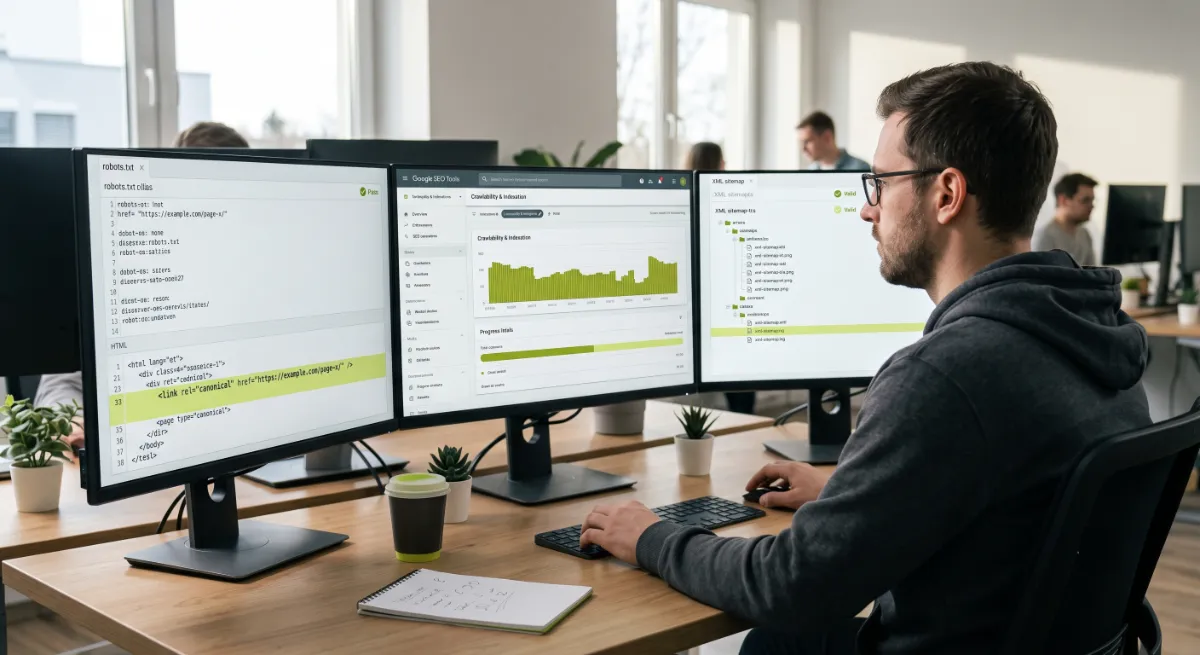
The checks that matter:
- robots.txt. Confirm you are not accidentally blocking important pages, directories, or assets like CSS and JavaScript.
- Indexation. Compare indexed pages in Search Console against what should be indexed. Investigate large gaps in either direction.
- Noindex and canonicals. Check no important page carries a stray noindex, and that canonical tags point where they should.
- XML sitemap. Confirm it exists, lists only indexable, canonical URLs, and is submitted in Search Console.
- Redirects and errors. Fix redirect chains, broken internal links, and server errors that waste crawl budget.
- HTTPS. Confirm the whole site is secure with no mixed-content or certificate issues.
Once crawlers can reach your pages, the next question is how fast and cleanly those pages load.
2. Core Web Vitals and Rendering
Core Web Vitals are a confirmed ranking factor, so every technical SEO audit has to check them on real-user data, not lab scores. Per Google’s Core Web Vitals documentation, the three metrics are measured at the 75th percentile of real Chrome User Experience Report data, which is what Google actually ranks on.
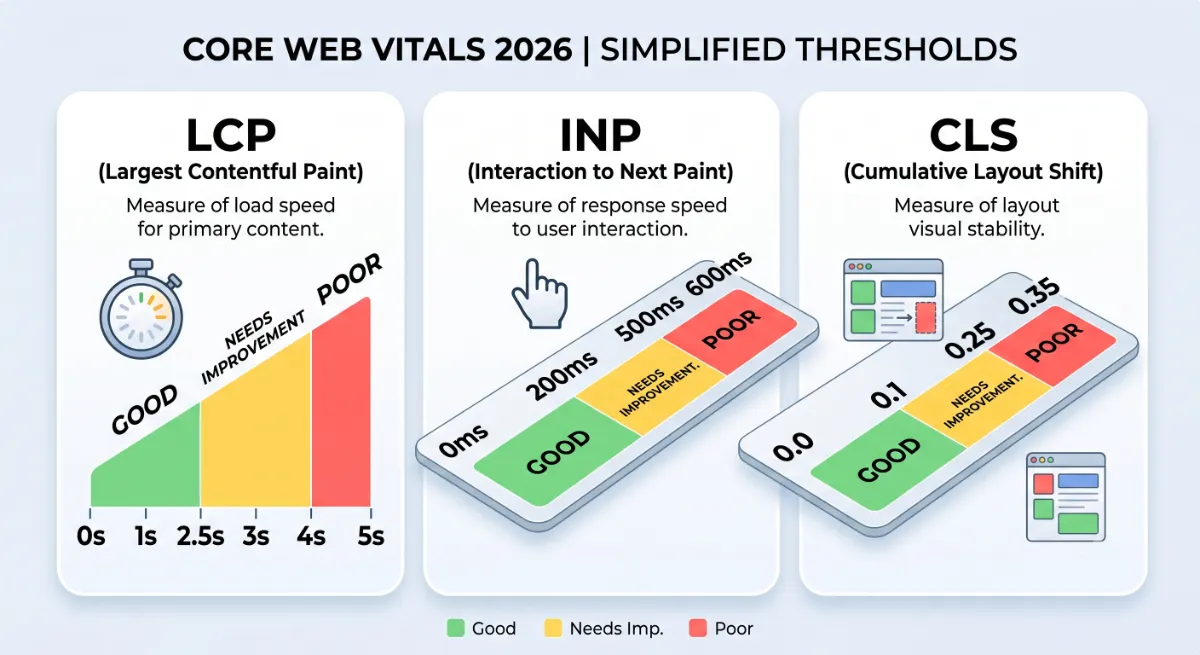
The 2026 thresholds and checks:
- LCP under 2.5 seconds. Optimize the largest element: server response, image formats like WebP, and preloading the hero.
- INP under 200 milliseconds. This replaced FID and measures responsiveness across the whole visit. Heavy JavaScript is the usual culprit.
- CLS under 0.1. Set explicit dimensions on images and reserve space for ads and embeds to stop layout jumps.
- Field data, not lab data. Check the real-user report in Search Console, not just a one-off Lighthouse score.
- Rendering. Confirm your important content exists in the raw HTML, since content that only appears after JavaScript may not be seen by every crawler.
Pro tip: INP is where modern sites quietly fail. Because it measures responsiveness across the whole session, heavy scripts, chat widgets, and faceted filters that felt fine under the old metric now show up clearly. If your audit only checks LCP, you are missing the metric most likely to be failing.
With speed handled, the audit shifts from how pages load to how machines understand them.
3. Structured Data
Structured data sits higher in a 2026 technical SEO audit than it did in an old technical SEO audit, because schema is now a primary way AI search engines decide what to cite. It is no longer the polish you add at the end. It is core infrastructure that makes your content machine-readable for both rich results and AI answers.
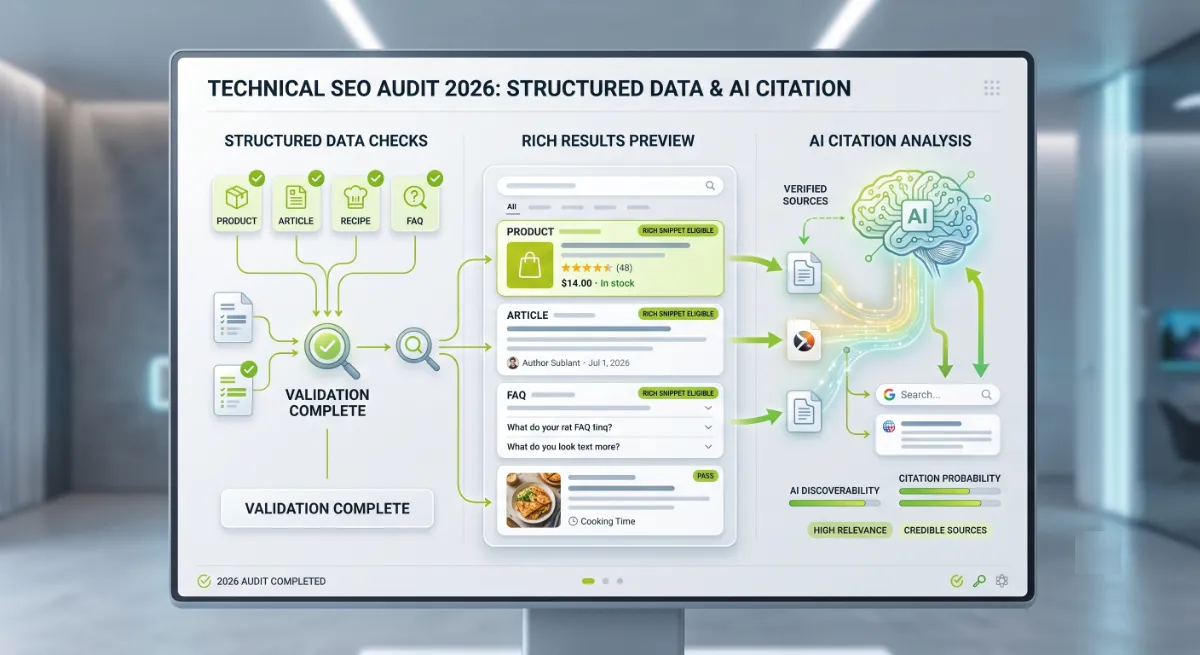
What to check:
- Coverage. Confirm the right schema types exist on the right templates: Article, Product, FAQ, Breadcrumb, Organization, and others that fit your content.
- Validity. Test with the Rich Results Test and the Schema Markup Validator, and clear every error.
- Accuracy. Per Google’s structured data guidelines, your markup must match the content visible on the page, or it gets ignored or penalized.
- Completeness. Fill recommended fields, not just required ones, since completeness is what makes you recommendable to AI engines, not merely eligible.
- Entity consistency. Keep your name, brand, and key facts consistent across your schema, your pages, and the wider web.
Why schema moved up the list: clean, complete structured data makes a page significantly more likely to be pulled into AI Overviews and cited by answer engines. In 2026, schema is not just about rich snippets, it is how you stay visible as search shifts toward AI answers.
That shift toward AI answers is exactly why the next layer did not exist on checklists a few years ago.
4. The AI and AEO Layer (New for 2026)
The AI and AEO layer is the part of a 2026 technical SEO audit that an older technical SEO audit simply did not have, and it is now essential. AI answer engines like ChatGPT, Perplexity, and Google AI Mode read your site alongside Google, so your audit has to confirm they can access and understand your content.
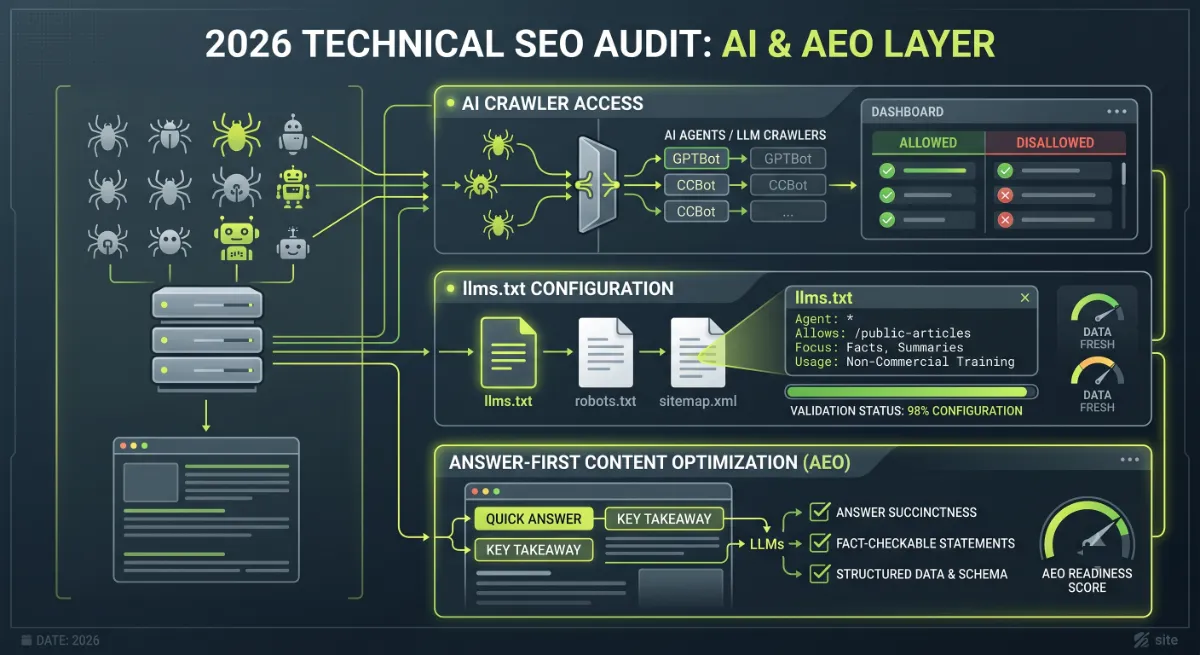
The checks that define a current audit:
- AI crawler access. Decide deliberately whether to allow crawlers like GPTBot, PerplexityBot, and Google-Extended in robots.txt. Blocking them by accident makes you invisible to AI answers.
- Answer-first content. Confirm key pages lead with a direct answer, since that is the format AI engines lift and cite.
- An llms.txt file. Consider adding one to guide AI systems to your most important content, an emerging but increasingly common practice.
- Question-based structure. Check that pages use clear headings, FAQ sections, and self-contained sections that map to real questions.
- Entity and citation signals. Confirm consistent, factual, well-sourced content that AI systems can trust and attribute.
Pro tip: Check your robots.txt and your CDN or firewall for AI-crawler rules on purpose, not by default. Many sites block AI bots without realizing it, either from an old security setting or a plugin default, and quietly disappear from a fast-growing channel.
With the machine-reading layers covered, the last layer ties the whole site together.
5. Architecture and Internal Linking
Site architecture is the final layer of a technical SEO audit checklist, and it determines how crawl equity and importance flow to your key pages. A logical structure helps both search engines and AI crawlers understand what matters most on your site and reach it efficiently.
The architecture checks:
- Crawl depth. Confirm important pages are reachable within a few clicks of the homepage, not buried deep.
- Internal linking. Fix orphan pages, strengthen links to priority pages, and use descriptive anchor text.
- URL structure. Check for clean, logical, readable URLs that reflect your hierarchy.
- Topic clusters. Confirm related content is grouped and interlinked, so authority concentrates around your key topics.
- Mobile parity. Since indexing is mobile-first, confirm the mobile version has the same content, links, and structured data as desktop.
Work through all five layers and you have a genuinely current audit. Here is where people go wrong.
Want a full technical SEO audit done properly, including the 2026 AI layer?
I audit crawlability, speed, schema, and AI readiness, then hand you a prioritized fix list. See my WordPress and SEO service.
What Most People Get Wrong
The biggest mistake in a technical SEO audit is running the audit in the wrong order, chasing Core Web Vitals while a crawlability issue quietly keeps pages out of the index entirely. A perfectly fast page that Google cannot crawl earns nothing. Always confirm pages can be reached and indexed before you optimize anything about how they perform.
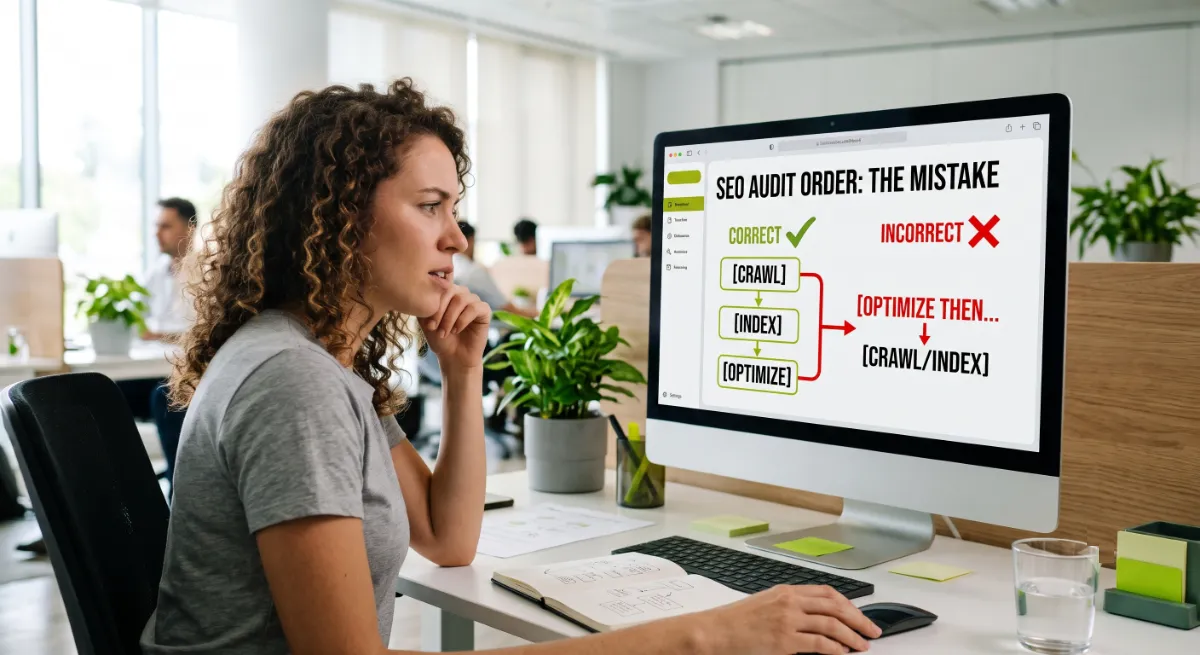
Here is the observation from client work. In a technical SEO audit, the two mistakes that cost the most are auditing out of order, and trusting lab scores over real-user data. Teams run a Lighthouse test, see a green number, and assume Core Web Vitals are fine, while the field data in Search Console tells a different story. Google ranks on the field data, so that is the number that matters. A great lab score with poor real-world INP is a failing grade where it counts.
The second trap is treating a technical SEO audit as a one-time project rather than a habit. Sites drift. A plugin update adds render-blocking scripts, a redesign orphans pages, a security setting blocks an AI crawler. Without a quarterly cadence, these regressions accumulate silently until a ranking drop finally surfaces them, by which point recovery takes far longer than prevention would have.
When your rankings are stuck and a technical SEO audit cannot easily tell you which issue is the real cause, that is exactly where an experienced audit pays for itself.
Stuck rankings and not sure what is holding you back?
I run full technical SEO audits and hand you a prioritized, plain-English fix list, not a 200-item data dump. See my WordPress and SEO service or book a free call.
Frequently Asked Questions
What is a technical SEO audit?
It is a systematic review of your website’s infrastructure to confirm search engines and AI crawlers can crawl, render, index, and understand your pages. It covers crawlability, Core Web Vitals, structured data, AI-crawler access, and site architecture, the technical foundations that decide whether your content can rank at all.
How often should I run a technical SEO audit?
Quarterly is the sensible cadence for most sites. Auditing on a schedule catches regressions, a plugin adding heavy scripts, a redesign orphaning pages, a crawler getting blocked, while they are still small. Waiting until a traffic drop appears means the problem has usually been live and costing you rankings for weeks.
What is new in a 2026 technical SEO audit?
Two things stand out. INP replaced FID as a Core Web Vital, so you audit responsiveness across the whole visit. And a full AI and AEO layer is now standard: confirming AI crawlers can access your site, adding answer-first content and structured data, so answer engines like ChatGPT and Perplexity can cite you.
What order should I fix technical SEO issues in?
Crawlability and indexation first, since nothing else matters if pages cannot be reached. Then Core Web Vitals and rendering, then structured data, then the AI and AEO layer, then architecture and internal linking. Each layer builds on the one before, so fixing out of order wastes effort on pages that may not even be indexed.
What are the Core Web Vitals thresholds for 2026?
Largest Contentful Paint under 2.5 seconds, Interaction to Next Paint under 200 milliseconds, and Cumulative Layout Shift under 0.1. All three are measured on real-user field data at the 75th percentile, from the Chrome User Experience Report, which is the data Google’s ranking systems actually use.
Do I need to allow AI crawlers like GPTBot?
It is a deliberate choice, not an automatic yes. Allowing crawlers like GPTBot and PerplexityBot lets AI answer engines read and cite your content, which is increasingly valuable as AI search grows. The key is deciding on purpose, since many sites block these bots by accident and vanish from that channel.
Can I run a technical SEO audit myself?
Much of it, yes, with free tools like Google Search Console, PageSpeed Insights, and a crawler such as Screaming Frog’s free tier. Where a do-it-yourself audit usually falls short is prioritization, knowing which of the flagged issues will actually move rankings versus which are cosmetic. That judgment is what experience adds.
Should I hire someone for a technical SEO audit?
Consider it when rankings are stuck and the cause is unclear, or when you want a prioritized roadmap rather than a raw list of issues. Diagnosing which technical problems actually matter, and in what order, is where an experienced audit earns its value. My WordPress and SEO service covers full audits.
Conclusion
A technical SEO audit in 2026 is not a longer version of the old technical SEO audit, it is a reordered one. Fix crawlability and indexation first, then Core Web Vitals with the new INP metric, then structured data, then the AI and AEO layer that older checklists never had, and finally architecture and internal linking. Work in that order, trust real-user field data over lab scores, and run the whole thing quarterly rather than waiting for a drop. Above all, prioritize ruthlessly, a handful of high-impact fixes beats a hundred cosmetic ones. Start with the layer everything depends on: open Search Console and confirm your important pages are actually being crawled and indexed.
Ready to find what is really holding your rankings back?
I run current, AI-ready technical SEO audits and turn them into a clear plan you can act on. Book a free call or browse my recent project portfolio.
This article was last reviewed and updated in June 2026 to reflect current Google ranking factors, Core Web Vitals thresholds, and AI search behavior.