

- Keyword research for AI search means mapping the questions, prompts, and entities that AI engines pull from, not head terms and volume.
- Success is measured in citations and answer inclusion, not clicks and rankings.
- People prompt AI in full conversational sentences, so target natural questions, not keyword fragments.
- AI engines fan one query out into many sub-queries, so cover a topic and its sub-questions comprehensively.
- Validate targets by actually prompting ChatGPT, Perplexity, and Google to see which questions trigger AI answers and who gets cited.
To do keyword research for AI search, you map the real questions, prompts, and entities that AI engines like Google AI Overviews, ChatGPT, and Perplexity use to build answers, then create content that becomes a cited source. Unlike traditional keyword research, you optimize for citation and answer inclusion, not just rankings and volume. Here is the exact process that works in 2026.
After optimizing content for AI search across client sites in 15+ countries, here is the shift that trips most people up. Your old keyword research, a spreadsheet of head terms sorted by search volume, is optimizing for a layer AI engines have already compressed away. AI search does not match keywords, it answers questions by synthesizing from sources it retrieves and cites. Get keyword research for AI search right, and you become one of those cited sources. Here is how.
Why AI Search Changes Everything
AI search changes keyword research because AI engines do not rank ten blue links, they assemble a single answer from multiple sources and cite them. Traditional SEO measures success in clicks and positions. AI search measures it in citations and answer inclusion, which is a fundamentally different target.
The mechanics matter here. AI Overviews and similar features use retrieval-augmented generation, pulling relevant passages from the search index and synthesizing them into an answer. So the job of keyword research shifts from finding high-volume terms to identifying the questions an answer will be built around, and making sure your content is the clearest, most citable source for those questions.
| Traditional keyword research | Keyword research for AI search |
|---|---|
| Head terms and exact keywords | Questions, prompts, and entities |
| Sorted by search volume | Prioritized by citation-worthiness |
| Goal: rank number one | Goal: be a cited source |
| Success is clicks and position | Success is answer inclusion |
Pro tip: The reassuring news, straight from Google, is that there is no separate AI index and no special AEO markup. Per Google’s own AI guidance, AI features draw from the same index as normal Search, so the helpful, people-first content that ranks is the same content that gets cited. Keyword research for AI search extends your process, it does not replace it.
With that foundation, here is the process, starting with the single biggest change.
Step 1: Start With Questions, Not Keywords
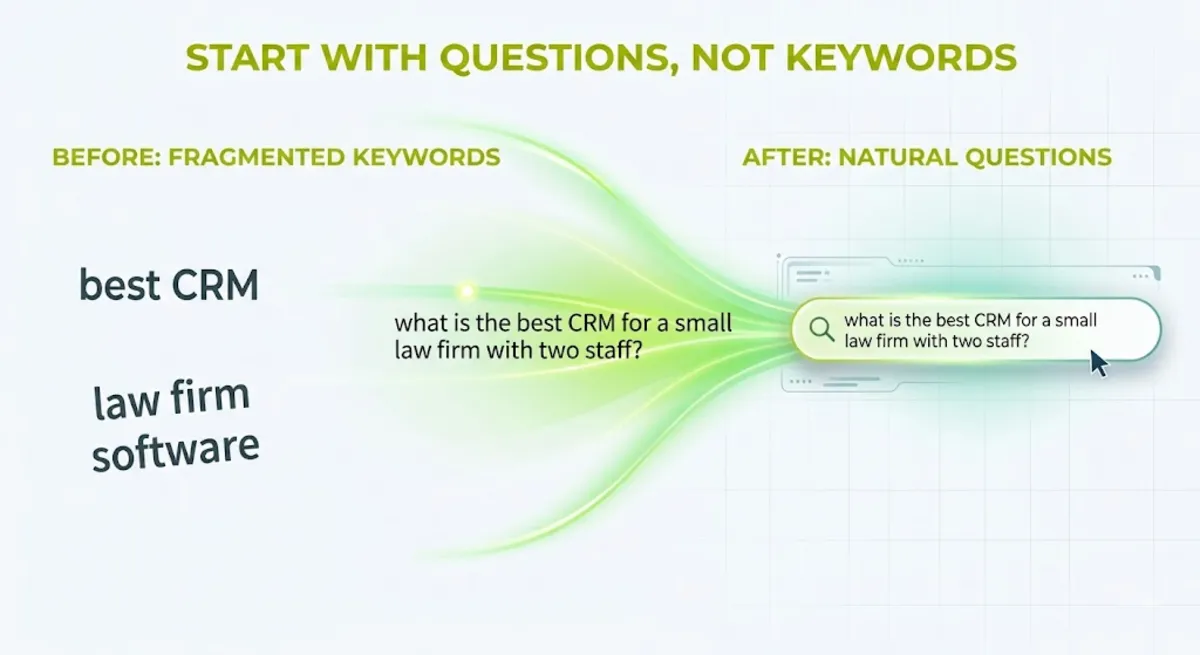
The first step in keyword research for AI search is to collect the real questions people ask, because they prompt AI engines in full conversational sentences, not keyword fragments. Someone types “what is the best CRM for a small law firm with two staff,” not “best CRM.” Your keyword research has to capture that natural phrasing.
Where to find the real questions people ask:
- People Also Ask and autocomplete surface the follow-up questions Google already associates with a topic.
- Real customer language from Reddit, forums, support tickets, and sales calls captures how people actually phrase their problems.
- The AI engines themselves. Ask ChatGPT, Perplexity, or Gemini your seed question, then ask what follow-up questions someone would ask next.
Group the questions your keyword research gathers by intent, because a “what is” question, a “how do I” question, and an “X versus Y” question each need a different kind of answer. This intent clustering is the backbone of keyword research for AI search, and it maps directly to the sections your content will need.
The customer-language advantage: your real prospects use specific phrasing that no keyword tool will show you. Mining support tickets and sales-call notes for the exact words customers use is one of the highest-value inputs, and it is one almost no competitor bothers to collect.
Once you have the questions, the next layer is what connects them: entities.
Step 2: Map Topics and Entities
The second step in keyword research for AI search is mapping the entities, the people, products, concepts, and places, that a complete answer must mention, because AI engines validate accuracy by checking entity coverage against trusted sources. Strong entity coverage signals that you genuinely understand the topic.
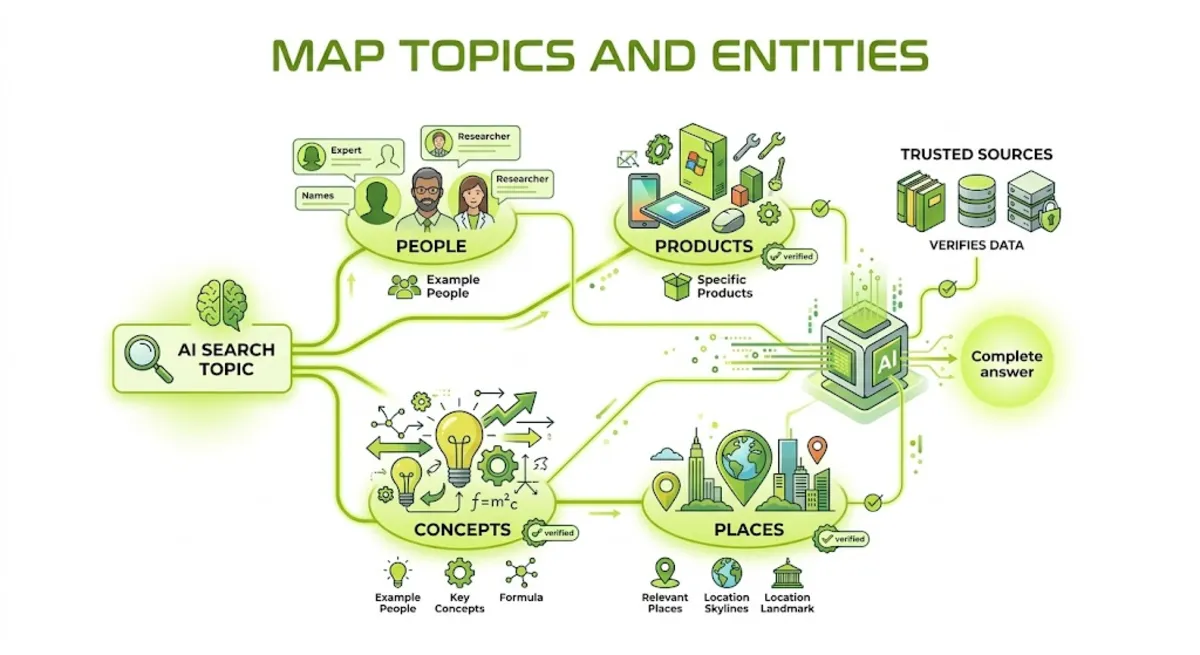
Think in terms of a topic and everything an authoritative answer would reference. For a query about a service, the relevant entities might include the specific tools, methods, related problems, and comparable options. Covering those entities clearly tells an AI engine that your page is a comprehensive, trustworthy source on the subject, not a thin page targeting a single phrase.
Pro tip: Entity coverage is where keyword research for AI search connects to entity SEO. Do not just list keywords, list the concepts and things an expert would naturally mention, then make sure your content defines and connects them. That entity clarity is what helps AI systems cite you with confidence.
Entities give you breadth. The next step gives you depth, by mirroring how the engines actually expand a query.
Step 3: Cover the Query Fan-Out
The third step is designing for query fan-out, the process where an AI engine expands one query into many related sub-queries behind the scenes. Google has confirmed that a single query can trigger dozens of related searches internally, pulling in a wider set of sources than a classic search.

This is genuinely good news for smaller sites. Because the fan-out pulls from subtopics and related concepts, a page that comprehensively addresses aspects of a topic can be cited even if it does not rank first for the main head term. Covering the sub-questions well is your opening.
To model the fan-out during keyword research for AI search, take your seed question and ask an AI engine directly what follow-up questions someone would ask, what related entities matter, and what a complete answer must include. The engine’s own expansion mirrors how it fans out internally, which hands you the exact sub-questions to cover on the page.
Now that you know what to cover, the harder question is what to prioritize, since AI search has no clean volume number.
Step 4: Prioritize Citation-Worthiness
In keyword research for AI search, you prioritize by citation-worthiness rather than search volume, because AI prompt volume is largely unmeasurable and large language models do not know real search numbers. Ask a chatbot for search volume and it will confidently invent figures, so never trust it for that.

Since you cannot rank questions purely by volume, prioritize them by a blend of signals:
- Buyer intent. Questions close to a hiring or buying decision are worth more than broad informational ones, even at lower apparent volume.
- Your ability to answer better. Questions where you have genuine first-hand data, examples, or expertise are where you can out-cite everyone.
- Whether the query triggers an AI answer. Questions that already produce an AI Overview or chatbot answer are live targets worth pursuing.
The reliable keyword research workflow blends both worlds: use AI to generate question ideas and clusters, then use real keyword tools to validate that there is genuine demand behind the seed topics. AI for ideas, real data for validation, so you never build a page nobody is looking for.
Pro tip: The content most likely to be cited tends to be original data, honest comparisons, and clear how-to guidance. If your keyword research for AI search surfaces a question you can answer with real numbers or genuine first-hand experience, prioritize it, that is exactly the material AI engines prefer to cite.
Every prioritization decision should then be checked against reality, which is the step almost everyone skips.
Step 5: Validate by Prompting AI
The final step in keyword research for AI search is validation: run your candidate questions through Google, ChatGPT, and Perplexity to see which trigger AI answers and who currently gets cited. This is the one test that tells you whether a target is real, and it is the step most people skip.
For each priority question, do three quick checks. First, does searching it produce an AI Overview or a chatbot answer at all? If yes, it is a live target. Second, who gets cited right now, and is the current answer weak or missing a source like yours? A weak existing answer is your opening. Third, revisit your key prompts monthly, because AI answers shift far faster than traditional rankings.
To run this whole process efficiently, it helps to know which tools earn their place.
Tools That Actually Help
No single tool does keyword research for AI search end to end, so you combine three layers: question discovery, AI visibility tracking, and traditional validation. Each covers a gap the others cannot.
| Layer | What it does for AI-search research |
|---|---|
| Question and autocomplete tools | Surface the real questions and follow-ups people ask around a topic. |
| The AI engines themselves | Model the query fan-out and reveal which questions trigger answers and who is cited. |
| AI visibility trackers | Monitor which prompts your brand appears in and who gets cited instead of you. |
| Classic keyword tools plus Search Console | Validate real demand and, via the Generative AI report, show how AI features send traffic. |
One caution worth repeating: Google explicitly warns that no third-party tool has access to its internal ranking or AI systems, so treat any tool promising “internal” AI metrics with skepticism. Use these tools where they speed up your workflow, but evaluate their advice against Google’s official guidance, and let real prompting of the engines be your ground truth.
Want your content built to get cited by AI, not just ranked?
I research the questions and entities AI engines pull from and structure content to become the cited source. See my WordPress and SEO service.
What Most People Get Wrong
The biggest mistake in keyword research for AI search is carrying the old volume-first mindset straight over, chasing head terms and ignoring the questions and entities AI engines actually use. A spreadsheet of high-volume keywords tells you almost nothing about which prompts get answered or who gets cited.
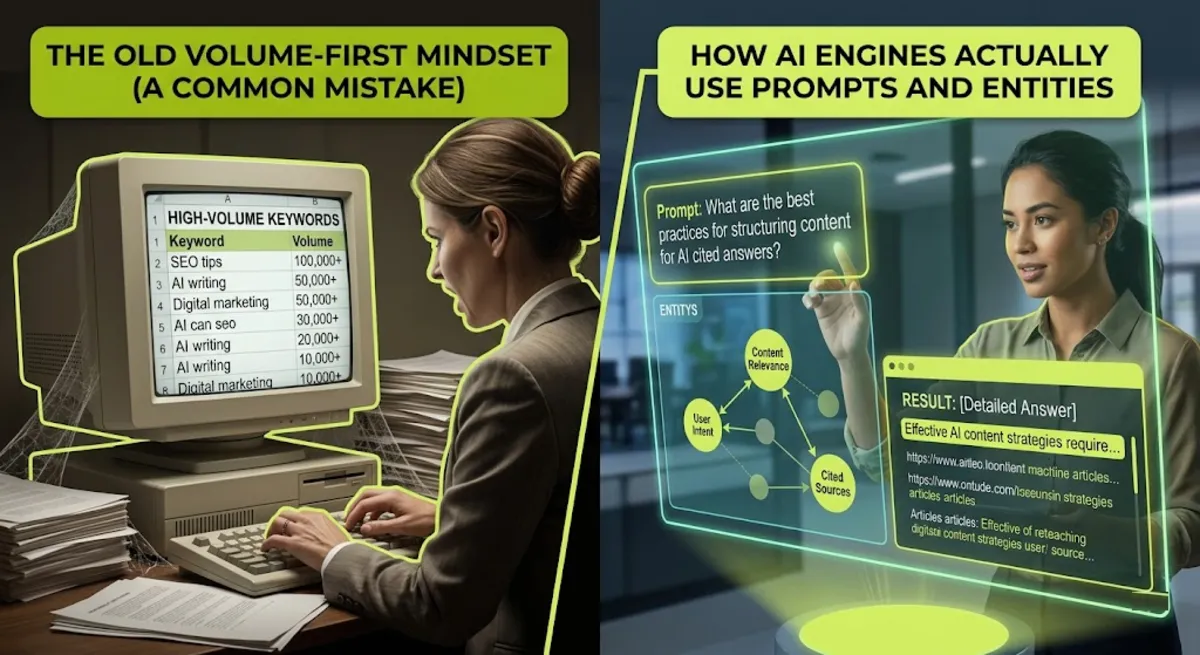
Here is what I see most often. People either treat AI search as a totally separate discipline needing secret markup, or they ignore it entirely and keep doing 2019-style keyword research. Both are wrong. Google is clear that the same helpful, people-first content wins in AI features, there is no magic AEO trick, a point reinforced across Google’s helpful content guidance. The real work is researching questions and entities, then answering them better and more clearly than anyone else.
The second common error is skipping validation. People build a big list of questions and never actually prompt the engines to see which ones trigger AI answers or who gets cited. Without that check, you are guessing. And the third is trusting AI for search volume, it will invent numbers every time. Use AI for ideas and structure, and real tools plus live prompting for validation.
When AI-search visibility matters and you want the research and content structure done right, that is where an experienced, current approach pays off.
Want to get cited in AI answers, not just ranked in blue links?
I do keyword research for AI search and build content structured to be the source AI engines pull from. See my WordPress and SEO service or book a free call.
Frequently Asked Questions
What is keyword research for AI search?
It is the practice of mapping the questions, prompts, sub-questions, and entities that AI engines like Google AI Overviews, ChatGPT, and Perplexity use to assemble answers, so your content becomes a cited source. Unlike traditional keyword research, it optimizes for citation and answer inclusion rather than just rankings and search volume, and it relies heavily on real conversational questions.
How is it different from traditional keyword research?
Traditional keyword research centers on head terms sorted by search volume, with the goal of ranking first. Keyword research for AI search centers on questions, prompts, and entities, with the goal of being cited in an AI-generated answer. Success is measured in citations and answer inclusion, not clicks and position. The two overlap, but the target and priorities differ.
Do I still need traditional keyword tools?
Yes, as one of three layers. Classic tools like Search Console and keyword platforms still validate real demand and surface question keywords, which matters because AI cannot reliably tell you search volume. You pair them with question-discovery sources and with actually prompting the AI engines. Use AI for ideas and structure, and real data plus live prompting for validation.
What is query fan-out?
Query fan-out is when an AI engine expands a single user query into many related sub-queries behind the scenes to gather a broader set of sources. Google has confirmed one query can trigger dozens of related searches internally. It matters because a page that comprehensively covers a topic and its sub-questions can be cited even if it does not rank first for the main term.
How do I find the questions people ask AI?
Combine several sources for your keyword research: People Also Ask and autocomplete, real customer language from Reddit, forums, support tickets, and sales calls, and the AI engines themselves. Ask a chatbot your seed question, then ask what follow-up questions someone would ask next and what a complete answer must include. That mirrors the engine’s own fan-out and reveals the sub-questions to cover.
Does structured data help with AI search?
It helps machines understand your content, but Google has stated there are no additional requirements or special markup to appear in AI Overviews or AI Mode beyond standard SEO best practices. Schema is still worth using for clarity, but the bigger drivers are helpful, people-first content, comprehensive question and entity coverage, and clear structure that is easy to extract.
How do I measure success in AI search?
Measure citations and answer inclusion, not just clicks. Check which prompts your brand appears in by manually querying AI platforms, filter AI referral traffic in analytics, and use Google’s Generative AI performance report in Search Console. Give any change four to six weeks before drawing conclusions, since AI answers shift faster than traditional rankings.
Should I hire someone to do AI-search keyword research?
Consider it if AI visibility matters to your business and you want the questions, entities, and content structure handled by someone who tracks this fast-moving area. The research method and content structure are where the results come from, not a single tool. My WordPress and SEO service covers AI-search research and content built to be cited.
Conclusion
Keyword research for AI search is not a reinvention of everything you know, it is a focused expansion of it. Start with the real questions people ask in natural language, map the entities a complete answer must cover, and design pages around the query fan-out so you can be cited across a topic. Prioritize by citation-worthiness and genuine buyer intent rather than raw volume, then validate every target by actually prompting Google, ChatGPT, and Perplexity to see what triggers answers and who gets cited. The engines reward the same thing they always have, clear, helpful, genuinely useful content, just researched and structured for how people now ask. Start by taking one important topic, prompting an AI engine for the questions around it, and building the most citable answer on the web.
Ready to show up in AI answers, not just search results?
I research the questions and entities AI engines cite, and build content to match. Book a free call or browse my recent project portfolio.
This article was last reviewed and updated in June 2026 to reflect current AI search behavior, Google’s generative AI guidance, and answer engine best practices.