
- To write content that AI cites, remember it quotes the clearest, most self-contained answer on a page, not the whole page.
- Lead with the answer, then explain. Buried answers rarely get cited.
- Specific facts, numbers, and cited sources make content far more quotable. Research shows large gains from adding them.
- Question-style headings and short, extractable paragraphs match how AI retrieves answers.
- Great writing is the most controllable lever, but it works alongside crawlability, ranking, and trust.
Writing content that AI cites comes down to one shift: make your best answers easy to lift. AI engines quote clear, specific, well-sourced passages, not buried or vague prose. Get the structure and the substance right and you become the source they pull from. Here are eight techniques that work.
Across 100+ WordPress projects, I have learned that writing is the lever you control most directly in AI search. You cannot force ChatGPT to quote you, but you can write so well and so clearly that quoting you is the obvious choice. The good news is that the same habits that earn AI citations also make your content better for human readers. Let me show you how to write content that AI cites, step by step.
What makes content citable to AI?
AI does not quote pages, it quotes passages. When an engine answers a question, it scans for the single clearest, most self-contained statement that resolves the query, then lifts or paraphrases it. So citability is not about your whole article being good. It is about whether any specific sentence or short block answers the question cleanly enough to stand on its own.
That reframes the whole task. To write content that AI cites, you are really writing a series of small, quotable answers, each one clear, specific, and supported, wrapped in content that proves you know the topic deeply. The techniques below all serve that goal.
It also explains why some thin, generic pages get quoted while richer ones get ignored. The thin page happened to state one answer cleanly, while the rich page buried its better answer in a paragraph an engine never reached. Citability rewards clarity and structure as much as depth, which is good news, because both are fully within your control.
Stop writing to be read top to bottom. Start writing so any single paragraph could be pulled out and still make complete sense on its own.
How to write content that AI cites
Eight techniques, ordered so the highest-impact habits come first. You do not need all eight perfect, but each one measurably improves how quotable your content is.

1. Lead with the answer
Put the direct answer in the first sentence or two of each section, then explain. This inverted-pyramid structure mirrors how AI scans for responses, and it means the quotable line sits exactly where the engine looks first. Burying your answer three paragraphs down is the single most common reason good content never gets cited.
2. Write self-contained, quotable sentences
Make key sentences stand on their own without the surrounding context. Instead of “this is why it matters,” write the full claim: “Caching reduces server response time, which directly improves Core Web Vitals.” A sentence that makes complete sense in isolation is a sentence AI can lift with confidence.
3. Use question-style headings
People ask AI questions, so headings phrased as questions map directly to those queries. Turn “Speed Tips” into “How do I make my WordPress site faster?” and answer it immediately underneath. This alignment between heading and likely query is one of the simplest ways to write content that AI cites.
4. Add specific data, numbers, and named facts
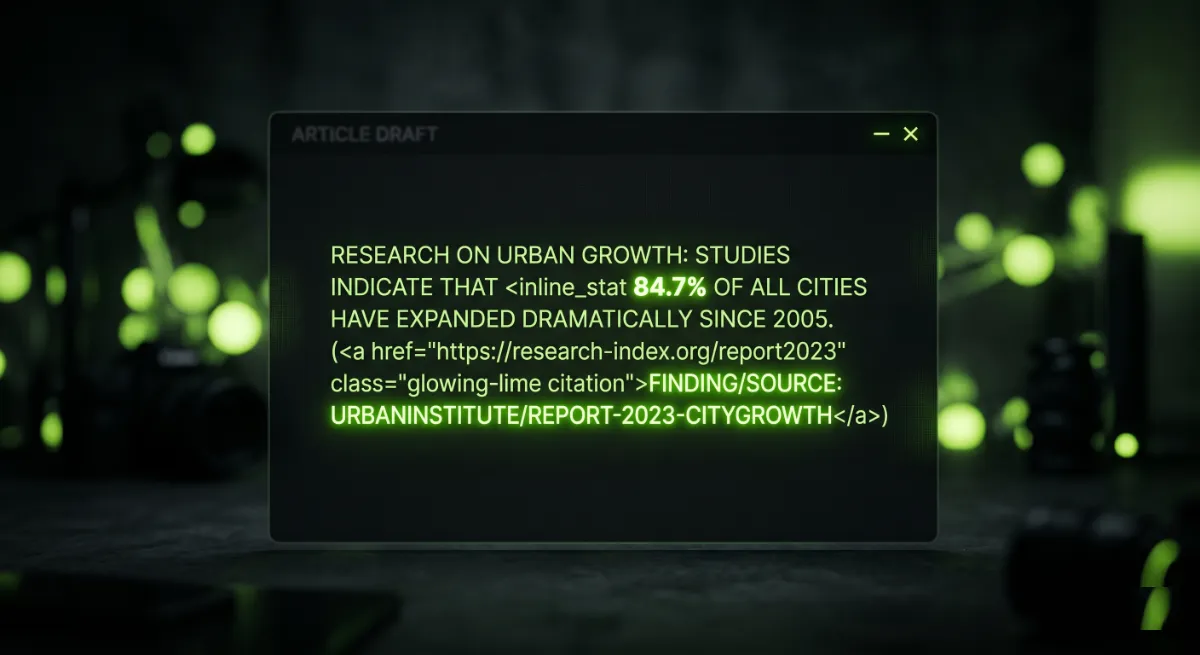
Specificity is citable, vagueness is not. Concrete numbers, dates, named tools, and measurable claims give AI something solid to quote. A Princeton study on generative engine optimization found that adding statistics, quotations, and cited sources lifted content visibility in AI answers by up to roughly 40 percent. Trade “improves speed a lot” for “cut load time from 4.2s to 1.1s.” The more precise the claim, the more confidently an engine can repeat it without hedging.
5. Cite credible sources
Content that references reputable sources reads as more trustworthy, and that same research found citing sources measurably increased AI visibility. Link to original studies, official documentation, and authoritative data. You are signalling that your claims are grounded, which makes an engine more comfortable repeating them.
6. Show real experience and expertise
AI and search both reward first-hand knowledge. Original insight, real examples, your own data, and a clear, credentialed author all raise the credibility of your content. Generic information that simply repeats what everyone else says gives AI no reason to pick you over a more authoritative source.
7. Structure for extraction
Format so machines can parse you easily: short paragraphs, descriptive subheadings, bulleted lists for steps and options, tables for comparisons, and clear definitions. A wall of text hides your answers, while clean structure surfaces them. Extractable formatting is half of how you write content that AI cites. A useful test: skim your page in five seconds and see if the key answers jump out. If they do to you, they will to a machine.
8. Keep it accurate and fresh
AI favors current, correct information. Update key pages, fix outdated facts, and show a recent review date. Stale or inaccurate content loses to fresher sources, and a single wrong fact can cost you trust that is hard to win back. Accuracy is the floor, freshness is the edge.
I write and optimize WordPress content for AI visibility as part of my AI Search Optimization service, structured and sourced so engines quote it.
A before and after
The difference is easiest to see in an example. Here is a typical paragraph, then the same point rewritten to be citable.
Before There are many things you can do to make your website faster, and speed is really important for SEO and user experience these days, so it is worth looking into various optimization techniques.
After To make a WordPress site faster, enable caching, compress images to WebP, and use a CDN. Together these typically cut load time by 50 to 70 percent, and faster pages improve both Core Web Vitals and conversions.
The “after” version leads with the answer, names specific techniques, includes a concrete number, and stands on its own. That is a passage AI can quote directly, and it reads better for humans too.
Generate question-style headings
Enter your topic and get citable, question-style headings to structure your content. No email, nothing stored.
What AI quotes versus what it skips
If you remember nothing else, remember the contrast. These are the traits that decide whether your content gets cited or ignored.
| Gets cited | Gets skipped |
|---|---|
| Direct, self-contained answers | Answers buried after long intros |
| Specific facts, numbers, and dates | Vague generalities |
| Cited, sourced claims | Unsupported assertions |
| Clear question-style headings | Clever but ambiguous headings |
| Short, extractable paragraphs | Dense walls of text |
| Fresh, accurate information | Outdated or incorrect content |
Every row is a writing decision you control. Shift your content toward the left column and you write content that AI cites by default.
How to make existing content citable
You do not have to start from scratch. Most sites already have decent content with the answers buried, and a focused refresh is often the fastest way to write content that AI cites. Work through your best existing posts with this short checklist.
- Move the answer up. Find the clearest answer in each post and lift it to the top of its section.
- Add a number or source. Replace one vague claim per page with a specific stat or a link to a credible source.
- Reword headings as questions. Turn label headings into the questions your readers actually ask.
- Break up walls of text. Split dense paragraphs, add a list or table where it helps extraction.
- Update the facts and date. Fix anything stale and show a recent review date.
Prioritize the pages that already rank or get traffic, since they are closest to being retrieved. A few of these edits can turn a skipped post into a quoted one without a full rewrite, which makes refreshing old content one of the highest-return ways to write content that AI cites.
Mistakes that keep your content uncited
A few habits quietly keep good content out of AI answers. Avoid these.
- Burying the answer. A great answer in paragraph five is invisible to an engine scanning the top. Lead with it.
- Writing for word count. Padding dilutes your quotable lines. Be thorough but tight.
- Staying vague. “Significantly improves performance” cites nothing. Give the number.
- Skipping sources. Unsupported claims read as opinion. Back them up.
- Generic, me-too content. If you only repeat what ranks already, AI has no reason to choose you. Add original insight.
Fix these and your existing content often becomes citable without a full rewrite. Sometimes the fix is just moving the answer to the top.
Where writing fits in AI visibility
Be clear about scope. Writing well is necessary but not sufficient. AI cannot cite content it cannot reach, cannot find through search, or cannot trust. Citable writing is the most controllable lever, but it works alongside the rest.
Pair it with the technical and trust work: open your AI crawlers, add clean structured data for AI search, rank for the questions buyers ask, and earn authority. Google’s own guidance on helpful content and its notes on AI features point the same way: people-first, well-structured content is the foundation. For the complete plan, see my guide on how to optimize WordPress for AI search. Think of it as a stack: crawlability lets AI reach you, ranking gets you retrieved, trust makes you believable, and citable writing makes you the passage it actually quotes. Skip a layer and the effort to write content that AI cites is wasted on a page no engine can use.
Frequently asked questions
How do I write content that AI cites?
Lead with a direct answer, write self-contained quotable sentences, use question-style headings, add specific data and cited sources, show real expertise, format for easy extraction, and keep it accurate and fresh. AI quotes the clearest passage, so make that passage unmissable.
Does adding statistics really help AI cite my content?
Yes. Research on generative engine optimization found that adding statistics, quotations, and cited sources increased content visibility in AI answers by up to roughly 40 percent. Specific, sourced claims are far more quotable than vague ones.
What is answer-first writing?
Answer-first writing puts the direct answer in the first sentence or two of a section, then explains. It mirrors how AI scans for responses, so your quotable line sits exactly where the engine looks first.
Should my headings be questions?
Often, yes. People ask AI questions, so headings phrased as questions map directly to those queries. Answer each question immediately underneath the heading for the best chance of being cited.
How long should content be to get cited?
There is no magic length. Depth and clarity matter more than word count. Cover the topic thoroughly with specific, quotable answers, and cut padding that dilutes them.
Does writing well guarantee AI will cite me?
No. Writing is the most controllable lever, but AI must also be able to crawl, find, and trust you. Pair great writing with crawlability, structured data, rankings, and authority.
Will rewriting old posts help?
Often a lot. Many posts have good answers buried in the middle. Moving the answer to the top, adding a number or source, and tightening the prose can make existing content citable without a full rewrite.
Can you write citable content for my site?
Yes. My AI Search Optimization service includes content written and structured to be cited by AI, and you can book a free call to start.
Conclusion
Writing content that AI cites is not a trick, it is a discipline. Lead with the answer, make every key sentence stand on its own, ground your claims in specific facts and credible sources, and format so a machine can lift your best lines without effort. Show that you genuinely know the topic, keep it accurate, and pair the writing with the technical and trust work that lets AI reach and believe you. Do that consistently and your content stops being skipped and starts being quoted.
See the full method in how to optimize WordPress for AI search, or have me write and optimize it through my AI Search Optimization service.
This article was last reviewed and updated in June 2026 to reflect current best practices for writing content that AI engines cite.