
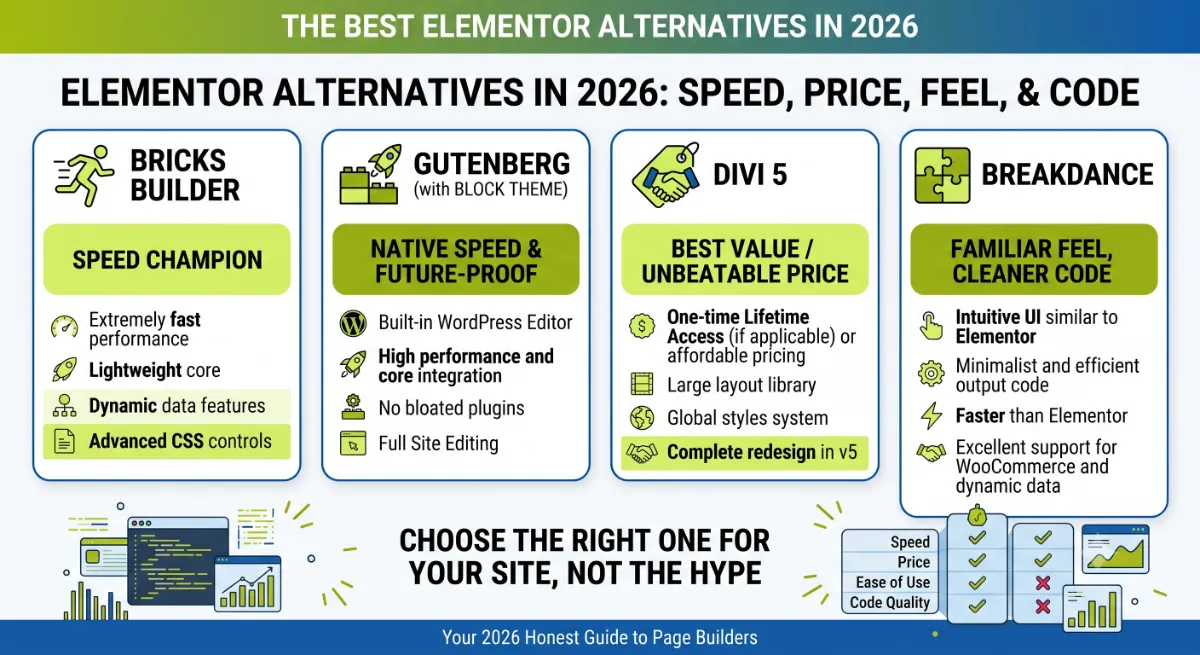
- The top Elementor alternatives in 2026 are Bricks, Gutenberg with a block theme, Breakdance, and Divi 5, each faster or cheaper in its own way.
- Bricks is the developer and performance pick, with lean code and a one-time license option.
- Gutenberg plus a block theme is the best free alternative and the direction WordPress core is heading.
- Switching builders is a full rebuild, not a swap, so the migration cost matters as much as the license price.
- For many sites, optimizing Elementor beats switching, since poor speed is usually the build, not the builder.
The best Elementor alternatives in 2026 are Bricks, Gutenberg with a block theme, Breakdance, and Divi 5, each stronger than Elementor in a specific way. Bricks and Gutenberg win on speed, Divi on price, and Breakdance on a familiar feel with cleaner code. This guide compares these Elementor alternatives honestly so you can pick the right one for your site, not just the most hyped.
After building and rescuing WordPress sites for clients in 15+ countries, I have used every builder on this list on real projects. So this list of Elementor alternatives is not scraped from other lists. It is which Elementor alternatives I actually reach for, when, and why. One honest note before we start: the builder is rarely the reason a site is slow. But if you have a real reason to leave, these are the alternatives worth your time, and the traps worth avoiding.
Why Look for Elementor Alternatives in 2026?
People look for Elementor alternatives in 2026 for three reasons: performance, cost, and control. Understanding those reasons helps you shortlist the right Elementor alternatives. Elementor is powerful and easy, but it adds extra CSS, JavaScript, and DOM markup that can drag down Core Web Vitals, its subscription adds up across many sites, and developers often want cleaner code than it produces. Those are fair reasons to shop around for Elementor alternatives.
The common motivations, in order:
- Speed. Performance-first builders ship far lighter code, which helps Core Web Vitals and rankings.
- Cost. Elementor Pro is a yearly subscription, and it stacks up fast for agencies with many sites.
- Clean code and ownership. Developers want semantic markup and less lock-in than Elementor gives.
- A fresh workflow. Some people simply want a class-based or block-native way of building.
Pro tip: Before you switch, be honest about your problem. If your only complaint is speed, optimizing Elementor with Containers, caching, and asset cleanup often fixes it for far less effort than rebuilding on a new builder.
If you have decided to look, here is how the main Elementor alternatives stack up against each other in 2026.
Elementor Alternatives Compared at a Glance
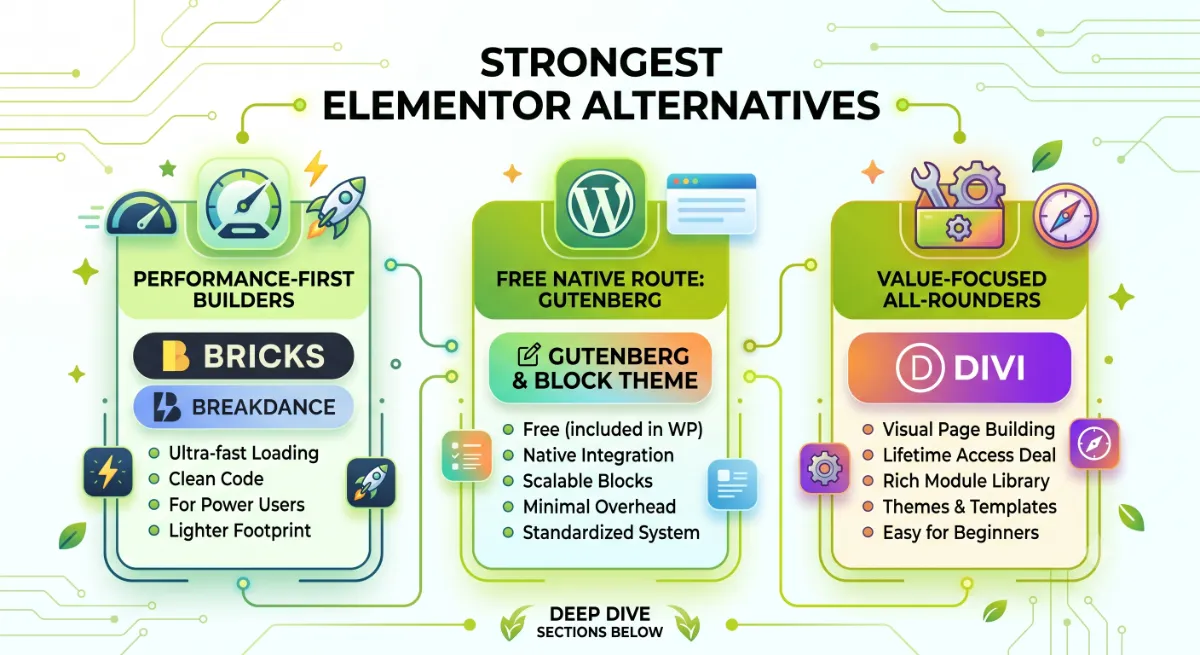
The strongest Elementor alternatives split into three camps: performance-first builders like Bricks and Breakdance, the free native route of Gutenberg with a block theme, and value-focused all-rounders like Divi. This table shows the trade-offs between the top Elementor alternatives at a glance, then the sections below go deeper on each.
| Builder | Best for | Code and speed | Price (approx, verify current) |
|---|---|---|---|
| Bricks | Developers, performance | Very lean, class-based | From about 79/yr, 599 lifetime |
| Gutenberg + block theme | Owners who want light and native | Lightest payload | Free |
| Breakdance | Elementor feel, cleaner output | Lean, all-in-one | Free tier, Pro from about 100/yr |
| Divi 5 | Agencies wanting a lifetime license | Improved in Divi 5 | About 89/yr or 249 lifetime |
| Beaver Builder | Stable, long-term agency sites | Clean, reliable | Paid, yearly |
Pricing changes often, so confirm current numbers on each builder’s site. Now, the builder most developers move to first among the Elementor alternatives.
Bricks: Best for Developers and Speed
Bricks is the best Elementor alternative for developers and performance, because it outputs lean, semantic code with a class-based workflow that keeps large sites maintainable. It generates a small HTML payload, roughly a third of what heavier builders produce, and passes Core Web Vitals by default. If clean code and speed are non-negotiable, Bricks is the pick.
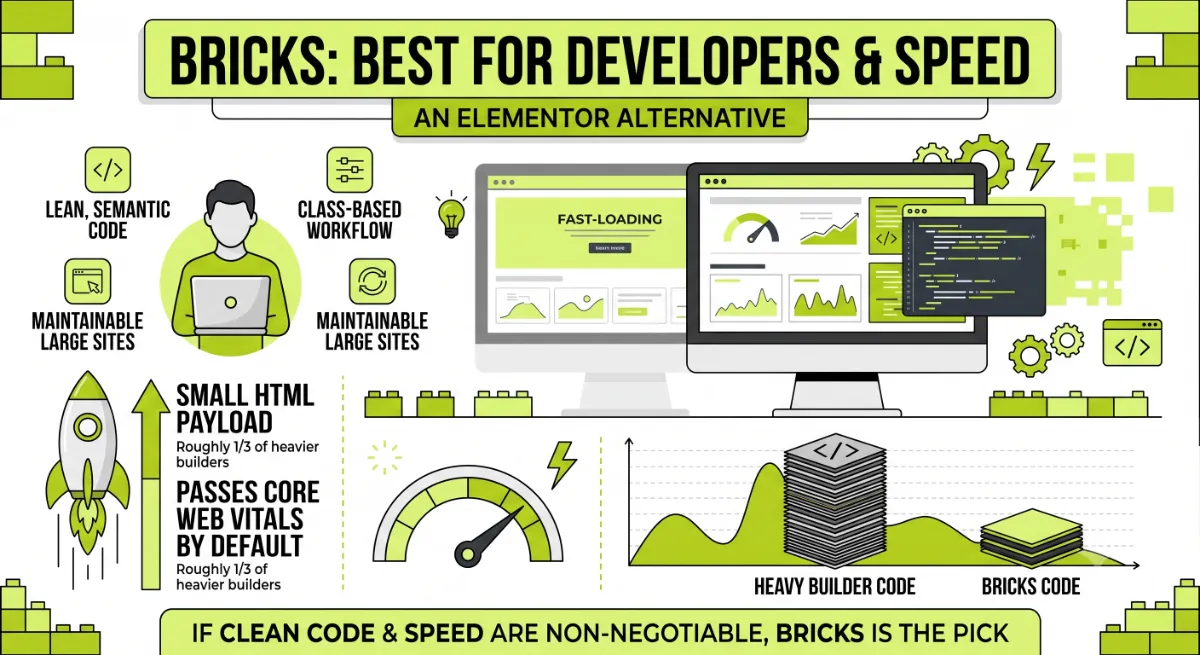
The class-based approach is the real advantage. Style a .btn-primary class once and every button on the site updates, which is a huge time saver on large builds. Per Bricks’ own pricing, it offers yearly plans and a one-time lifetime license, so agencies escape the annual subscription treadmill. The trade-offs are a steeper learning curve and a smaller template ecosystem than Elementor. Best for developers and performance purists.
Pro tip: Bricks has no free download, but you can try the full builder online at try.bricksbuilder.io before you buy. Test your typical layout there first to feel the workflow.
If paying for any builder feels like the wrong move, the best of the Elementor alternatives might be free.
Gutenberg and a Block Theme: Best Free Option
Gutenberg with a block theme is the best free Elementor alternative, and it is the direction WordPress core itself is heading. The native block editor is fast, lightweight, and built into WordPress, so there is no page-builder plugin loading extra code. Pair it with a block library like Kadence Blocks, GenerateBlocks, or Spectra, and it becomes a genuine page builder.
This is the option most listicles bury, because it earns them no affiliate commission. But for a content site, a blog, or a lean business site, it is often the smartest choice. As the WordPress block themes documentation shows, a block theme plus the editor gives you full-site editing without any builder overhead. The trade-off is fewer drag-and-drop conveniences and a more hands-on design process.
If you want the Elementor feel without the Elementor bloat, look at the builder built to win those users over.
Breakdance: Best All-in-One Option
Breakdance is the best Elementor alternative for people who want a familiar visual feel with cleaner output, built by the team behind Oxygen. It deliberately targets frustrated Elementor users: a modern drag-and-drop interface, but lighter code and an all-in-one toolkit. It ships with a form builder, popup builder, strong WooCommerce elements, and over a hundred pre-styled components out of the box.
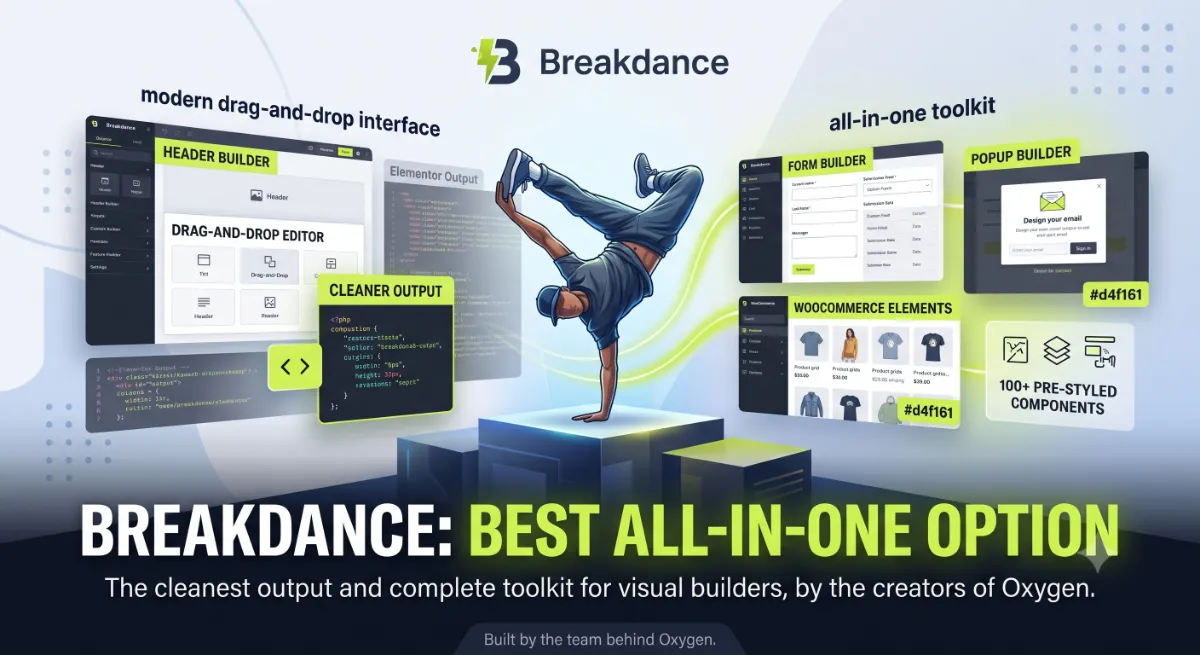
It has a real free tier, and its paid plans start lower than many rivals, with Pro features that keep working even if your license lapses. Compared to Bricks, Breakdance holds your hand more and ships more ready-made elements, which makes it faster for marketing sites and stores but slightly heavier structurally. You can see the full toolkit on the Breakdance site. Best for people who want the Elementor workflow with fewer code complaints.
Those three cover most needs. A few more Elementor alternatives deserve a mention before you decide.
Divi, Beaver Builder, and Lightweight Blocks
Beyond the top three, several Elementor alternatives fit specific situations well, and these Elementor alternatives suit agencies and lean content sites especially. None is a bad choice; each simply suits a different buyer.
Divi 5
Divi from Elegant Themes is the most established Elementor rival, now rebuilt as Divi 5 for better performance, with over a million users. Its big draw is the license: unlimited sites for a yearly fee or a one-time lifetime payment, which agencies love. Watch out for older Divi 4 sites, which run in a backward-compatibility mode with a speed cost until migrated.
Beaver Builder
Beaver Builder is the reliability-first choice, around since 2014 and known for stable, clean, well-supported code. It has fewer flashy design elements, and its Beaver Themer add-on is sold separately, but for agencies managing many client sites with minimal surprises, it is a safe long-term bet.
GenerateBlocks and Kadence
If you like the Gutenberg route but want more design control, GenerateBlocks with GeneratePress, or Kadence Blocks with the Kadence theme, give you a lightweight, block-native stack. Both ship tiny payloads and are excellent, lightweight Elementor alternatives for performance-focused content sites.
With the Elementor alternatives clear, the real question is which one is right for you.
Not sure which builder your project actually needs?
I build on Elementor, Bricks, Divi, and Gutenberg, so I recommend based on your goals, not a favorite. See my WordPress development service.
How to Choose the Right One
To choose the right Elementor alternative, run it through three axes: speed priority, budget model, and your skill level. I call it the 3-Axis Builder Test, and it cuts through the hype fast. Rank those three for your project, and the right Elementor alternatives almost pick themselves.
Here is how the axes map:
- Speed first, developer-comfortable: choose Bricks for the leanest code and class-based control.
- Free and native, lightest possible: choose Gutenberg with a block theme.
- Visual ease with cleaner output: choose Breakdance.
- Agency, many sites, one license: choose Divi 5 or Beaver Builder.
That rebuild reality is the piece almost everyone underestimates, which leads to the biggest mistakes.
What Most People Get Wrong
The biggest mistake is assuming a new builder will automatically fix a slow site. It will not. Poor performance is usually the build, not the builder. A fast builder used with heavy habits, too many widgets, huge images, no caching, still produces a slow site. Switching without changing how you build just moves the problem.
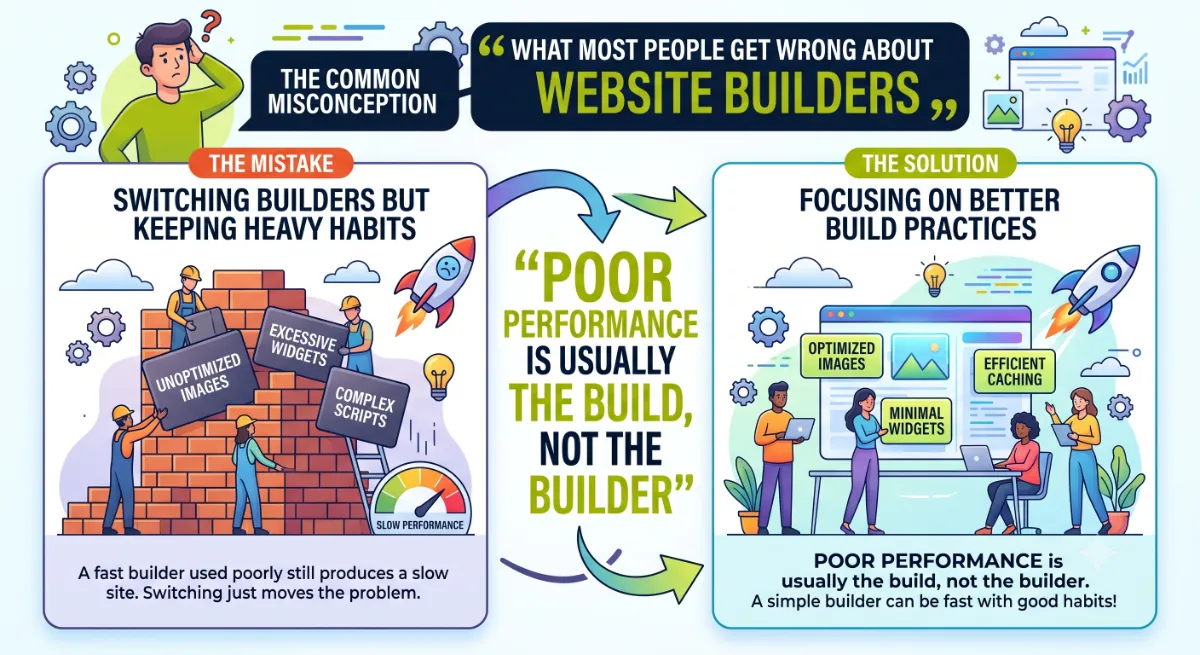
Here is the observation from years of client work: most people who ask me for an Elementor alternative did not actually need one. They needed Elementor optimized, or a leaner build approach. When a switch to one of the Elementor alternatives truly is the right call, the pattern is consistent: Bricks for developers, Gutenberg for owners who want light and native, and Breakdance for those who want the Elementor feel without the bloat. The tool matters less than the hands using it.
When a switch is genuinely worth it, that is where an experienced developer saves you the rebuild pain, by picking the right tool and migrating cleanly with your rankings intact.
Thinking about switching, or not sure it is worth it?
I will give you a straight answer on whether to switch, optimize, or rebuild, based on your site. See my WordPress development service or book a free call.
Frequently Asked Questions
What is the best Elementor alternative in 2026?
It depends on your priority. Bricks is best for developers and speed, Gutenberg with a block theme is the best free option, Breakdance is best for a familiar visual feel with cleaner code, and Divi 5 is best for agencies wanting an unlimited-site license. There is no single winner among the Elementor alternatives.
Is there a free Elementor alternative?
Yes. The native WordPress block editor, Gutenberg, is completely free and lightweight, especially with a block theme and a library like Kadence Blocks or GenerateBlocks. Elementor also has a free version, but among free Elementor alternatives, Gutenberg with a block theme is the lightest and most future-proof route in 2026.
Is Bricks better than Elementor?
For clean code and performance, yes. Bricks outputs far leaner markup and passes Core Web Vitals by default, with a class-based workflow developers love. Elementor is easier for beginners and has a bigger template ecosystem. Bricks wins on speed and maintainability; Elementor wins on ease and ecosystem.
Which Elementor alternative is fastest?
Gutenberg with a lightweight block theme usually ships the smallest page, and Bricks is the fastest full builder, with a small HTML payload and strong Core Web Vitals by default. Both are significantly lighter than Elementor out of the box, which is why they top most lists of fast Elementor alternatives for mobile speed and rankings.
Can I switch from Elementor to another builder easily?
Not easily. Elementor stores content as its own data, so there is no clean export. Switching means rebuilding each page by hand in the new builder, then matching URLs and redirecting any that change. Plan for that rebuild time, since it is the real cost of switching.
Should I switch from Elementor or just optimize it?
If your only issue is speed, optimize Elementor first with Containers, caching, and asset cleanup, which fixes most cases. Switch only if you want clean code, a one-time license, or a different workflow long term. For many sites, optimizing beats the cost and risk of rebuilding.
Which builder is best for WooCommerce?
Breakdance has strong native WooCommerce elements and is fast to build stores with, while Bricks gives you leaner code with a bit more manual work. Elementor still has the widest WooCommerce add-on ecosystem. For a fast store, Breakdance or Bricks are excellent Elementor alternatives.
When should I hire a developer to choose or switch builders?
Hire a developer when you are unsure whether to switch, when the site is business-critical, or when a migration must preserve rankings. A developer recommends the right tool for your goals and rebuilds cleanly. My WordPress development service covers builds on every major builder.
Conclusion
The best Elementor alternatives in 2026 come down to your priority, and the right one of these Elementor alternatives depends on what you value: Bricks for developers and speed, Gutenberg with a block theme for a free and native build, Breakdance for a familiar visual feel with cleaner code, and Divi 5 for agencies wanting a lifetime license. Run the 3-Axis Builder Test on speed, budget, and skill, and the right one becomes obvious. Just remember two things: switching is a full rebuild, not a swap, and for many sites, optimizing Elementor beats starting over. Pick the tool that fits your goals, then build it well, because the build matters more than the brand.
Want the right builder chosen and built properly the first time?
I design and develop fast WordPress sites on Elementor, Bricks, Divi, and Gutenberg. Book a free call or browse my recent project portfolio.
The exact speed, budget, and skill checklist I use to pick the right WordPress builder for a project, before a dollar is spent.
Get it free →This article was last reviewed and updated in June 2026 to reflect current WordPress page builder features and pricing.