
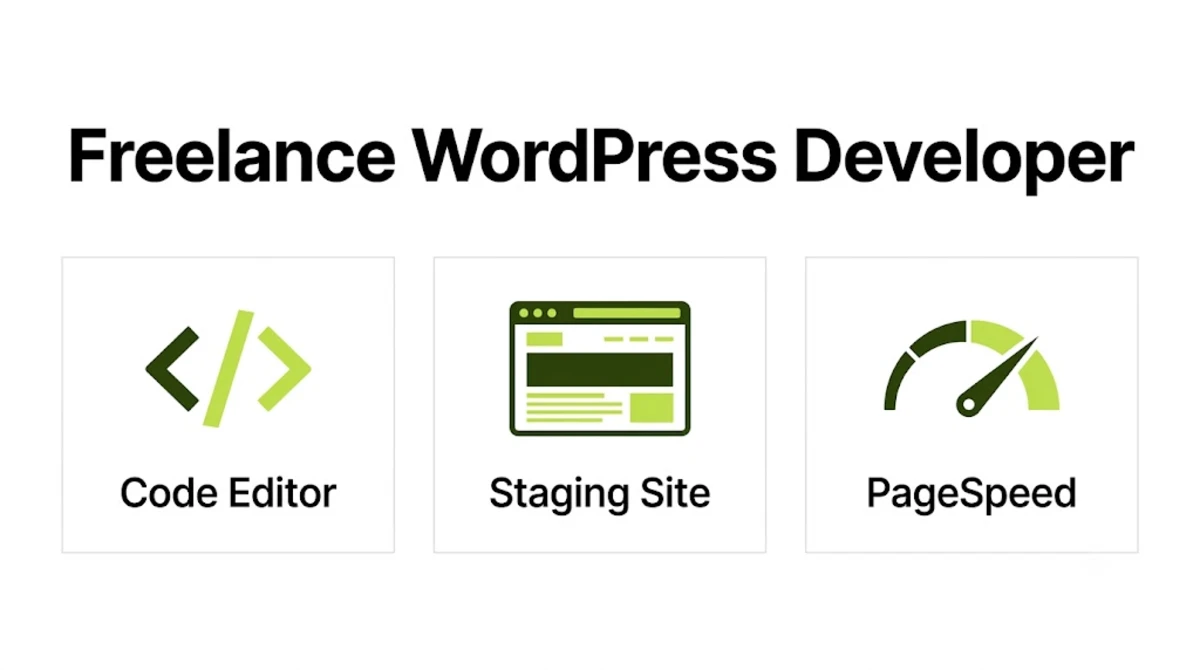
- A freelance WordPress developer builds, fixes, and speeds up WordPress sites, working directly with you rather than through a manager.
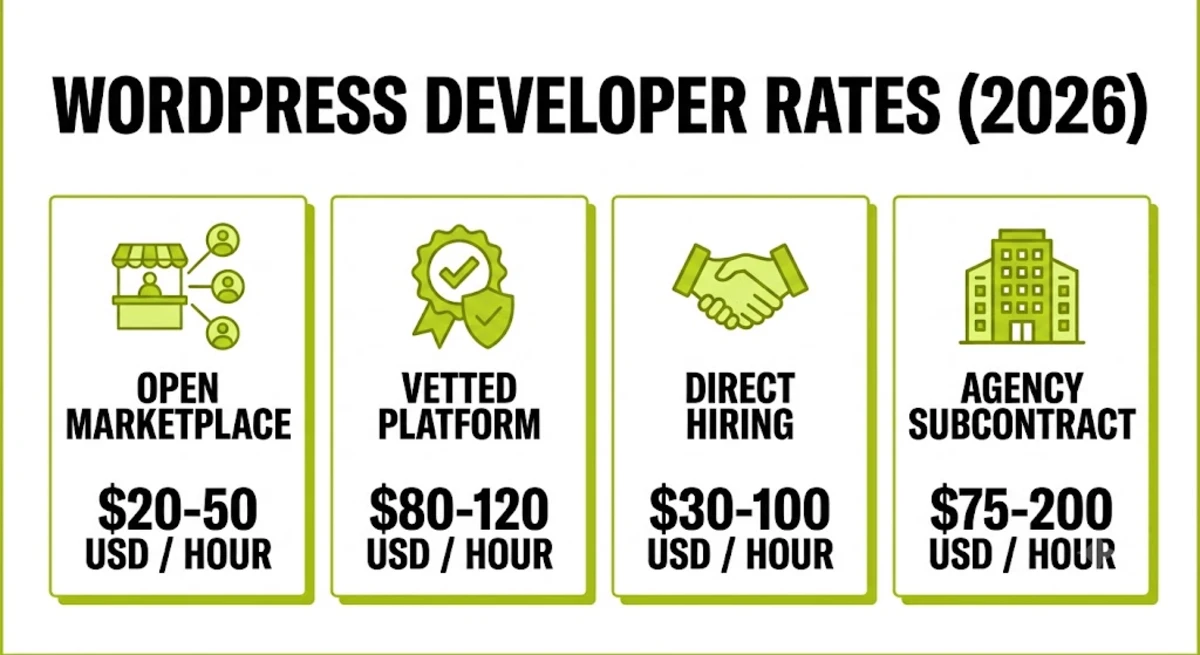
- The same work costs 20 to 120 dollars an hour depending on where you hire, not on skill.
- Codeable guides its experts to 80 to 120 dollars, while Upwork lists 20 to 35.
- Solo hiring has five real gaps. Each one has a clause or a habit that closes it.
- Write a six-line brief before you contact anyone. It changes the quotes you get back.
A freelance WordPress developer builds, customises, fixes, and speeds up WordPress sites as an independent contractor rather than an agency employee. Most handle themes, plugins, WooCommerce, performance, and technical SEO. You work with them directly. Rates run from 20 to 120 dollars an hour in 2026, and the channel you hire through moves that number more than skill does.
I have worked as a freelance WordPress developer for seven years. In that time I have delivered 250+ projects to clients in 15+ countries. Therefore this guide includes the part my own marketing pages leave out. Specifically, the five things a solo developer cannot cover, and what to put in writing to close each one. Read the honest version first, before you hire anyone, including me.
What a Freelance WordPress Developer Actually Does
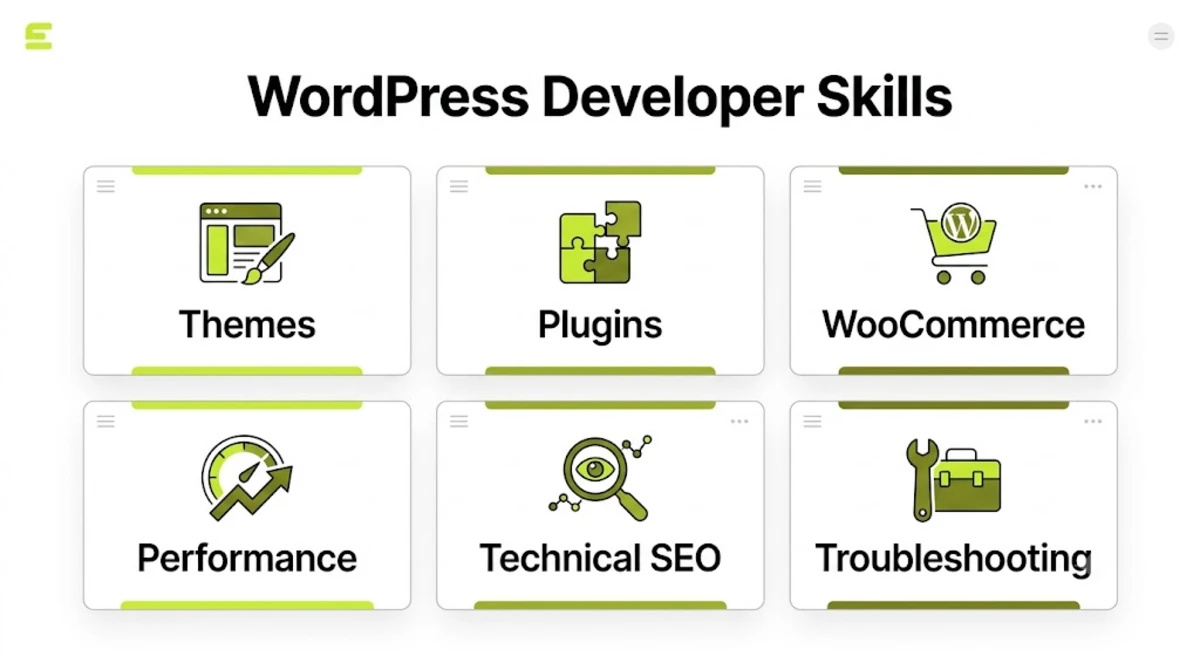
A freelance WordPress developer writes the code, configures the stack, and fixes what breaks. Specifically, the role usually covers six things: custom theme work, plugin development or customisation, WooCommerce setup, performance and Core Web Vitals, technical SEO, and troubleshooting. Some also design. However, many do not, and the good ones say so upfront.
However, the title covers a wide skill range. One freelance WordPress developer installs a theme and fills in content. Another writes custom plugins, tunes database queries, and rebuilds a failing checkout. Nevertheless, both use the same job title. Therefore the useful question is never “are you a WordPress developer” but “which of these six areas is your deepest”.
Pro tip: Ask any freelance WordPress developer which of the six areas they would turn down. For example, a specialist names one or two without hesitation. Someone who claims all six equally is describing an ambition, not a track record.
That range also explains the strangest number in this market, which is what the same work costs.
The Channel Premium: Why the Same Work Costs 20 or 120 Dollars an Hour
Where you hire a freelance WordPress developer changes the price more than who you hire. Upwork states that WordPress developers on its platform can earn 20 to 35 dollars an hour. Meanwhile Codeable guides its experts to 80 to 120 dollars an hour, then adds a 17.5 percent platform fee on top. That is the same job, on the same CMS, at a three to five times spread.
However, the gap is not a quality gap. Instead, it is a selection gap. First, open marketplaces let anyone bid. Price competition then pulls rates down, and clients sort through hundreds of profiles themselves. Meanwhile vetted platforms screen applicants first, remove the bidding war, and charge for that filtering. Consequently you are paying for who was allowed to quote, not for better code.
| Channel | Typical rate | What it selects for | Who it suits |
|---|---|---|---|
| Open marketplace (Upwork, Fiverr, Freelancer) | 20 to 50 USD | Availability and price | Buyers willing to vet themselves |
| Vetted platform (Codeable) | 80 to 120 USD plus 17.5% fee | Screening and dispute cover | Buyers paying to skip the vetting |
| Elite network (Toptal) | 80 to 150 USD plus | Enterprise process | Large budgets and long engagements |
| Direct from the developer’s own site | 30 to 100 USD | Whatever you verify yourself | Buyers who can judge the work |
| Agency subcontract | 75 to 200 USD billed on | Coordination and cover | Multi-discipline projects |
What most guides get wrong: they treat rate as a proxy for skill. In reality, it is mostly a proxy for the channel and its fee structure. The same freelance WordPress developer can appear at 35 dollars on a marketplace and 90 through a vetted platform. Meanwhile the platform sets the floor and takes a cut.
Think of it like buying the same bottle in a supermarket, a wine shop, and a restaurant. The liquid does not change. Instead, what changes is who chose the shelf, and what that curation costs you.
Which leaves the practical question of what you should actually budget.
What Freelance WordPress Developers Cost in 2026
First, budget 50 to 100 dollars an hour for an experienced freelance WordPress developer working directly, or 20 to 50 through an open marketplace. For context, ZipRecruiter puts the average US salaried WordPress developer at 84,542 dollars a year, roughly 40.65 an hour before benefits and payroll costs.
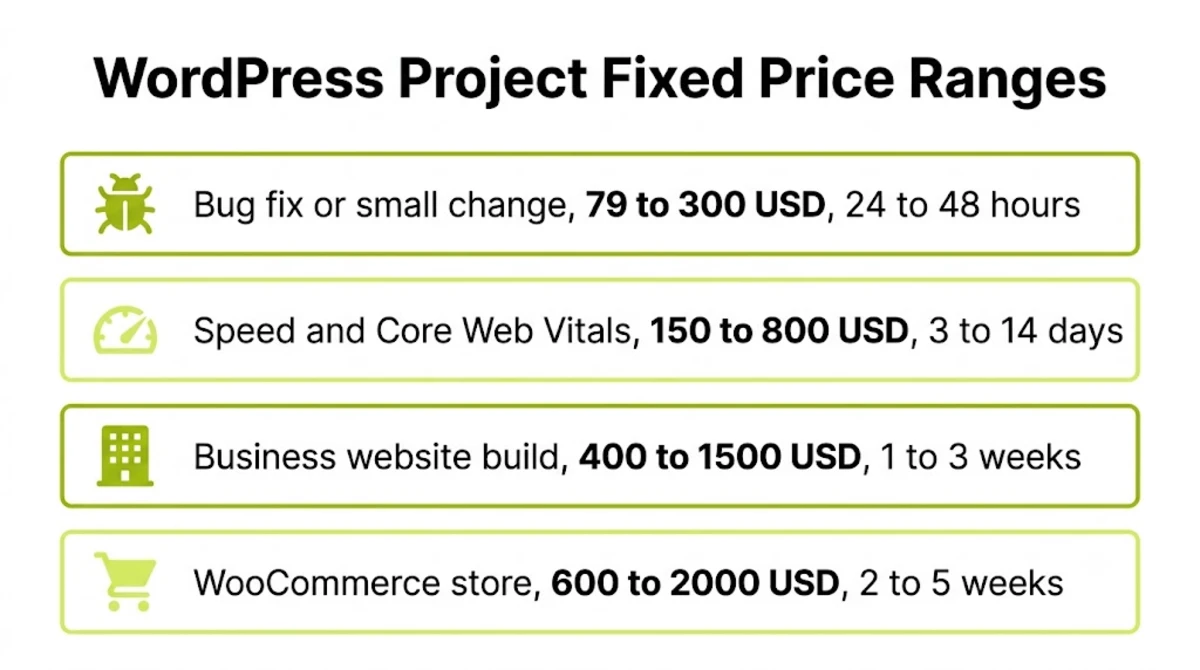
Fixed pricing is usually the better instrument, since it moves estimation risk onto the person best placed to manage it. My own published pricing starts at 79 dollars for a scoped bug fix. It runs to 4,999 for a custom theme build. In addition, maintenance retainers start at 49 a month. Furthermore, ranges like that beat an hourly number, because they tell you what a finished outcome costs.
| Work type | Typical fixed price | Typical timeline |
|---|---|---|
| Bug fix or small change | 79 to 300 USD | 24 to 48 hours |
| Speed and Core Web Vitals pass | 150 to 800 USD | 3 to 14 days |
| Business website build | 400 to 1,500 USD | 1 to 3 weeks |
| WooCommerce store | 600 to 2,000 USD | 2 to 5 weeks |
| Custom theme or plugin | 1,500 to 6,000 USD | 3 to 6 weeks |
Pro tip: Ask for the fixed price and the assumptions behind it, in the same message. The assumptions are the real quote. For example, a developer who lists what they expect to find is estimating. One who gives a number with no conditions is guessing.
Price aside, the job itself changed this year in ways worth knowing before you brief anyone.
What Changed in 2026 and Why It Affects Your Brief
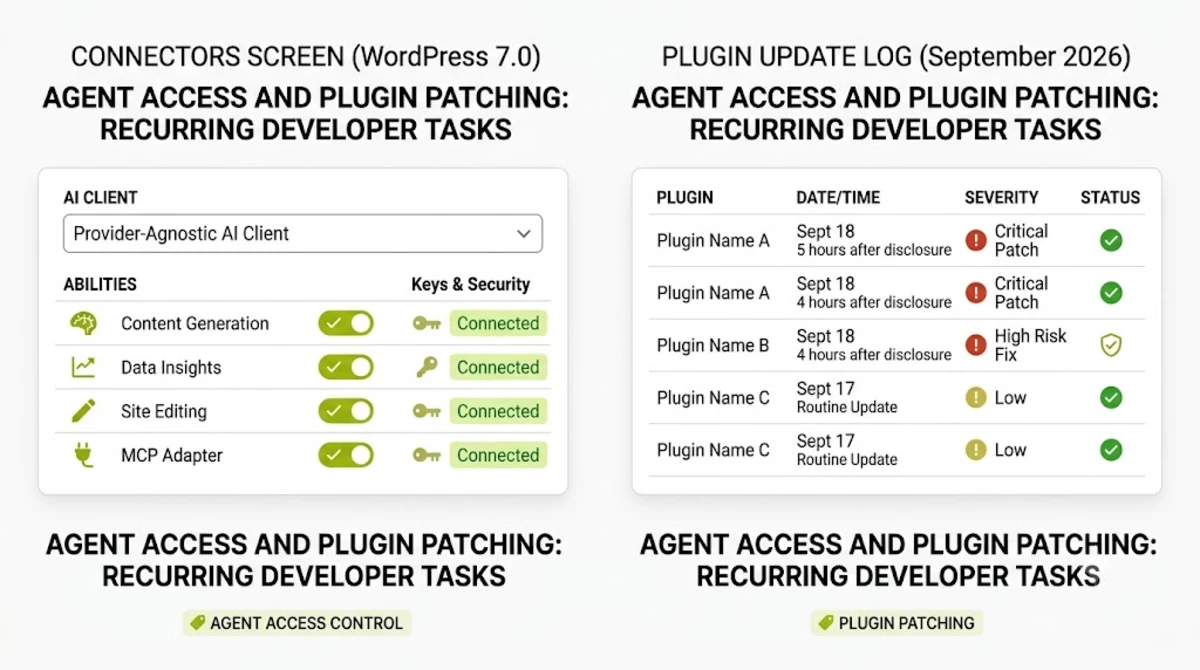
Two changes reshaped what a competent freelance WordPress developer needs to handle, and both create ongoing work rather than one-off tasks.
First, agents can now act on your site through defined abilities. Initially, that speeds up routine building. However, it creates a review job. Someone has to hold the Connectors keys, decide which abilities stay open, then check what the agent shipped. Therefore ask any freelance WordPress developer how they handle this. A blank look in September 2026 is a real signal.
Second, plugin risk grew sharply. Patchstack recorded 11,334 new WordPress vulnerabilities during 2025, up 42 percent, with 91 percent of them in plugins. The median time from public disclosure to mass attack was five hours. As a result, the plugin list your developer proposes is a security decision, not a convenience one.
Consequently both changes push toward ongoing support, which is exactly where solo hiring gets tested.
The Solo Coverage Check: 5 Gaps and How to Close Them
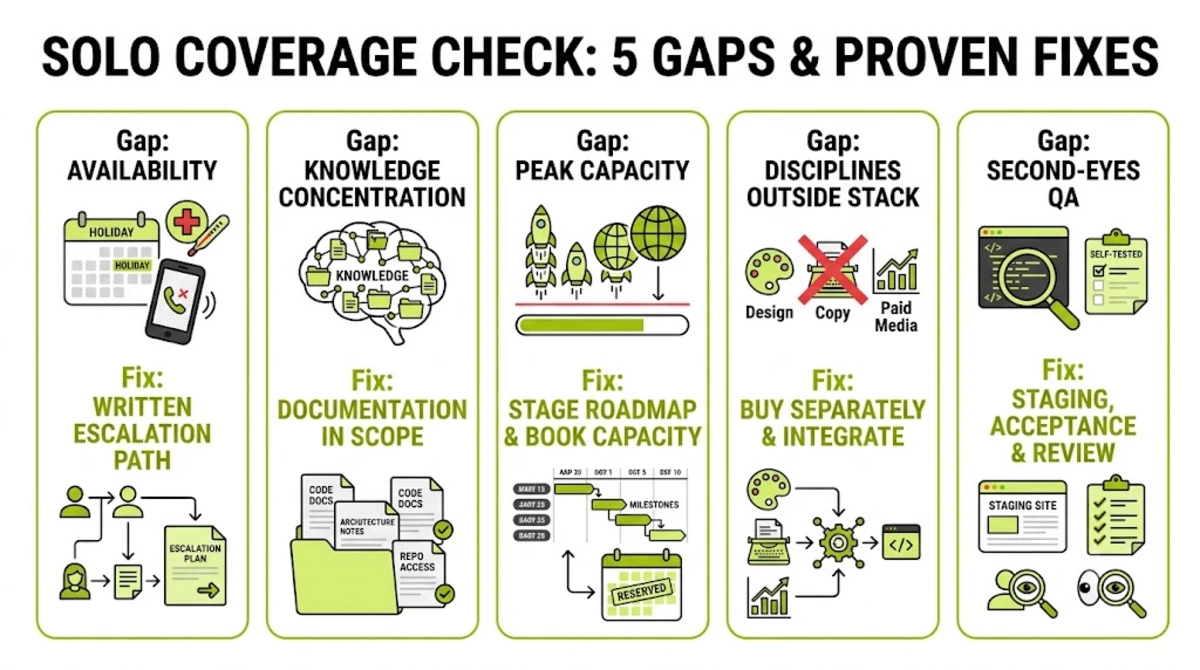
Here is the section my own service pages do not run. A single freelance WordPress developer has five structural gaps that an agency covers by default. However, none of them is a dealbreaker. However, all of them get worse when nobody names them before the contract. So run this check on any solo hire.
1. Availability when one person is unavailable
Holidays happen. Similarly, illness happens, and so do other clients. Furthermore, one person cannot answer at 2 a.m. on a Sunday and also be sharp on Monday. The fix: agree an escalation path in writing. Name a backup developer, or agree a response window you both accept. Alternatively, set up a separate emergency support arrangement for real outages. In short, vague availability promises fail exactly when you need them.
2. Knowledge sitting in one head
By design, solo work concentrates context. Consequently, if the relationship ends, the reasoning behind every custom function leaves with it. The fix: put documentation in the scope rather than hoping for goodwill. Specifically, ask for commented code, a short architecture note, and the repository in your own account. Furthermore, request a written summary each month on retainers. Ten minutes of notes beats a forensic audit later.
3. Peak capacity
A freelance WordPress developer cannot parallelise. As a result, three simultaneous launches will queue, no matter how good they are. The fix: stage the roadmap and book capacity ahead of your busy season. Alternatively, split non-overlapping work across two freelancers, provided the boundaries are clear. Indeed, agencies sell exactly this, and it is a fair reason to pay their premium.
4. Disciplines outside the stack
In short, development is not brand design, copywriting, or paid media. Although some freelancers do two of those well, almost nobody does all four. The fix: buy those separately and let the developer integrate the output. In practice, asking a developer to write your positioning produces filler, and you will pay twice when a copywriter rewrites it later.
5. Second-pair-of-eyes QA
Typically, agencies run a separate QA pass by default. Meanwhile solo developers test their own work, which misses what they were not looking for. The fix: require a staging environment, write your own acceptance criteria before work starts, and test on real devices yourself. In addition, on critical builds, pay a second developer for a two-hour code review. It costs little and catches the expensive things.
Finally, close all five and solo hiring works well. Sometimes, though, it is simply the wrong shape for the job.
Already working with a freelancer and something has broken?
Inherited sites are most of my work, including undocumented custom code, plugin conflicts, and builds where the original developer has gone quiet. See how WordPress bug fixing works.
When a Freelance WordPress Developer Is the Wrong Choice
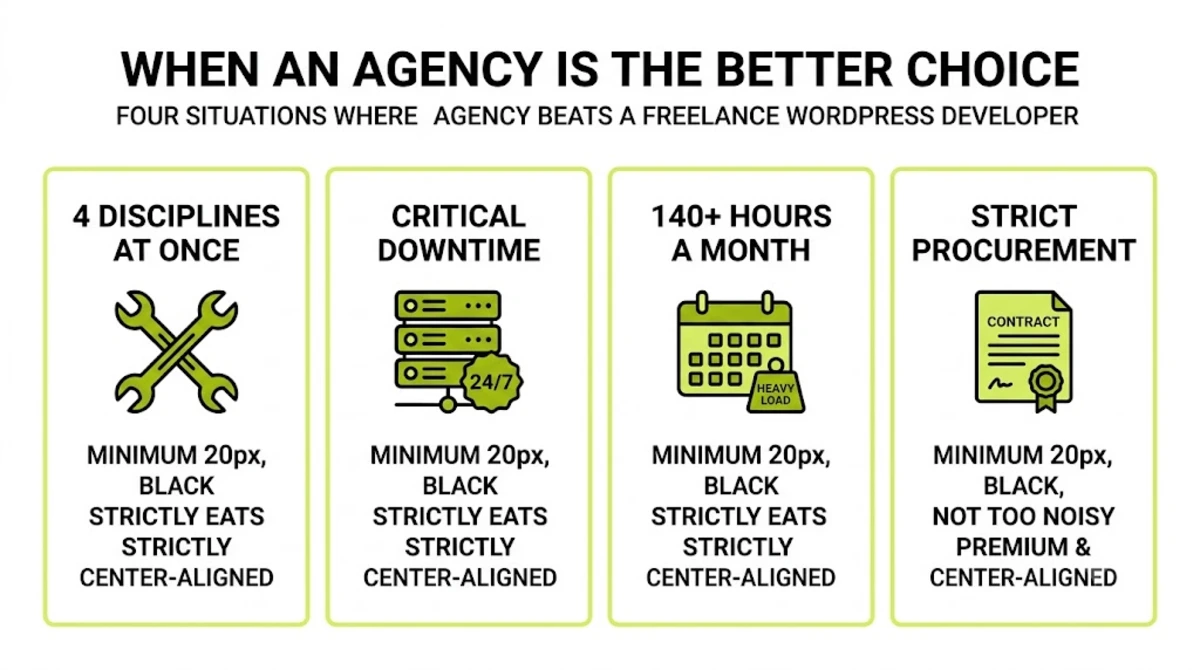
However, four situations genuinely call for an agency or an in-house hire instead, and pretending otherwise wastes everyone’s time.
- You need four disciplines at once. Brand, copy, paid media, and development on one deadline need coordination. Therefore one person cannot provide it.
- Downtime costs more than the fee. If an hour offline costs thousands, buy rostered cover rather than one person’s best intentions.
- The work is continuous at 140 hours a month or more. At that volume, sustained across two quarters, run the numbers on an employee.
- Procurement requires it. Some enterprises need vendor insurance, formal SLAs, and a legal entity that outlives one person. That is a real constraint, not snobbery.
Outside those four, a freelance WordPress developer usually wins on speed and cost. After all, the person judging the work is the person doing it. Meanwhile agencies add a project manager layer that helps on complex programmes, although it slows down simple ones. For agencies that need capacity without the hire, white-label development solves the same problem from the other direction.
If a freelancer still fits, the brief decides how well the project goes.
How to Brief a Freelance WordPress Developer So the Project Lands
In practice, most bad quotes come from bad briefs. Because a developer who cannot see the shape of the work prices in uncertainty, so vague requests cost you money before anyone writes a line of code. Therefore six lines fix that, and they take about ten minutes to write.
- The outcome in one sentence. “Checkout must stop failing on mobile Safari” beats “improve the store”.
- The URL and the access you can provide. Staging, admin, hosting, repository. Say what you have and what you cannot give.
- The hard deadline and why it exists. A real date with a reason gets planned around. An invented one gets padded.
- Your budget ceiling. Withholding it does not get you a lower price. It gets you a scope you cannot afford.
- What done looks like. Write the acceptance test now: “passes Core Web Vitals on mobile in PageSpeed field data”.
- Who decides. Name the approver. Projects stall on invisible stakeholders more often than on technical problems.
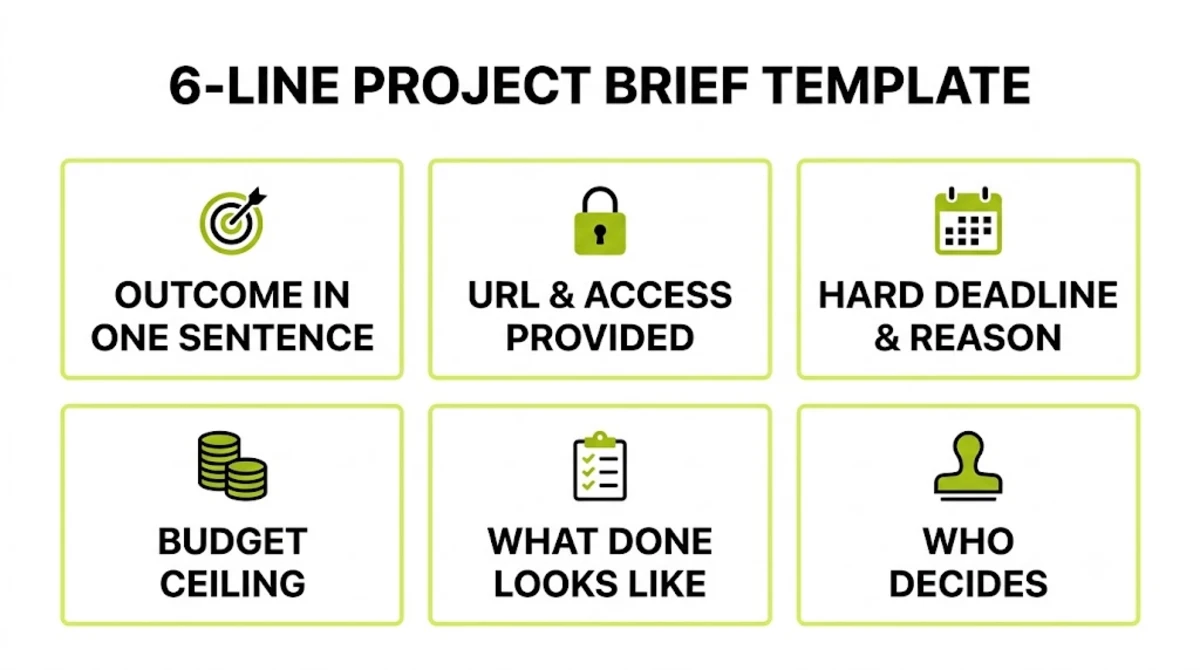
Finally, send that brief to three freelance WordPress developers, and the replies sort themselves. Specifically, one will ask sharper questions than the others, and that is usually your answer.
Want a second opinion on a freelancer you are about to hire?
Send me the shortlist and the site URL. You will get a straight read on the proposal and the gaps worth closing, whether or not you hire me. Send the details here or message me on WhatsApp.
Frequently Asked Questions
What does a freelance WordPress developer do?
They build and customise WordPress sites as independent contractors. The work usually covers custom themes, plugin development, WooCommerce setup, speed and Core Web Vitals, technical SEO, and troubleshooting. You deal with them directly, so the person who scopes the job is the person who writes the code.
How much does a freelance WordPress developer cost?
Between 20 and 120 dollars an hour in 2026, depending mostly on the channel. Open marketplaces list 20 to 50, vetted platforms guide to 80 to 120 plus fees, and direct hiring usually sits between. Fixed prices are more useful: 79 to 300 for a small fix, 400 to 2,000 for a build.
Where do I find a good freelance WordPress developer?
Upwork offers the widest pool and escrow protection but leaves the vetting to you. Codeable pre-screens WordPress specialists at a higher price point. Toptal suits enterprise budgets. Hiring direct removes platform fees and gives continuity, provided you can judge the work yourself.
Is a freelance WordPress developer cheaper than an agency?
Usually yes, because there is no project manager layer or agency overhead in the rate. Agencies earn their premium on multi-discipline programmes and rostered cover. For a defined technical brief, a freelance WordPress developer is generally faster and cheaper for the same output.
What can a freelance WordPress developer not do?
Five things structurally: guarantee cover when unavailable, parallelise simultaneous launches, supply brand design and copy and paid media alongside development, run an independent QA pass, or satisfy procurement rules that demand a larger vendor. Each gap has a fix, but only if you name it before signing.
Should I pay hourly or a fixed price?
Choose fixed price when the scope is clear, because the developer then carries the estimation risk. Hourly when the work is exploratory, such as diagnosing an unknown bug or ongoing small changes. Ask for the assumptions behind any fixed quote, because those assumptions are where change requests come from.
How do I brief a freelance WordPress developer?
Six lines: the outcome in one sentence, the URL and access you can give, the hard deadline and why, your budget ceiling, what done looks like as a test, and who approves. Send the same brief to three developers. The sharpest questions usually identify the right hire.
What happens if my freelance developer disappears?
Recovery depends entirely on what you hold, so prepare before anything goes wrong. With the repository, hosting, and licences in your own accounts plus commented code, another developer can pick it up in days. Without them, expect a forensic audit first. Settle ownership at the start, never during the problem.
Do I own the code a freelance developer writes?
Only if the contract says so. Default copyright rules vary by country, and many freelance agreements are silent on it. State that ownership transfers on final payment, and confirm any third-party or open-source components separately, since GPL-licensed plugin code carries its own terms.
Can a freelance WordPress developer handle a large WooCommerce build?
Yes, provided the timeline reflects one person’s throughput and the brief is technical rather than multi-disciplinary. In practice, large stores fail on checkout logic, caching exceptions, and payment edge cases, which are specialist problems rather than headcount problems. Confirm specific WooCommerce experience, not general WordPress experience.
When should I hire a freelance WordPress developer instead of an agency?
When the brief is technical and defined, the budget matters, and you want direct access to whoever writes the code. Choose an agency when four disciplines must run in parallel, downtime is critical, or procurement demands it. For scoped work, see WordPress development services.
Conclusion
A freelance WordPress developer is the right hire when the brief is technical, the budget matters, and you want the coder on the call. Three things decide how it goes. The channel sets your rate more than skill does, so choose it deliberately. The five solo gaps are real, and each closes with a clause rather than extra spend. A six-line brief improves every quote you receive. Write that brief this week, send it to three freelance WordPress developers, and hire the one who asks the sharpest questions back.
You have the brief. Here is the fastest way to use it.
I am a freelance WordPress developer, Top Rated on Upwork with a 100 percent job success score and 250+ projects delivered across 15+ countries. Send the six lines and your URL, and you will get a fixed-price scope, a timeline, and the assumptions behind both within 48 hours.
Book a free call
This article was last reviewed and updated in {{UPDATED}} to reflect current freelance WordPress developer rates, WordPress 7.0 changes, and hiring best practices.