
A law firm website redesign should make the site faster, clearer and easier to contact you through, without throwing away the rankings and links the old site earned. The design is the easy part. The redesigns that hurt firms are the ones where old URLs disappear, practice area content gets trimmed to “look cleaner”, and nobody checks Search Console for a month after launch.
This is how I approach a law firm redesign so the new site performs better from day one, plus the signs you actually need one and what it should cost.
Signs your law firm website needs a redesign
- It is slow on a phone. If the main content takes more than a few seconds to appear on mobile, you are losing people who searched for a lawyer in a hurry.
- Practice areas share one page. A single page listing every service rarely ranks for any of them.
- Attorney bios are thin. A photo and two lines do not build trust or show expertise.
- You cannot edit it yourself, or every change goes through a vendor ticket.
- You do not own it. Many legal marketing packages lease you the site. Stop paying and the site, and sometimes the domain, stays with them.
- The intake form is buried or broken, and you cannot tell how many leads the site produces.
- It looks dated next to the firms you compete with, which matters when a prospective client is comparing three firms side by side.
Refresh or full redesign?
Not every tired site needs a rebuild. If the structure is sound, practice areas have their own pages and the site is reasonably fast, a refresh can be enough: new design system, better photos, tightened copy, improved forms and a speed pass. A full redesign makes sense when the structure itself is the problem, when you are moving off a leased or proprietary platform, or when the theme is so heavy that speeding it up costs more than rebuilding.
How to redesign without losing rankings
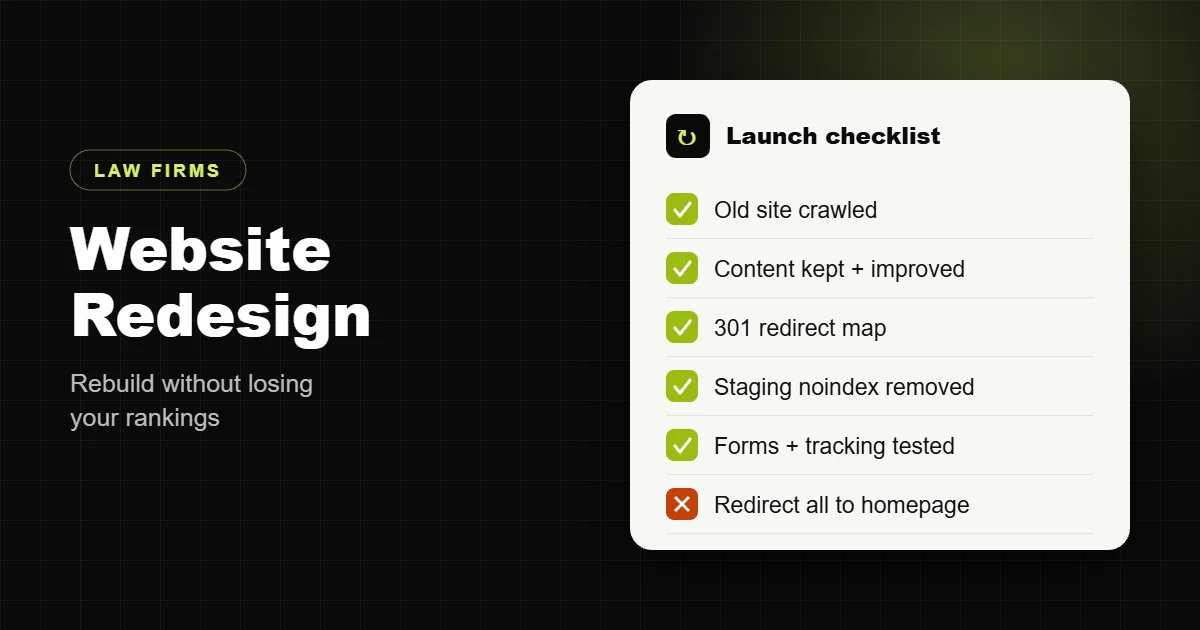
- Crawl the current site. Export every URL, title, meta description and H1. This is your inventory.
- Benchmark performance. Pull the last 12 months of pages and queries from Search Console and Analytics, plus your Core Web Vitals and monthly lead count. You need a before picture to prove the after.
- Decide what stays. Any page with rankings, traffic or links keeps its content, improved rather than cut. Thin pages can be merged into stronger ones.
- Keep URLs where you can. If the structure changes, build a one-to-one redirect map from every old URL to its closest new page. No mass redirects to the homepage.
- Build on staging and block indexing there. Then remember to remove that block at launch. A surprising number of redesigns go live still telling Google not to index them.
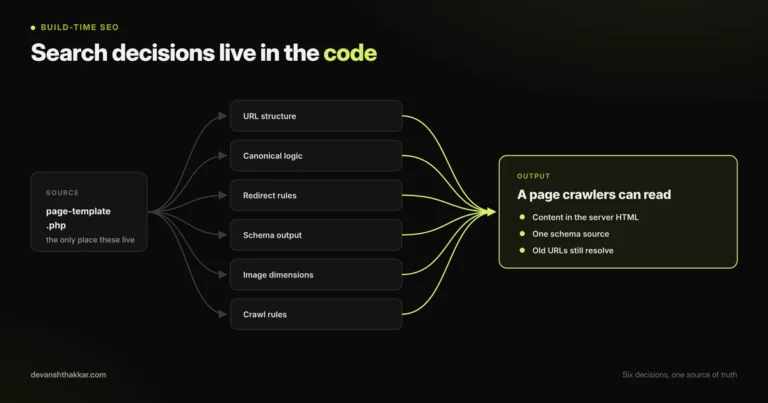
- Carry over the technical setup: titles, meta descriptions, schema for the firm and attorneys, canonical tags, analytics, conversion tracking and Search Console verification.
- Launch, then check immediately: redirects resolve with one hop, forms deliver, the sitemap is submitted, robots.txt allows crawling, and key pages are requested for indexing.
- Monitor for four to eight weeks. Watch Search Console for crawl errors and 404s, compare rankings and leads with the benchmark, and fix anything that slipped.
Some ranking movement in the first couple of weeks is normal while Google recrawls. A site that keeps its content and redirects properly usually settles at or above where it was.
What to improve while you are at it
- Structure: one page per practice area and per location you genuinely serve, each with its own consultation call to action.
- Attorney bios with bar admissions, education, practice focus and Person schema. My guide to law firm schema markup has a copy-ready example.
- Speed: a lean theme, compressed images, properly configured caching and passing Core Web Vitals on mobile.
- Intake: a short, tested form on every practice page and tap-to-call on mobile. See law firm website intake forms.
- Accessibility: contrast, labels, keyboard navigation and headings built to WCAG 2.1 AA. See law firm website ADA compliance.
- Ownership: the site, hosting account and domain in your firm’s name, with admin access you control.
How long a law firm redesign takes
Design and build are rarely what slows a project down. Content is. Practice area pages and attorney bios need attorney review, and that review is usually the longest stage. If the content is ready or mostly carried over, a solo or small firm redesign can move quickly. If every page is being rewritten, plan for the review rounds.
What a redesign costs
Prices across the market vary widely, from a few thousand dollars with a freelancer to five figures with a legal marketing agency, often on top of a monthly fee. I go through the full range and the hidden costs in my guide to law firm website cost.
With me, a complete law firm website redesign is $1,999, fixed: new design, every practice area and attorney page, legal pages, SEO carried over and improved, redirects, a tested intake form and one month of support after launch. You own the site. See what is included on my law firm website development page.
Thinking about a redesign? Send me your current site and I will tell you whether it needs a rebuild or just a refresh, and what I would keep.
Frequently asked questions
How do I know if my law firm website needs a redesign?
Common signs are slow mobile load times, one page covering every practice area, thin attorney bios, a buried or broken intake form, a site you cannot edit yourself, or a leased site you do not own.
Will a website redesign hurt my law firm’s rankings?
It can if old URLs disappear or content is cut. Keeping content, mapping every old URL to a new one with 301 redirects and monitoring Search Console after launch prevents most losses.
Should I refresh or fully redesign my law firm website?
Refresh if the structure is sound and the site is reasonably fast. Redesign if the structure is the problem, the theme is too heavy to fix, or you are moving off a leased platform.
What is a redirect map?
A list that pairs every old URL with its closest new page, used to set up 301 redirects so visitors and search engines land in the right place after launch.
How long does a law firm website redesign take?
It depends mostly on content. Attorney review of practice area pages and bios is usually the longest stage, not design or development.
How much does a law firm website redesign cost?
Market prices range from a few thousand dollars to five figures plus monthly fees. With Devansh Thakkar it is $1,999 fixed for a complete site with one month of support.
Can I keep my domain when I redesign?
Yes, and you should. Make sure the domain is registered in your firm’s name and that you have access to the registrar account.
What happens to my old blog posts in a redesign?
Keep posts that rank, get traffic or have links, and update them. Merge thin or outdated posts into stronger ones and redirect the old URLs.
Should I switch platforms when redesigning?
Moving to WordPress makes sense if your current platform is proprietary or leased. It gives you ownership and full control over SEO, speed and content.
What should I check after my redesigned site goes live?
Redirects, form delivery, robots.txt, the XML sitemap, analytics and conversion tracking, and Search Console errors for the first several weeks.