
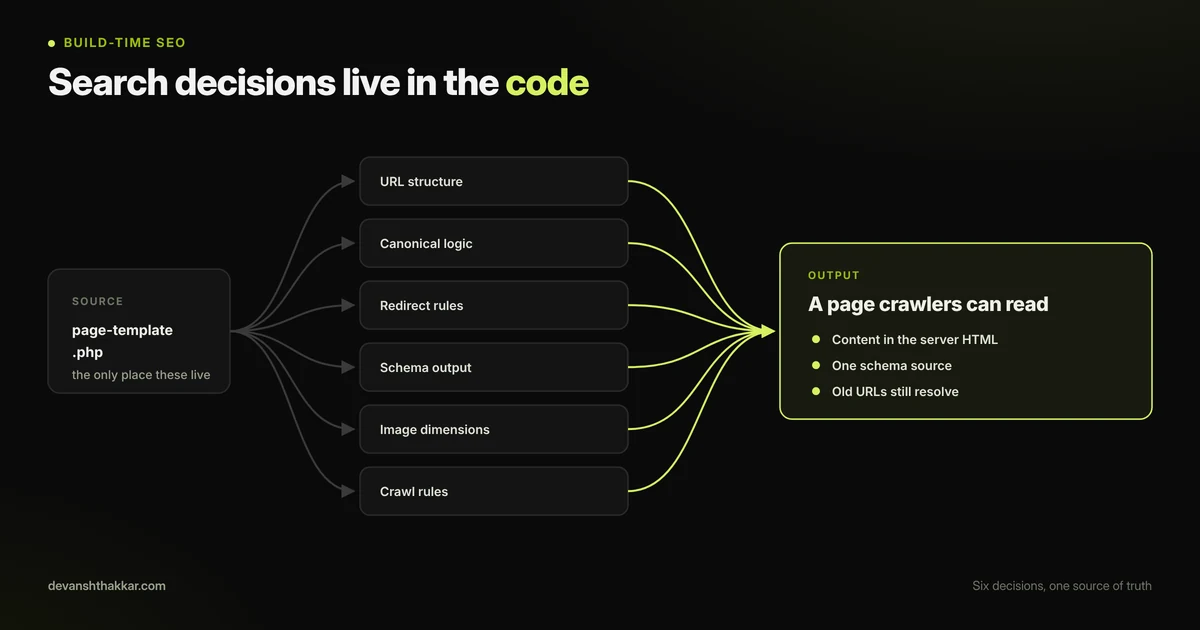
- An SEO web developer owns the search decisions that get built into code, not the keyword strategy.
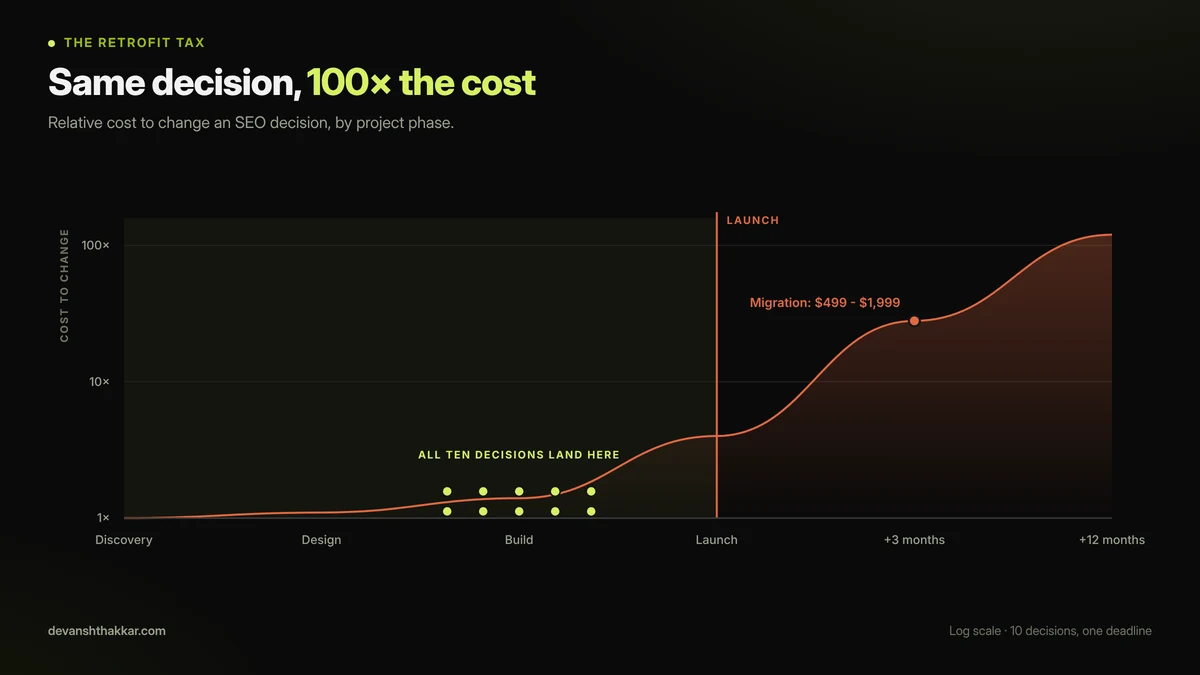
- Ten of those decisions cost almost nothing at build time and thousands to retrofit later.
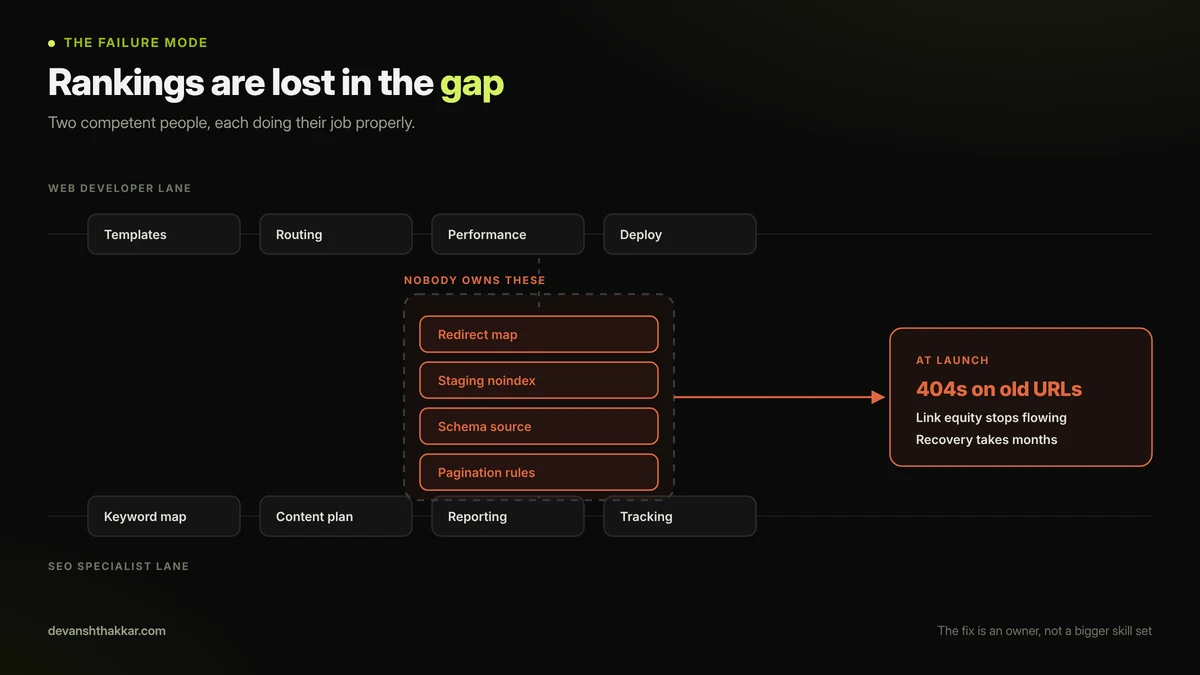
- Rankings are usually lost in the gap between developer and SEO, where nobody owns the redirect map.
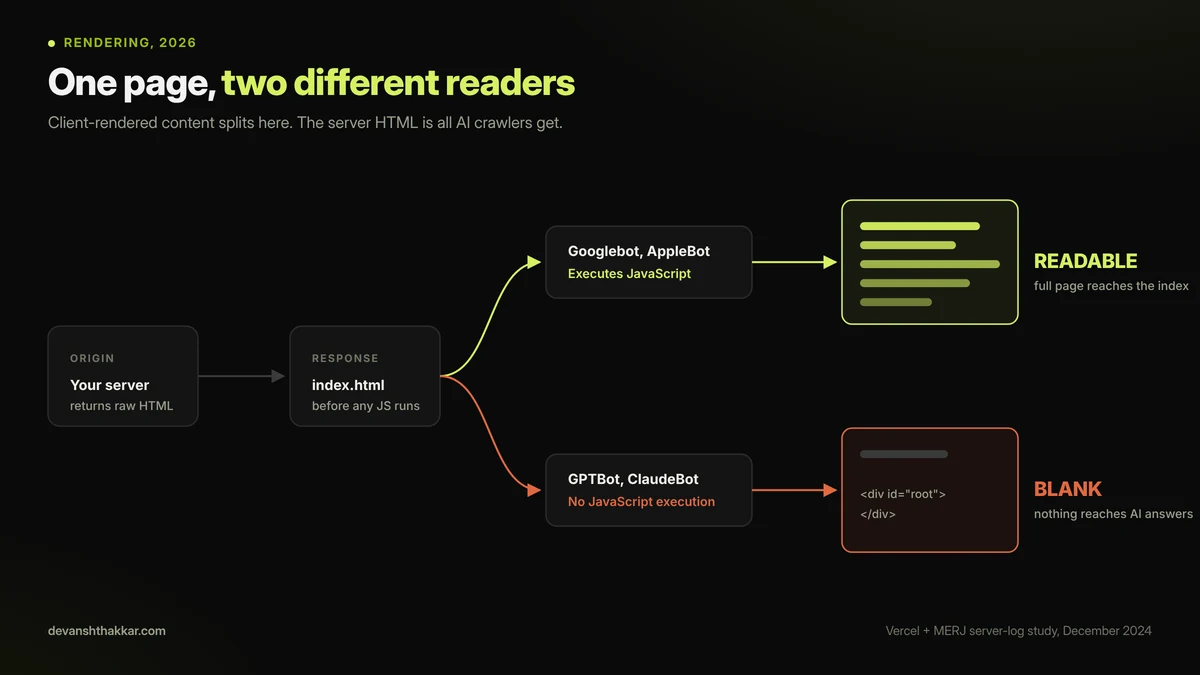
- AI crawlers do not run JavaScript, so rendering is now an engineering decision with two audiences.
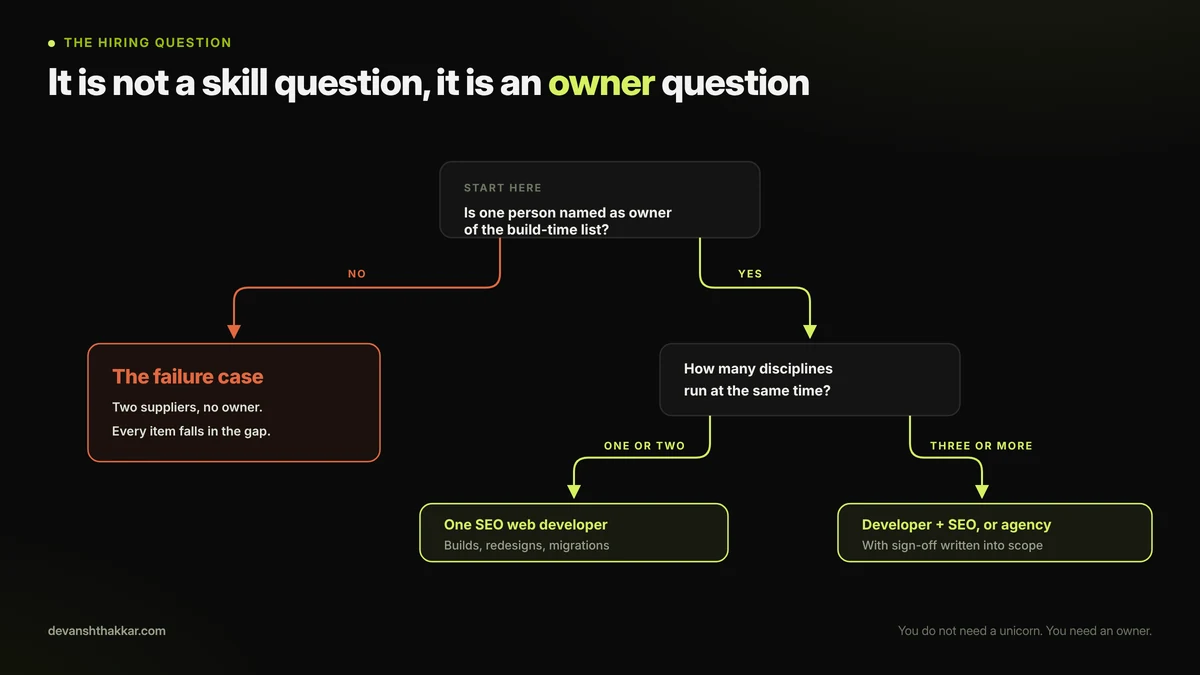
- You do not need one person with two titles. You need one named owner of the build-time list.
An SEO web developer builds search requirements into the code itself: URL structure, rendering, redirects, schema, Core Web Vitals, and crawl controls. They implement rather than strategise. Hiring one matters because roughly ten of those decisions are cheap during the build and expensive to change after launch.
Across 250+ projects, the most expensive problems I inherit are not bugs. They are decisions nobody made. A redesign ships, the old URLs return 404, and six months of rankings disappear. Nobody was careless. Instead, the developer assumed the SEO had a redirect map, and the SEO assumed the developer would carry the old URLs across. So this guide is about that gap, and the ten decisions that close it.
What an SEO Web Developer Actually Does
An SEO web developer writes the code that decides whether search engines can reach, render, and understand a site. Specifically, that covers URL and routing rules, rendering strategy, canonical logic, redirects, structured data in templates, pagination, image handling, and Core Web Vitals. In other words, an SEO web developer implements the technical half of SEO rather than deciding which keywords to target.
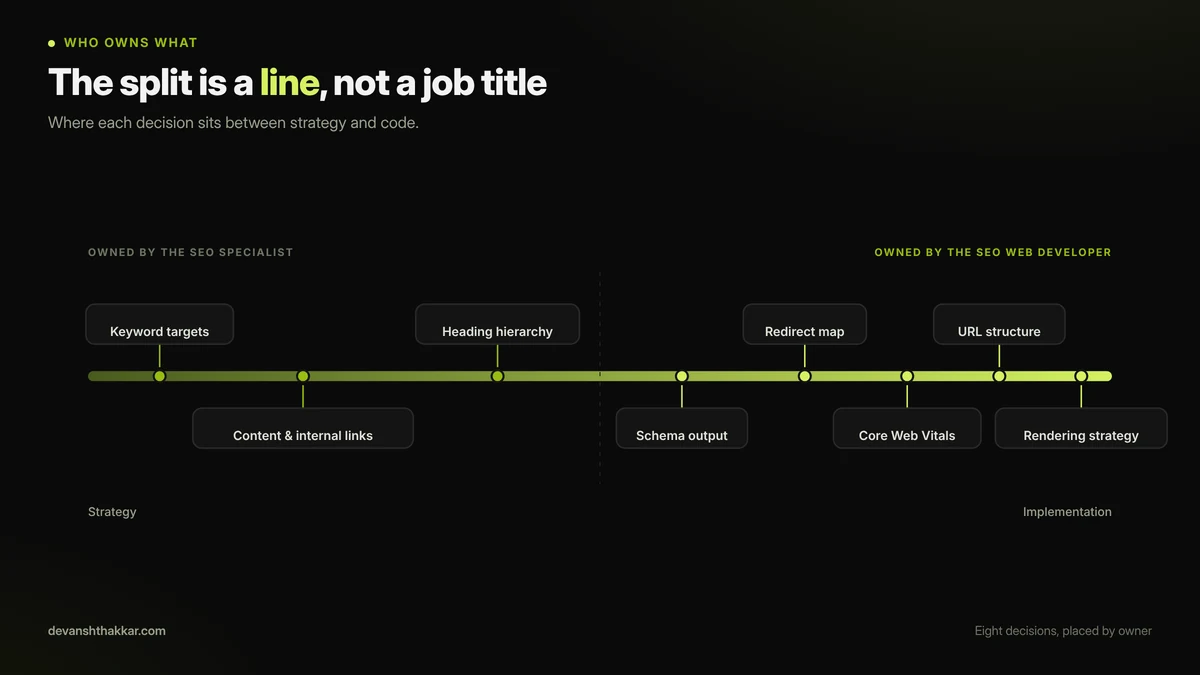
That distinction matters when you are hiring. An SEO specialist decides what should happen. By contrast, an SEO web developer makes it happen in code. Both roles are real, although they fail in different ways. Consequently the question is never which one is better, but which decisions each one owns.
| Decision | SEO specialist | SEO web developer |
|---|---|---|
| Which keywords to target | Owns | Advises |
| URL structure and routing | Advises | Owns |
| Rendering strategy | Rarely involved | Owns |
| Redirect map on a redesign | Advises | Owns |
| Schema output in templates | Advises | Owns |
| Core Web Vitals | Reports | Owns |
| Content and internal linking | Owns | Builds the structure |
Pro tip: Ask any candidate which column they live in. A good SEO web developer answers immediately and names the things they do not do. Anyone claiming both columns equally is usually weak in one of them.
Those two columns look tidy on a page. In practice, though, the damage happens between them, which is the part no SEO web developer job description covers.
The Handoff Gap: Where Rankings Actually Get Lost
What most guides get wrong: they tell you to hire someone with both skills. However, the failure is almost never a missing skill. It is a missing owner. Two competent people can lose a site’s rankings between them while each does their job properly. Hiring an SEO web developer helps only because it removes the seam.
Furthermore, the pattern repeats across rescue jobs. A redesign is scoped, the SEO sends a keyword map, and the developer builds beautiful templates. Launch day arrives. Then the old URLs 404, the staging noindex tag ships to production, schema appears twice because the plugin and the template both output it, and the new pagination creates thousands of thin URLs. Nobody did anything wrong. Equally, nobody owned the list.
Think of it like wiring a house. Running cable through an open wall costs very little. Running the same cable after the plaster is on means breaking walls, patching, and repainting. The cable did not get more expensive. The access did. That is the whole economic case for an SEO web developer on the build team.
Therefore the fix is not a unicorn hire. It is a named owner for a specific list, which is where the next section starts.
The Retrofit Tax: 10 Decisions With a Build-Time Deadline
I call this the retrofit tax: the difference between making a decision during the build and changing it after launch. Specifically, each item below is nearly free while the site is being built. Afterwards, each one becomes a scoped project with a price attached, and the prices below are my own published rates for exactly that work.
| # | Decision | Cost during build | Cost after launch |
|---|---|---|---|
| 1 | URL structure and routing | Included | $499 to $1,999 as a migration with redirects |
| 2 | Rendering strategy for search and AI crawlers | Included | Template rebuild |
| 3 | Redirect map for a redesign | A day of mapping | Months of lost rankings |
| 4 | Heading hierarchy in templates | Included | Per-template edits |
| 5 | Schema in the template, not a plugin | Included | $249 to $499 SEO implementation |
| 6 | Internal link architecture | Included | Content rewrite |
| 7 | Image pipeline and dimensions | Included | $299 to $799 Core Web Vitals work |
| 8 | Pagination and filtered URLs | Included | Index bloat that takes months to clear |
| 9 | Robots, sitemaps, and crawler rules | Minutes | Wasted crawl budget |
| 10 | Analytics, Search Console, staging noindex | Minutes | No baseline to measure against |
Two of these deserve a closer look, because they cause the most damage when an SEO web developer is not involved early.
Schema in the template rather than a plugin. Plugins generate schema from settings they cannot fully see. As a result, a template that also outputs schema produces two competing graphs on the same page. Therefore pick one owner. Then switch the other off.
The image pipeline. Dimensions, modern formats, and lazy-loading rules belong in the template, not in a plugin added later. WordPress 7.1, released on 19 August 2026, moved image resizing into the browser before upload, which changes what the pipeline has to handle on a site built before that date.
The staging noindex tag. Every staging site should block indexing. Equally, every launch checklist should remove that block. I have been called in twice for sites that lost all traffic after a successful launch, and the cause both times was a noindex tag that shipped to production.
Item two changed meaningfully this year, so it needs its own section.
What Changed in 2026: Two Crawlers, One Page
For years, rendering was a performance question. Now it decides whether half your potential audience can read the page at all, which makes it the clearest example of an engineering decision with a search consequence.
Here is the finding that matters. A server-log study by Vercel and MERJ, published in December 2024, found that none of the major AI crawlers execute JavaScript. They fetch script files and ignore them: JavaScript made up 11.50 percent of ChatGPT crawler requests and 23.84 percent of Claude’s, with no execution observed. No AI vendor has documented adding rendering since. Meanwhile Googlebot and AppleBot do render.
Consequently a page can rank perfectly in Google and be effectively blank to ChatGPT, Claude, and Perplexity. That is not a content problem. It is a rendering decision made by an SEO web developer or, more often, by a developer who was never asked about search.
Pro tip: Test any page in one command. Run curl -s https://example.com/page/ and read the output. Whatever text you see there is what a non-rendering AI crawler sees. If your prices, specifications, or main copy are missing, they are invisible in AI answers.
In addition, the same study found another number worth knowing. Roughly a third of AI crawler fetches ended in 404s, against 8.22 percent for Googlebot. In other words, stale sitemaps and broken internal links burn the attention these crawlers give you. Both are SEO web developer deliverables rather than content problems, and both sit on the retrofit list above.
WordPress shifts the balance here, since a standard PHP theme already renders on the server. Still, the common failure remains: content loaded by a builder widget, a tab script, or a lazy-loading plugin after the HTML arrives. For that reason, AI search optimisation starts with the same curl check rather than with content.
Given all of that, the hiring question becomes simpler than it looks.
One Hybrid Hire or Two Specialists?
Both work. However, only one arrangement consistently fails, and it is the one most businesses default into: two suppliers, no named owner for the retrofit list.
- One SEO web developer suits small and mid-size sites, new builds, redesigns, and migrations. Nothing falls between people, because there is no gap to fall into.
- A developer plus an SEO specialist fits larger programmes with content and link budgets. It works well, provided the list has one named owner and launch sign-off is written into the scope.
- An agency fits when design, copy, paid media, and development run together. Ask specifically who signs off the redirect map, because the project manager usually will not know.
Notice what decides it. In short, size and budget matter less than whether one person holds the list, which is why the honest answer to “do I need a hybrid” is usually no. You need an owner.
Planning a redesign or a migration right now?
This is the exact moment the retrofit list is cheapest to get right, and the exact moment it is most often skipped. See how WordPress SEO work runs.
What an SEO Web Developer Costs in 2026
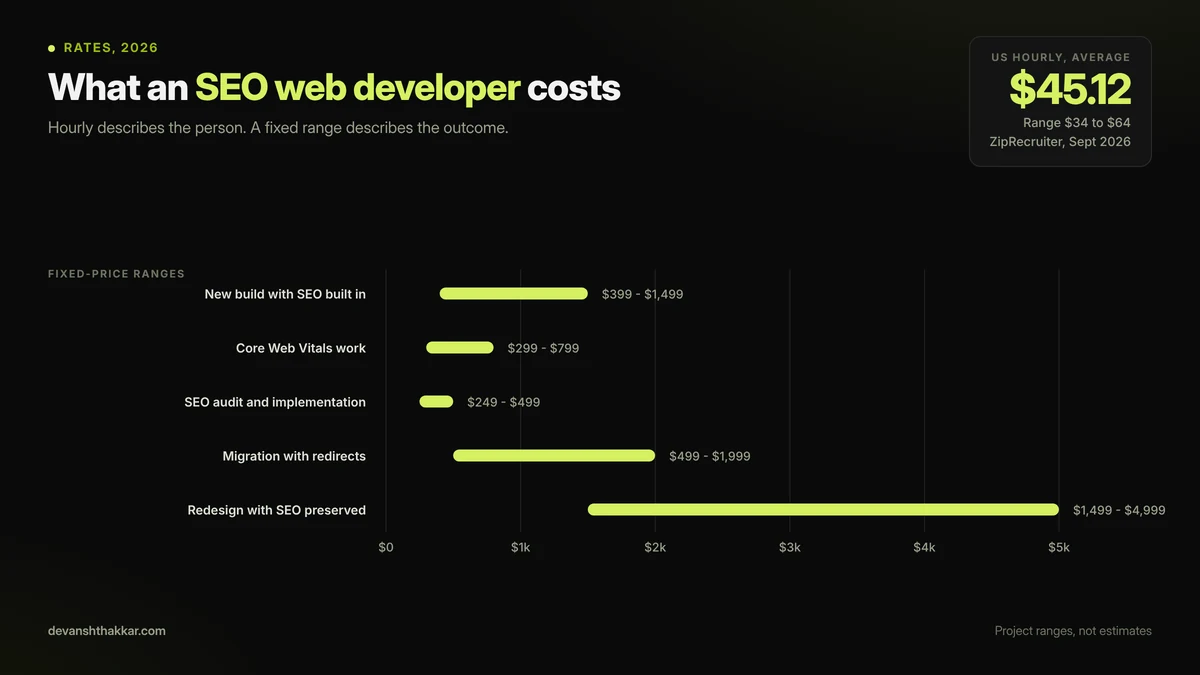
ZipRecruiter data from September 2026 puts the average US pay for an SEO web developer at $45.12 an hour, within a range of roughly $34 to $64. Meanwhile freelance rates run wider, because the SEO web developer title covers everything from a WordPress generalist to a rendering specialist.
Fixed pricing is more useful than an hourly number, since it prices the outcome. For reference, these are my own published rates for the work in the retrofit table.
| Work | Typical range | Timeline |
|---|---|---|
| SEO audit and implementation | $249 to $499 | 2 to 4 weeks |
| Core Web Vitals work | $299 to $799 | 1 to 2 weeks |
| Migration with redirects | $499 to $1,999 | 3 to 7 days |
| Redesign with SEO preserved | $1,499 to $4,999 | 3 to 6 weeks |
| New build with SEO built in | $399 to $1,499 | 1 to 2 weeks |
Read those two tables together and the economics become obvious. Building SEO into a $399 to $1,499 site costs nothing extra. By contrast, retrofitting the same decisions afterwards can cost more than the original build. Full pricing is published here rather than hidden behind a quote form.
Price settled, the remaining question is how to tell a real SEO web developer from a job title.
7 Questions to Ask Before You Hire One
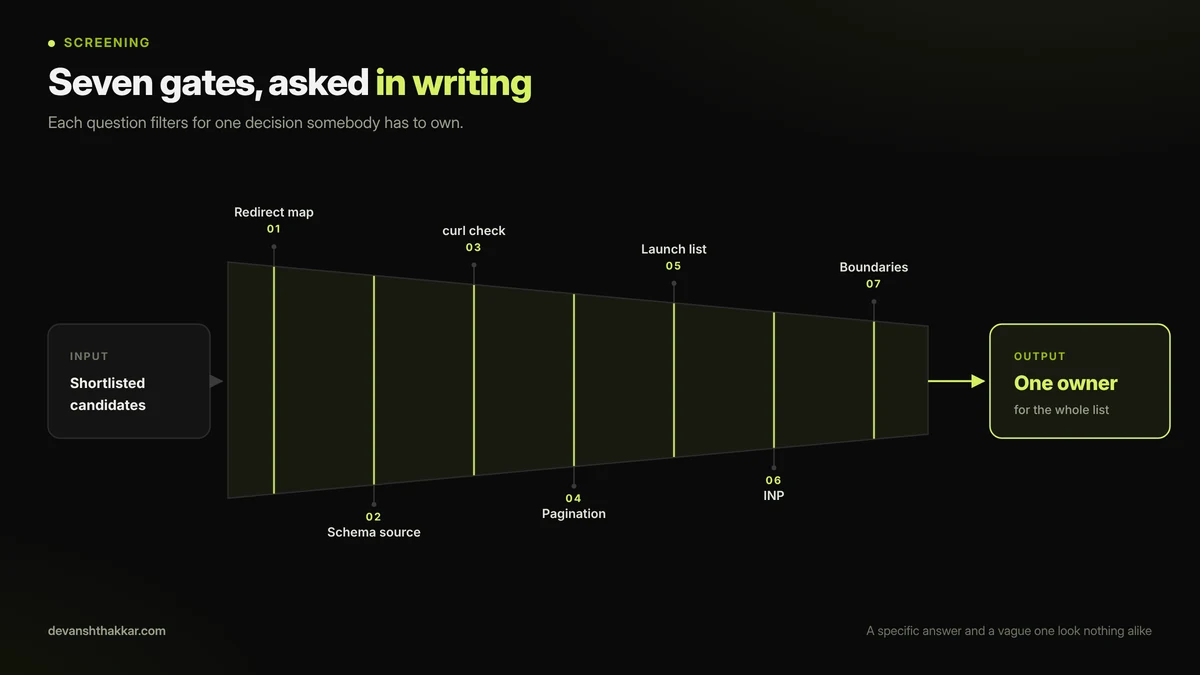
Ask these in writing. Notably, you do not need to judge the technical detail yourself, because a specific answer and a vague one look completely different on the page.
- “Who produces the redirect map, and when?” Expect a name and a stage, not reassurance.
- “Will schema come from the template or a plugin?” Expect one answer, plus how the other gets disabled.
- “What does curl return on a product page you built?” Expect them to know, or to offer to check.
- “How do you handle pagination and filtered URLs?” Expect canonical and crawl rules, not silence.
- “What is your launch-day checklist?” Expect indexability, redirects, and Search Console in the first three items.
- “Which Core Web Vital do WordPress sites usually fail, and why?” Expect INP, with a reason involving scripts.
- “What do you not do?” Expect content, link building, or strategy. An honest boundary is a good sign.
Before you brief any SEO web developer, though, it helps to know how exposed your own project already is.
Not sure what your current build is exposed to?
Send me the URL and I will run the curl check, look at your redirects, and tell you what is actually open, whether or not you hire me. Send the details here or message me on WhatsApp.
Frequently Asked Questions
What does an SEO web developer do?
They build search requirements into code: URL structure, rendering, canonical logic, redirects, schema in templates, pagination, image handling, and Core Web Vitals. In short, they implement the technical half of SEO. Keyword research, content, and link building sit with an SEO specialist instead, which is the clearest line between the two jobs.
What is the difference between an SEO specialist and an SEO web developer?
The specialist decides what should happen, while the developer makes it happen in code. A specialist produces keyword maps and content plans. A developer produces routing rules, redirects, structured data, and performance work. Problems usually appear in the gap between them, not inside either role.
How much does an SEO web developer cost?
ZipRecruiter put the US average at $45.12 an hour in September 2026, in a range of roughly $34 to $64. Fixed pricing is more useful for project work: SEO audit and implementation commonly runs $249 to $499, and a migration with redirects $499 to $1,999, depending on site size.
Do I need an SEO web developer or an SEO agency?
Choose a developer when the work is technical and tied to a build, redesign, or migration. Choose an agency when content, links, and paid media run alongside it. Either way, confirm in writing who owns the redirect map and the launch checklist, since that is where most damage occurs.
Can one person handle both development and SEO?
Yes for small and mid-size sites, where the combined workload is manageable and nothing falls between people. Larger programmes usually need both roles. The deciding factor is not the headcount but whether one named person owns the build-time decision list, whatever their title says.
Why do websites lose rankings after a redesign?
Almost always because old URLs were not redirected to their new equivalents. Secondary causes include a staging noindex tag shipping to production, changed heading structure, lost internal links, and duplicate schema. All five are build-time decisions, so all five are preventable rather than bad luck.
Do AI crawlers read JavaScript?
No. A Vercel and MERJ server-log study found that major AI crawlers fetch JavaScript files without executing them, and no vendor has documented adding rendering since. Googlebot and AppleBot do render. Therefore a page can rank in Google while being invisible to ChatGPT, Claude, and Perplexity.
How do I check what AI crawlers see on my page?
Run curl -s against the page URL and read the output, or view the page with JavaScript disabled. Whatever text appears is what a non-rendering crawler reads. If your main copy, prices, or specifications are missing, they are absent from AI answers too.
Does WordPress need an SEO web developer if I use an SEO plugin?
Often yes. Plugins handle titles, meta descriptions, sitemaps, and basic schema well. They cannot design URL structure, write redirect rules, fix render-blocking scripts, or resolve schema that the theme also outputs. Those remain SEO web developer decisions regardless of which plugin is installed.
What should be on a launch-day SEO checklist?
Start with three: confirm the live site is indexable, confirm old URLs redirect to their new equivalents, and verify Search Console on the new property. After that, check canonical tags, the XML sitemap, schema output, and Core Web Vitals field data once real traffic arrives.
When should I hire an SEO web developer?
Before a build, redesign, or migration starts, rather than after traffic drops. That timing is the whole point, because the same decisions cost little during the build and become scoped projects afterwards. For an existing site, hiring an SEO web developer still pays, so see WordPress SEO services.
Conclusion
An SEO web developer is worth hiring for timing as much as for skill. Three things decide the outcome. First, ten decisions carry a build-time deadline, and each one gets expensive the day after launch. Second, rankings are lost in the handoff gap, so name one owner for the list rather than hunting for a hybrid. Third, rendering now serves two different crawlers, which makes a curl check part of every launch. Run that check on your own site this week, then ask any SEO web developer the seven questions before anyone writes code.
You have the list. Here is the fastest way to get it owned.
I am Top Rated on Upwork with a 100 percent job success score and 250+ projects delivered across 15+ countries, building WordPress sites with the search decisions handled in code rather than retrofitted. Send your URL and your timeline, and you will get a fixed-price scope within 48 hours.
Book a free call
This article was last reviewed and updated in {{UPDATED}} to reflect current SEO web developer rates and how AI crawlers render pages.