
- A WooCommerce agentic commerce setup makes your store discoverable and buyable by AI shopping agents, built on four layers.
- WooCommerce ships native MCP support, so AI assistants can read and manage your catalog and orders through a standard protocol.
- WooCommerce is a launch partner for Stripe’s Agentic Commerce Protocol, which handles agent-driven checkout and payments.
- The universal foundation is clean, structured product data, the same Schema.org markup that already powers AI search.
- Protocols are changing fast, so invest in the durable foundation and scope agent permissions tightly for safety.
A WooCommerce agentic commerce setup makes your store discoverable and purchasable by AI shopping agents, so an assistant like ChatGPT or Gemini can find your products and complete a checkout for a customer. It rests on four layers: structured product data, the WooCommerce MCP, an agent checkout like Stripe’s, and agent-discovery files. This guide walks through the whole WooCommerce agentic commerce setup, plainly.
After building and optimizing WooCommerce stores for clients in 15+ countries, I can tell you this is the most important shift since mobile. Soon, a real share of your customers will never see your storefront. Their AI agent will shop for them. The stores that are ready to be found and bought from by agents will win that traffic, and most stores are closer to ready than they think. Here is exactly how a WooCommerce agentic commerce setup works in 2026, and how to do a WooCommerce agentic commerce build without chasing every shiny protocol.
What Is Agentic Commerce?
WooCommerce agentic commerce, like agentic commerce anywhere, is shopping done by an AI agent on a person’s behalf, where the agent browses, compares, and completes the purchase instead of the human visiting your store. A regular chatbot answers questions. An agent acts: it searches catalogs, checks shipping and returns, adds to cart, and pays. The person just approves the result.
For a store owner, this splits into two jobs. First, your products have to be discoverable to agents that are helping customers solve a problem. Second, those agents have to be able to securely complete a transaction with you. A WooCommerce agentic commerce setup is simply the work of making both of those true for your store. Picture a shopper telling their assistant to “reorder my usual coffee beans” or “find a gift for my sister who loves gardening,” and the agent buying from your store directly.
Pro tip: As Stripe puts it, the parts of commerce that used to be design problems are becoming protocol problems. Your storefront still matters for humans, but for agents, your structured data and your API are the storefront.
The good news for Woo merchants is that the platform has moved fast here.
Where WooCommerce Stands Today
WooCommerce is one of the best-positioned platforms for agentic commerce because it shipped native support early and bet on open standards, which is what makes a WooCommerce agentic commerce setup realistic today. For WooCommerce agentic commerce, this matters: it added the WooCommerce MCP as a beta in version 10.3 in October 2025, then matured it into a stable, schema-defined abilities layer in version 10.9. That layer lets AI assistants like Claude, Cursor, and VS Code read and manage products and orders through a standard protocol.
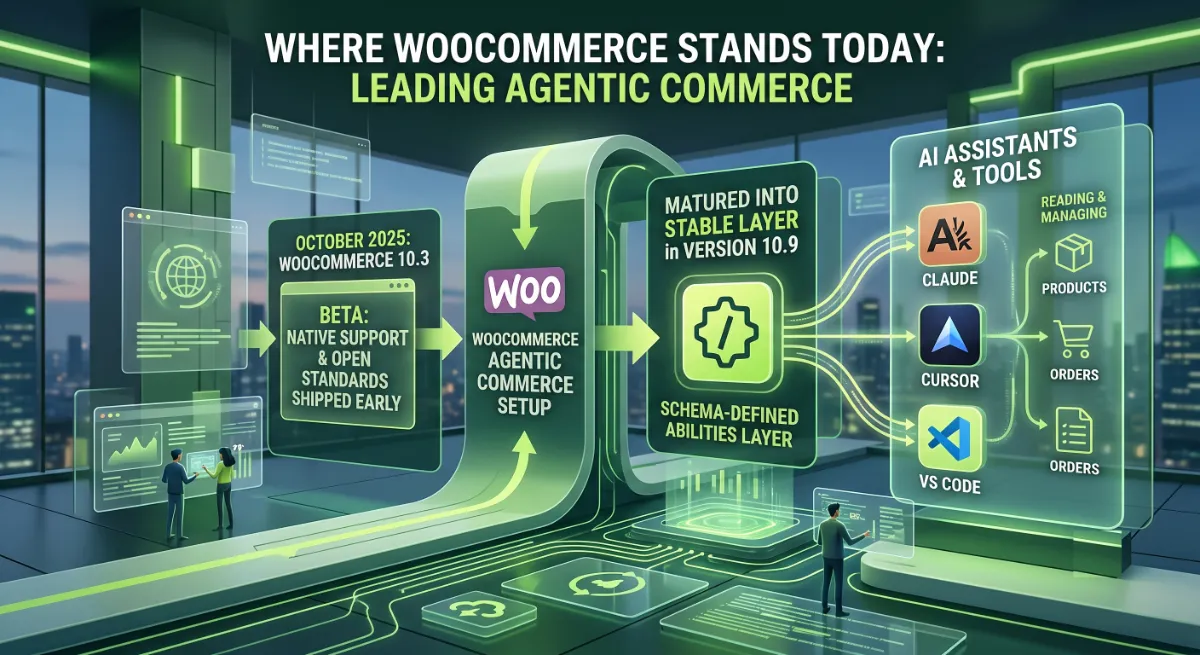
Two facts make a WooCommerce agentic commerce setup practical right now. First, per WooCommerce’s own roadmap, its abilities layer is transport-neutral, meaning the same registered ability works over MCP, REST, and future surfaces, so your setup survives when a protocol changes. Second, WooCommerce is a launch partner for Stripe’s Agentic Commerce Suite, which uses the Agentic Commerce Protocol to handle agent-driven discovery, checkout, and payments through your existing Stripe stack. Unlike Shopify’s more managed, single-standard approach, WooCommerce stays open and composable, which is a real advantage as standards shift.
To set it up well, you need a simple mental model of the protocols involved.
The Protocols, Kept Simple
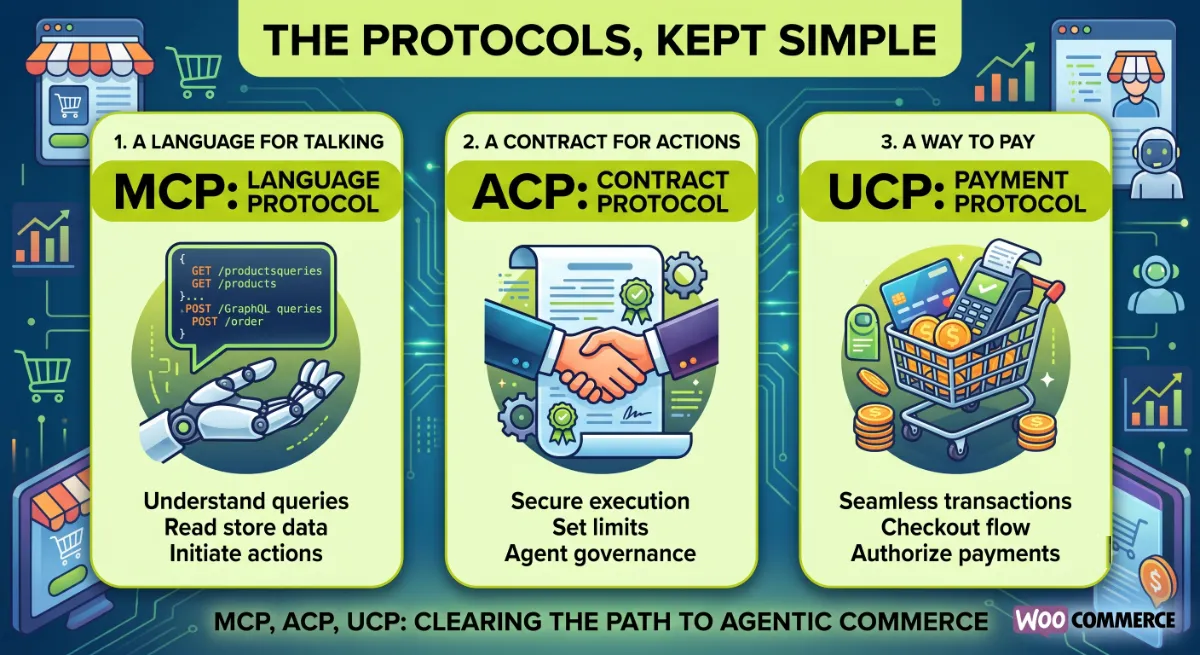
The WooCommerce agentic commerce protocols sound intimidating, but they map to three simple jobs: a language for talking to your store, a contract for what agents can do, and a way to pay. Once you see them that way, a WooCommerce agentic commerce setup stops feeling like alphabet soup, and the WooCommerce agentic commerce path gets clear.
Here is the plain-English version:
- MCP (Model Context Protocol): the language. Created by Anthropic, it lets an AI agent read your live product and order data directly instead of scraping your pages. WooCommerce ships this natively.
- ACP (Agentic Commerce Protocol): the checkout handoff. Built by Stripe and OpenAI, it lets an agent complete a purchase using secure Shared Payment Tokens, so no card details are exposed. WooCommerce supports it through Stripe.
- UCP (Universal Commerce Protocol): the merchant-agent contract. Built by Google and Shopify for discovery through checkout. WooCommerce does not ship it natively, but plugins can add it if you want Google and Shopify-agent coverage.
- Shared Payment Tokens: the payment primitive that lets an agent pay a specific merchant a specific amount, safely, on a user’s behalf.
The clean way to remember it: MCP is the language, ACP is the checkout, UCP is the contract. You do not need all three on day one. Start with MCP and structured data, add Stripe’s ACP for checkout, and layer UCP later if your agents need it.
With the map in hand, here is the actual setup.
How to Set Up WooCommerce for Agentic Commerce
A WooCommerce agentic commerce setup follows five steps across four layers I call the Agent-Ready Stack: Data, Access, Transact, and Discover, plus a governance pass. This is the WooCommerce agentic commerce blueprint I use with clients. Build them in order, because each layer depends on the one before it, and the whole thing is far easier than the acronyms suggest.
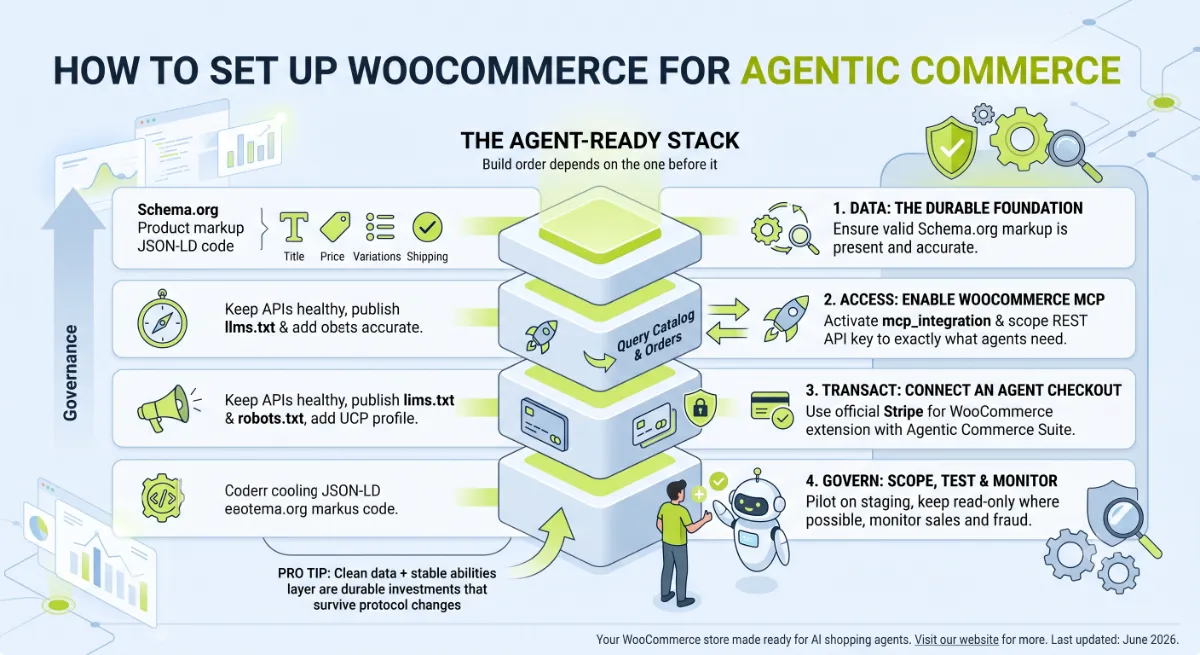
Step 1: Data. Get your product data structured. This is the foundation, and it is the same Schema.org product markup that already helps you rank. If you run Rank Math or Yoast, your products likely output valid Product JSON-LD already. Make sure titles, prices, availability, variations, shipping, and return policies are all present and accurate, because agents read these fields to decide whether to recommend you.
Step 2: Access. Enable the WooCommerce MCP. Update to a current WooCommerce version, then turn on the mcp_integration feature, generate a WooCommerce REST API key scoped to exactly what agents need, and point an MCP client at your store through Automattic’s remote MCP bridge. This lets agents query your catalog and orders through the abilities layer, safely and with permissions intact.
Step 3: Transact. Connect an agent checkout. Use the official Stripe for WooCommerce extension to join Stripe’s Agentic Commerce Suite, which brings ACP checkout, Shared Payment Tokens, and agent-aware fraud protection. You connect your catalog once, then choose which AI agents to sell through from the Stripe dashboard, while payouts run through your existing stack.
Step 4: Discover. Publish agent-discovery surfaces. Help agents find you: keep your REST and Store APIs healthy, publish an llms.txt file that points agents to your catalog, allow reputable AI shopping agents in robots.txt, and, if you want Google and Shopify-agent coverage, add a UCP profile at /.well-known/ucp with a plugin.
Step 5: Govern. Scope, test, and monitor. Pilot on a staging store first, keep query permissions read-only where possible, and validate everything before pointing an agent at real revenue. Then monitor which agents drive sales.
Pro tip: Start with Steps 1 and 2. Clean structured data plus the WooCommerce MCP already makes your store readable to agents. That alone puts you ahead of most stores, and you can add checkout and discovery next.
Follow the stack and you are genuinely agent-ready. Skip straight to the shiny protocol layer, though, and you make the mistake I see most.
Want your WooCommerce store made agent-ready without the guesswork?
I set up the full Agent-Ready Stack: structured data, MCP, Stripe checkout, and discovery. See my WordPress development service.
What Most People Get Wrong
The biggest mistake is chasing protocols instead of building the foundation. People rush to install a UCP plugin or wire up ACP before their product data is clean, when structured data is what actually makes a WooCommerce agentic commerce store discoverable to agents. Most WooCommerce stores are already 60 percent of the way to a WooCommerce agentic commerce setup simply because their Schema.org data is decent. Fix the data first, and every layer above it works better.
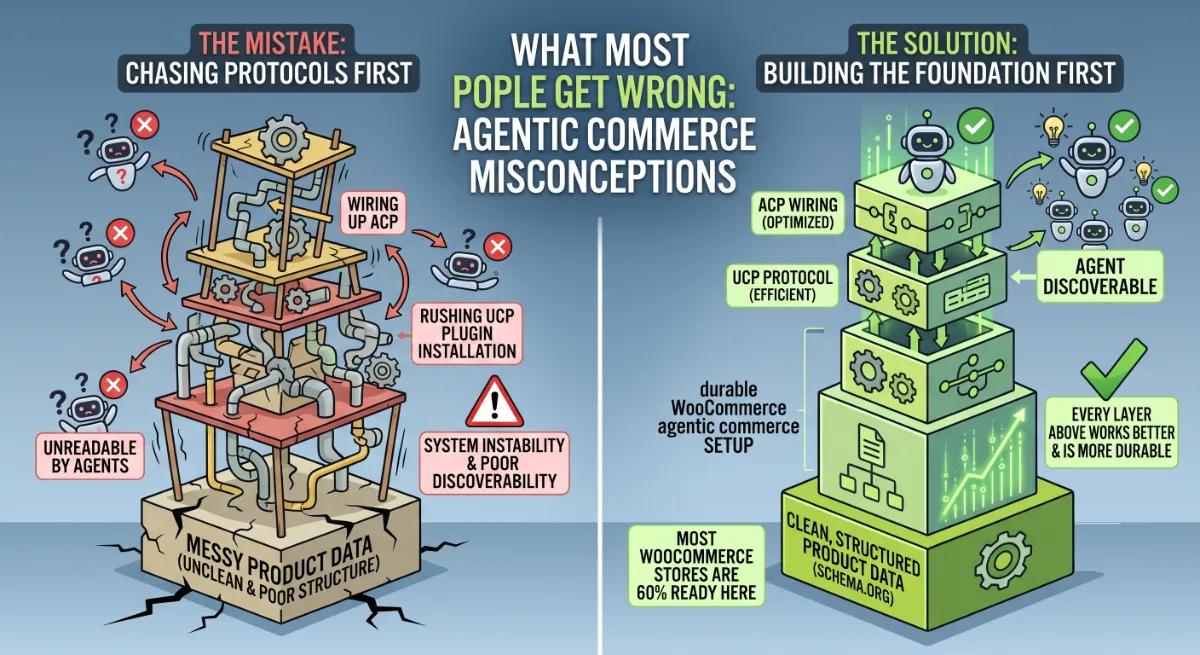
Here is the observation from client work, and the reason to stay calm about the hype: these protocols are churning fast. OpenAI launched in-chat Instant Checkout in late 2025 and retired it within about six months, reshaping it into a different model, while the underlying protocol survived. So do not bet your store on any single consumer feature. Bet on the durable layer of any WooCommerce agentic commerce setup: clean structured data and WooCommerce’s transport-neutral abilities layer, which is designed to survive when a protocol version changes. That is why you do not need to build your own AI agent. You need to make your store readable and buyable, then let the agents come to you.
When the stakes are real revenue and real customers, that is where getting the setup and the governance right the first time matters most.
Ready to make your store the one agents buy from?
I handle the full WooCommerce agentic commerce setup, from structured product data to safe agent checkout. See my WordPress development service or book a free call.
Frequently Asked Questions
What is a WooCommerce agentic commerce setup?
It is the work of making your WooCommerce store discoverable and purchasable by AI shopping agents. It has four layers: structured product data, the WooCommerce MCP for agent access, an agent checkout such as Stripe’s Agentic Commerce Suite, and discovery files that help agents find your store.
Does WooCommerce support agentic commerce natively?
Yes, in part. WooCommerce ships native Model Context Protocol support, first as a beta in version 10.3 and matured into a stable abilities layer in 10.9. That covers agent access to products and orders. For agent checkout, WooCommerce partners with Stripe’s Agentic Commerce Protocol.
Do I need Stripe for WooCommerce agentic commerce?
For the smoothest agent checkout, yes. WooCommerce is a launch partner for Stripe’s Agentic Commerce Suite, so if you use Stripe you can enable agent-driven checkout, Shared Payment Tokens, and fraud protection through the official extension. You can still be discoverable to agents without it, using structured data and MCP.
What is the difference between MCP, ACP, and UCP?
MCP is the language agents use to read your store data, and WooCommerce ships it natively. ACP, built by Stripe and OpenAI, handles the checkout handoff. UCP, built by Google and Shopify, is the broader merchant-agent contract. In short: MCP is the language, ACP is the checkout, UCP is the contract.
Is my store already agent-ready?
Partly, if your product data is clean. Most WooCommerce stores using Rank Math or Yoast already output the Schema.org markup agents read, which is the biggest single factor. The remaining WooCommerce agentic commerce work is enabling MCP, connecting an agent checkout, publishing discovery files, and scoping permissions safely.
Is agentic commerce safe for my store?
It can be, with the right governance. The main risk is giving an agent broad, write-enabled access. Keep API keys tightly scoped, use read-only permissions where possible, rely on WooCommerce’s abilities layer that validates and limits actions, and pilot on staging before going live with real orders.
Should I wait since the protocols keep changing?
No. The consumer features shift, but the foundation does not. Clean structured data and WooCommerce’s transport-neutral abilities layer survive protocol changes. Getting those right now puts you ahead, and adding or swapping a protocol later is straightforward once the foundation is in place.
Can you set up agentic commerce on my WooCommerce store for me?
Yes. A WooCommerce agentic commerce setup is new, technical, and safety-sensitive, so many owners prefer it handled end to end. I set up the full Agent-Ready Stack, structured data, MCP, Stripe checkout, discovery, and governance, and test it safely. See my WordPress development service.
Conclusion
A WooCommerce agentic commerce setup is not hype, it is the next place your customers will shop, and a WooCommerce agentic commerce build is genuinely within reach today. Build the Agent-Ready Stack in order: structured product data first, then the WooCommerce MCP for access, then Stripe’s ACP for checkout, then discovery files, with tight permissions throughout. Remember the two things that matter most: the foundation of clean structured data survives every protocol change, and you make your store readable and buyable rather than building an agent yourself. Start with your product data today, and you are already ahead of most stores.
Want to be the store AI agents choose, and buy from?
I make WooCommerce stores agent-ready and fast, end to end. Book a free call or browse my recent project portfolio.
The exact Data, Access, Transact, Discover, and Govern checklist I use to make a WooCommerce store ready for AI shopping agents.
Get it free →This article was last reviewed and updated in June 2026 to reflect current WooCommerce, MCP, and agentic commerce protocol developments.