
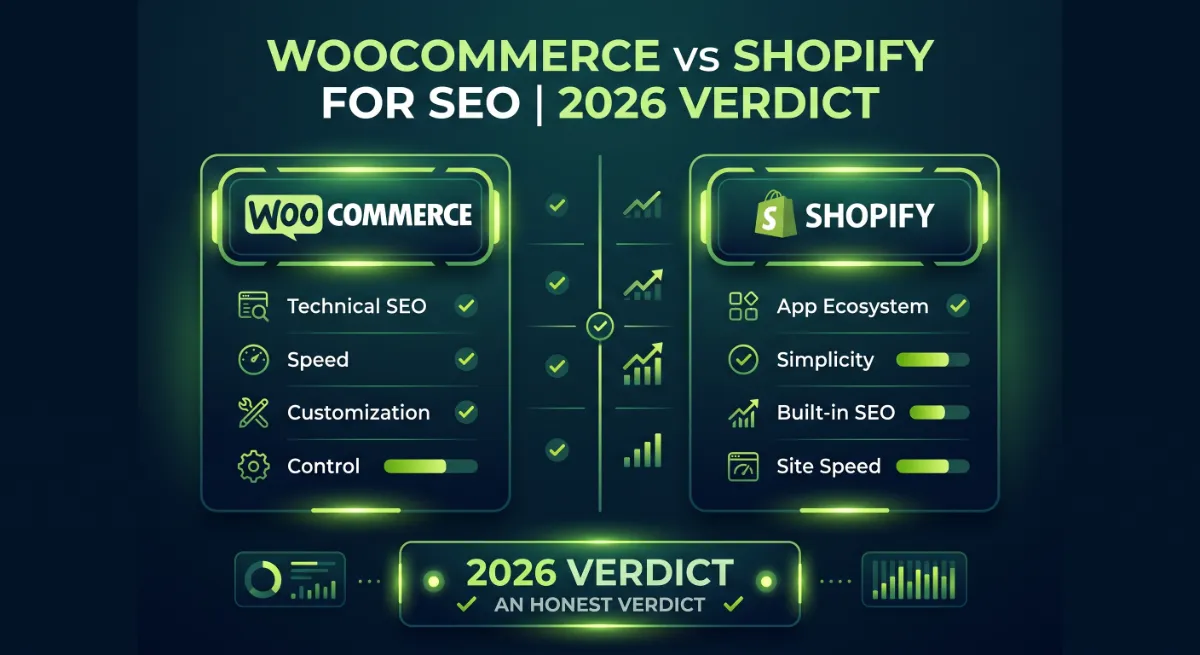
- In WooCommerce vs Shopify for SEO, neither platform has an inherent ranking advantage, since Google ranks pages, not platforms.
- WooCommerce wins on control: full URL hierarchy, schema flexibility, and WordPress as a serious content engine.
- Shopify wins out of the box: managed hosting, strong default Core Web Vitals, and clean baseline schema.
- Shopify enforces fixed /products/ and /collections/ URL paths that cannot be changed. WooCommerce lets you shape any structure.
- The right choice depends on who does the SEO work, your content strategy, and whether you have a developer.
In WooCommerce vs Shopify for SEO, the honest answer to the WooCommerce vs Shopify question is that neither platform ranks better by default, because Google ranks individual pages, not the platform underneath them. WooCommerce gives you more control and a stronger content engine, while Shopify gives you better defaults and less maintenance. The right pick depends on your team, your content plans, and how much technical control you need. This guide breaks down both sides.
After building and ranking both WooCommerce and Shopify stores for clients in 15+ countries, here is the framing I give every client who asks. Stop asking which platform ranks better in WooCommerce vs Shopify, because that is the wrong question. Ask which platform lets your team do the SEO work you actually plan to do. That reframe answers the decision almost every time, so let us walk through it.
The Short Answer
In WooCommerce vs Shopify for SEO, WooCommerce is the stronger foundation for content-led, control-heavy strategies, and Shopify is the stronger default for lean teams that want good SEO fast. In WooCommerce vs Shopify, both platforms rank on page one across competitive niches every day. The gap is not ranking power, it is operating model.
Here is the truth the WooCommerce vs Shopify debates usually miss: strong ecommerce SEO still comes down to category structure, product page quality, internal linking, page speed, schema, and authority signals. Every one of those is achievable on either platform. What changes between them is how much control you get, how much work it takes, and where the bottlenecks show up.
Pro tip: Choose the platform your team can maintain consistently. A WooCommerce store nobody optimizes will lose to a well-run Shopify store, and a neglected Shopify store will lose to a well-run WooCommerce one. Consistency beats platform every time.
To choose well, you need to know exactly where each one pulls ahead.
Where WooCommerce Wins: Control
WooCommerce wins the WooCommerce vs Shopify SEO comparison on control, because running on WordPress gives you full command over the technical and content levers that shape long-term organic growth. Nothing is locked behind a platform wall.

The genuine WooCommerce advantages:
- Full URL control. You can build hierarchical URLs like /category/subcategory/product, remove prefixes, and shape your structure around your keywords rather than the platform’s rules.
- A real content engine. WordPress supports true category hierarchies, custom post types, and topic clusters, which makes it far stronger for editorial content and long-tail SEO than a flat blog.
- Schema flexibility. With Rank Math or Yoast you control exactly what product structured data is output and how, rather than accepting a theme’s defaults.
- Technical depth. Full access to robots.txt, canonicals, hreflang, redirects, and templates, so advanced or programmatic SEO is entirely on the table.
That freedom is why, in WooCommerce vs Shopify, content-led brands and technical teams lean WooCommerce. But freedom has a flip side, and that is where Shopify answers back.
Where Shopify Wins: Defaults
Shopify wins the WooCommerce vs Shopify SEO comparison on defaults, because it ships fast, secure, and technically sound out of the box with almost no setup. In the WooCommerce vs Shopify decision, for teams without a developer, that head start is real.

The genuine Shopify advantages:
- Speed by default. Shopify runs on its own managed CDN and infrastructure, and a larger share of Shopify stores pass Core Web Vitals than WooCommerce stores, where plugin bloat and cheap hosting often drag speed down.
- Clean baseline schema. Modern themes ship Product, Organization, and Breadcrumb structured data automatically, so most stores start rich-result eligible without touching code.
- Security handled. SSL, PCI compliance, and automatic patching are built in, removing a whole maintenance burden that, if neglected on WooCommerce, can cost you rankings.
- Fewer moving parts. Less to configure, fewer ways to break it, and predictable upkeep, which suits lean teams that want results without technical overhead.
With both sides clear, here is the head-to-head.
WooCommerce vs Shopify: SEO Scorecard
Across the SEO factors that matter most, WooCommerce vs Shopify splits cleanly along one line: control versus convenience. This scorecard shows where each platform pulls ahead so you can weigh it against your own priorities.
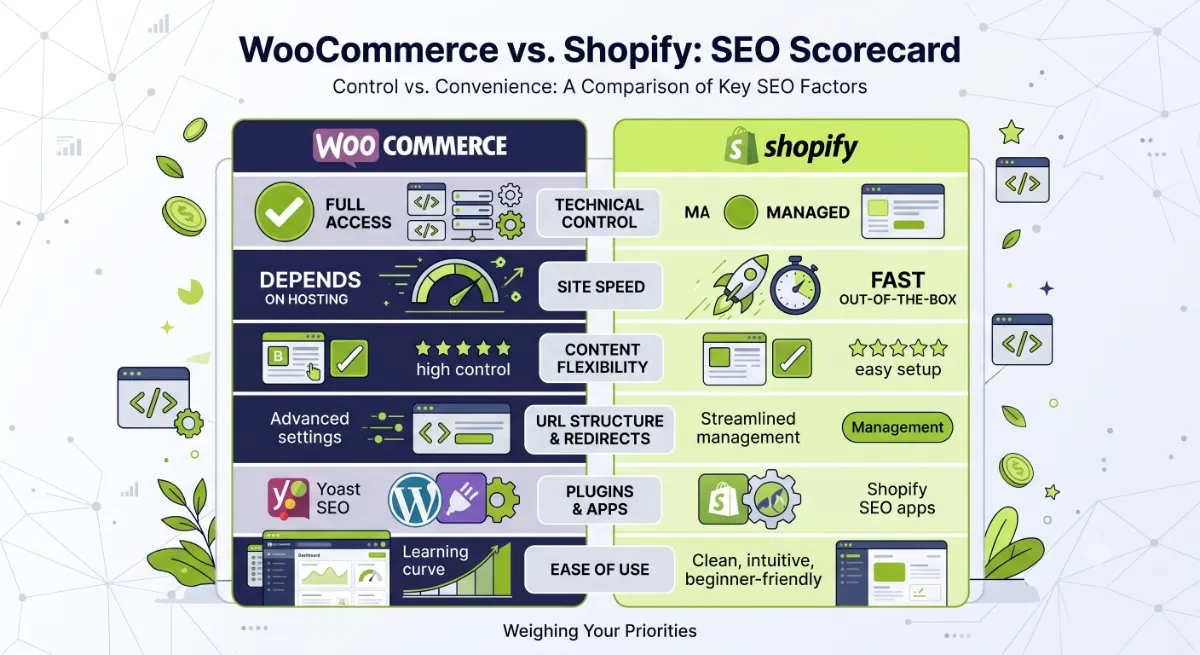
| SEO factor | WooCommerce | Shopify |
|---|---|---|
| URL structure | Full control, any hierarchy | Fixed /products/ and /collections/ |
| Page speed | High ceiling, needs good hosting | Fast by default, managed CDN |
| Schema | Flexible via plugins | Clean baseline in modern themes |
| Content and blogging | Full WordPress content engine | Functional but flatter blog |
| Security | Your responsibility | Built in and automatic |
| Maintenance | Ongoing, hands-on | Minimal, managed |
| Best suited to | Content-led, technical teams | Lean teams wanting speed to good |
Notice there is no row where one platform simply cannot compete. The WooCommerce vs Shopify differences are about effort and control, which is exactly why the choice is personal to your store.
Which Should You Choose?
Choose WooCommerce if content and technical control drive your growth, and choose Shopify if you want strong SEO with minimal overhead and no developer. That single distinction resolves most of the WooCommerce vs Shopify decision, but a few specifics sharpen it.
Choose WooCommerce when: organic content is your main acquisition channel, you need custom URL structures or programmatic landing pages, you want deep taxonomy and schema control, or you already run your business on WordPress. The catch is that you need a developer or the willingness to maintain it, and you must invest in good hosting and performance.
Choose Shopify when: you have a lean team, want fewer moving parts, value predictable maintenance, and your growth leans on paid plus brand search more than editorial content. The catch is that you accept the fixed URL structure and less technical flexibility as the price of that simplicity.
Pro tip: Be honest about who will actually do the SEO work. The platform that matches your real capacity, not your aspirations, is the one that will rank. I have seen ambitious WooCommerce builds underperform simple Shopify stores purely because no one maintained them.
Answer that honestly and the decision makes itself. Which brings us to the mistakes that derail it.
Weighing WooCommerce against Shopify for your store’s SEO?
I build and rank both, so I will give you a straight recommendation based on your goals, not a platform bias. See my WordPress development service.
What Most People Get Wrong
The biggest mistake in the WooCommerce vs Shopify SEO debate is believing one platform inherently ranks higher. It does not. Google ranks pages based on content, relevance, experience, and authority, none of which is granted or blocked by your platform choice. A great page on either platform beats a mediocre page on the other, every time.

Here is the observation from client work. In WooCommerce vs Shopify, the stores that win are the ones whose team fits their platform. In WooCommerce vs Shopify, content-heavy brands thrive on WooCommerce because they use the control it offers. Lean product-led teams thrive on Shopify because they lean on its defaults instead of fighting them. The failures I see are mismatches: a non-technical team on WooCommerce that never optimizes it, or a content-first brand on Shopify frustrated by the fixed URLs.
The second WooCommerce vs Shopify trap is re-platforming to chase rankings. Migrating from one to the other rarely fixes an SEO problem that was really about strategy, and a botched migration, with broken redirects and lost URLs, can wipe out traffic for months. If your current platform can do the job, fixing your SEO on it is almost always safer and cheaper than switching.
When the decision genuinely matters to your revenue, an honest second opinion from someone who builds on both is worth more than any comparison chart.
Not sure which platform fits your SEO strategy?
I work in both WooCommerce and Shopify and will recommend the right one for your goals, then build it to rank. See my WordPress development service or book a free call.
Frequently Asked Questions
Is WooCommerce or Shopify better for SEO?
Neither is inherently better, because Google ranks pages, not platforms. WooCommerce wins on control, URL structure, and content depth, while Shopify wins on default speed, clean schema, and low maintenance. The better platform is the one your team can optimize and maintain consistently for your specific strategy.
Does Shopify’s fixed URL structure hurt SEO?
Rarely in a serious way. Shopify enforces /products/ and /collections/ prefixes that cannot be removed, which limits fully custom architectures. For catalog-led stores this is a non-issue, but for content-led brands building deep topic clusters, the lack of URL flexibility is a lasting constraint worth weighing.
Which platform is faster for Core Web Vitals?
Shopify tends to be faster by default, since it runs on managed infrastructure and a CDN, and a larger share of Shopify stores pass Core Web Vitals. WooCommerce has a higher performance ceiling with good hosting and optimization, but slow hosting and plugin bloat commonly drag unoptimized stores down.
Is WooCommerce better for content marketing and blogging?
Yes. WooCommerce runs on WordPress, which offers true category hierarchies, custom post types, and mature content structures that suit topic clusters and long-tail SEO. Shopify’s blog is functional but flatter, so brands whose growth engine is editorial content usually find WooCommerce the stronger foundation.
Do both platforms support schema for rich results?
Yes. Shopify ships Product, Organization, and Breadcrumb schema in modern themes automatically, while WooCommerce adds schema through plugins like Rank Math or Yoast with more flexibility. Neither guarantees rich results, though. Schema makes you eligible, but content quality and relevance still determine what Google actually shows.
Should I switch platforms to improve my rankings?
Usually not. Re-platforming rarely fixes an SEO issue that is really about content or strategy, and a poor migration can lose URLs and traffic for months. If your current platform can do the job, improving your SEO on it is almost always safer and cheaper than switching for ranking reasons.
Which platform is better for AI search visibility?
Both can be cited by AI assistants, since AI search relies on clear content and structured data rather than platform. WooCommerce offers more control to fine-tune structured data and content, while Shopify provides clean defaults. As with traditional SEO, the quality of your structured, first-hand content matters most.
Should I hire someone to help decide or build?
Consider it, since the platform decision shapes your SEO for years and a good build matters as much as the choice. Someone who works in both can give you an unbiased recommendation and then execute it well. My WordPress development service covers both platforms.
Conclusion
WooCommerce vs Shopify for SEO is not a contest of which platform ranks higher, because Google ranks pages, not platforms. The WooCommerce vs Shopify choice is one between control and convenience. WooCommerce gives you full command of URLs, schema, and a serious content engine, ideal when content and technical SEO drive your growth and you have the capacity to run it. Shopify gives you speed, security, and clean defaults with minimal overhead, ideal for lean teams that want strong SEO fast. In WooCommerce vs Shopify for SEO, match the platform to who will actually do the work, and either one can rank at the top. If organic content and technical control are your engine, WooCommerce is the stronger foundation, and building it right is exactly where an experienced developer earns their keep.
Ready to build a store that actually ranks?
I help you pick the right platform, then build the SEO foundation to grow on it. Book a free call or browse my recent project portfolio.
This article was last reviewed and updated in June 2026 to reflect current WooCommerce and Shopify SEO capabilities.