The Two Audiences Every Property Management Website Gets Wrong
A property management website serves two audiences with opposing needs sharing the same digital space. Landlords want evidence that you will maximise their rental return, minimise vacancy periods, select quality tenants rigorously, and handle maintenance without needing to be chased. Tenants want to know what properties you manage, how to apply, what the maintenance request process is, and whether they will be treated fairly during the tenancy. Most property management websites either ignore tenants entirely – making the site feel cold and transactional for a relationship that lasts years – or attempt to serve both audiences from the same homepage in a way that dilutes the pitch to both. I build property management sites with distinct audience paths that share a credibility foundation: a landlord acquisition section built around proof of performance, and a tenant section built around transparency and ease of application.
Landlord Acquisition Pages That Convert Investors Comparing Property Managers
A landlord evaluating property management agencies searches with clear commercial intent: “best property manager [suburb],” “property management fees [city],” “how to switch property manager,” “rental property management [area].” These are buyers with a specific, valuable, recurring service need. The landing pages that convert them are those that answer the evaluation criteria directly: your management fee structure (displayed transparently, not hidden behind “contact us for a quote”), your average days on market for new listings, your vacancy rate, your rent collection rate, your maintenance response time, and how many properties in their specific suburb you currently manage. These performance metrics – when they are genuinely strong – convert landlord enquiries more effectively than any amount of promotional language. I build landlord acquisition pages as structured performance demonstrations, not sales pitches.
Rental Listing and Vacancy Pages That Attract Quality Tenants
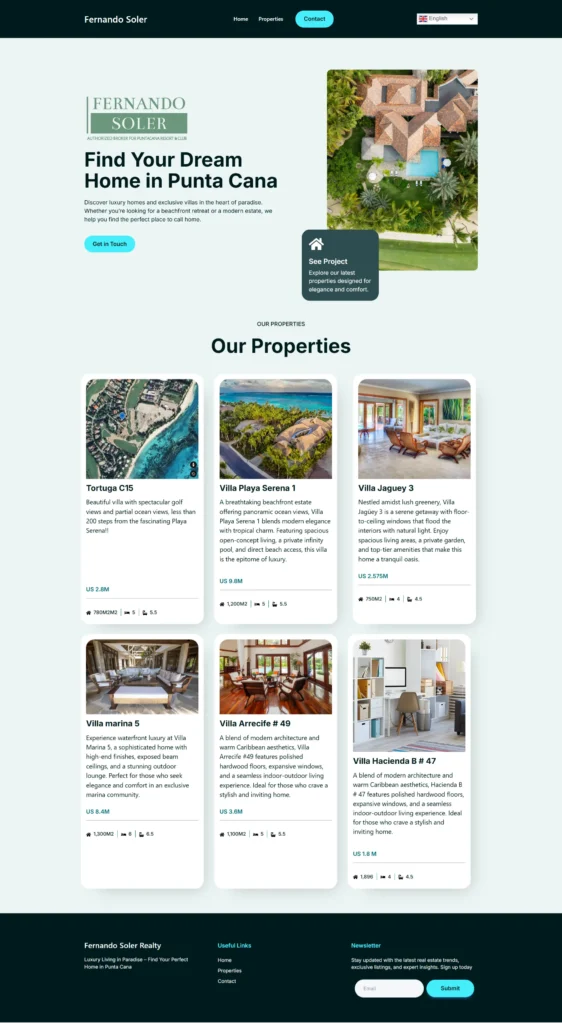
Property management companies that publish their available rental listings on their own website capture two advantages that OTA-dependent agencies miss. First, tenants who find a property on your site are already in your brand environment before they apply – they arrive knowing who manages the property and have had a first impression of your professional standards. Second, rental listing pages on your own domain build search equity with every published vacancy and every address-specific search they rank for. I build rental listing systems using a custom post type in WordPress with fields for all standard rental details, integration with your property management software for automatic listing sync, online rental application forms, and suburb-level rental pages that aggregate your current listings by area and rank for searches like “apartments for rent [suburb].”
Maintenance Request Portal That Reduces Phone Volume and Documents Everything
Maintenance management is the highest-friction operational area in residential property management, and the quality of the maintenance process is the primary driver of tenant satisfaction and retention. A tenant who can submit a maintenance request online with photos, receive an automated acknowledgement with an expected response timeline, and track the status of their request through to resolution has a dramatically better experience than one who leaves voicemails that may or may not be followed up. I build maintenance request portals on property management websites that capture the property address, issue description, urgency level, and photo attachments, route the request to the correct property manager, and trigger an automated tenant acknowledgement. The request data integrates with property management software including PropertyMe, Console Cloud, Property Tree, Buildium, and AppFolio where API access is available.
Suburb Rental Market Reports That Build Authority and Capture Investor Searches
Property investors researching where to buy or whether to change property managers search for suburb-level rental market data: “average rental yield [suburb],” “vacancy rate [area],” “median rent [suburb] 2024,” “rental demand [region].” This content is genuinely sought by the landlord audience a property management company needs to attract, and most agencies either do not produce it or produce it only as a PDF that search engines cannot index. I build suburb rental market pages as regularly updated web content – median rent tracking, vacancy rate context, rental demand indicators, comparable property commentary, and management company performance data for that specific suburb. These pages rank for investor research searches, establish your agency as the local authority on rental market conditions, and organically attract the property owners in each suburb who are your most valuable prospective clients.
Trust and Compliance Display for a Regulated Industry
Property management is a licensed profession in every Australian state and territory, in most US states, and in most UK jurisdictions. A landlord entrusting their investment property to a management agency needs confidence that the agency holds the correct licence, maintains a trust account with appropriate auditing, carries professional indemnity and public liability insurance, and employs property managers who are individually licensed or supervised by a licensed agent. I build compliance and trust sections that display the agency licence number with a link to the state register, the trust account structure and audit frequency, the professional indemnity coverage level, REIA or relevant property management association membership, and any awards or recognition from the industry body. These displays serve both the compliance requirement and the conversion function – a prospective landlord who sees verifiable credentials is significantly more likely to enquire than one who has to ask whether the agency is properly registered.
Owner Statement and Reporting Access That Strengthens Client Retention
Property investors who receive timely, clear, and transparent financial reporting on their investment retain their property management relationship longer and refer other investors at a higher rate than those who receive confusing or delayed statements. I build owner portal sections on property management websites that provide secure, branded access to monthly owner statements, maintenance invoice history, annual income and expenditure summaries, and lease renewal notifications – connected to your property management software via its client portal functionality or API. The portal login lives on your own domain under your brand rather than requiring landlords to navigate to a generic software platform interface. For agencies using PropertyMe, Console Cloud, or Buildium, the owner portal connection is typically available through the platform’s existing white-label or portal features, which I configure and embed correctly within the WordPress site.