


- Is Elementor good for SEO? Yes, when you pair it with an SEO plugin and keep it fast.
- Elementor outputs clean, semantic HTML and gives you full control over headings, alt text, and mobile layouts.
- The main SEO risk is performance: bloated, deeply nested pages that fail Core Web Vitals.
- Elementor has no native meta tags, schema, or sitemaps, so a plugin like Rank Math is mandatory, not optional.
- Google ranks your rendered page, not the builder you used, so your setup decides your results.
Is Elementor good for SEO? Yes, when you optimize it. Elementor outputs clean, semantic HTML, gives you full control over headings, alt text, and mobile layouts, and integrates with SEO plugins like Rank Math. It will not rank a slow, bloated site, though, and it does not handle meta tags or schema on its own. Your setup decides the outcome.
After building and ranking Elementor sites for clients in 15+ countries, I can settle this debate quickly. The builder is rarely the reason a site does or does not rank. The setup is. So instead of asking whether the tool is “SEO friendly,” the better question is whether your Elementor site is configured for search. This guide gives you the honest verdict on is Elementor good for SEO, the real risks, and the exact setup that makes any Elementor site rank-ready.
Is Elementor Good for SEO? The Short Answer
Yes. Is Elementor good for SEO when it is set up correctly? Absolutely, and it can rank just as well as a Gutenberg or hand-coded site. The reason is simple: Elementor is a tool, and Google does not rank or penalize tools. Google evaluates the page your visitor actually experiences, its speed, its structure, its mobile usability, and its content. A well-built Elementor page checks every one of those boxes.
What makes Elementor good for SEO out of the box is that it produces relatively clean, semantic HTML, which is unusual among visual builders. As Elementor’s own SEO guidance notes, page builders can even help SEO by making engaging pages that keep people on your site longer. The catch is that “can be good” is not the same as “is automatically good.” You have to configure it.
Pro tip: If someone tells you Elementor is bad for SEO, they almost always mean a specific Elementor site was built badly. The builder and the build are two different things, and that distinction is the whole question behind is Elementor good for SEO.
What keeps the verdict a confident yes is the setup, and to see why is Elementor good for SEO holds up, look at what the builder actually gives you.
What Makes Elementor Good for SEO
What makes Elementor good for SEO is the direct control it hands you over the on-page signals search engines read, all without touching code. You decide the structure, the semantics, and the mobile experience inside the visual editor, and those are exactly the things Google’s crawlers parse.
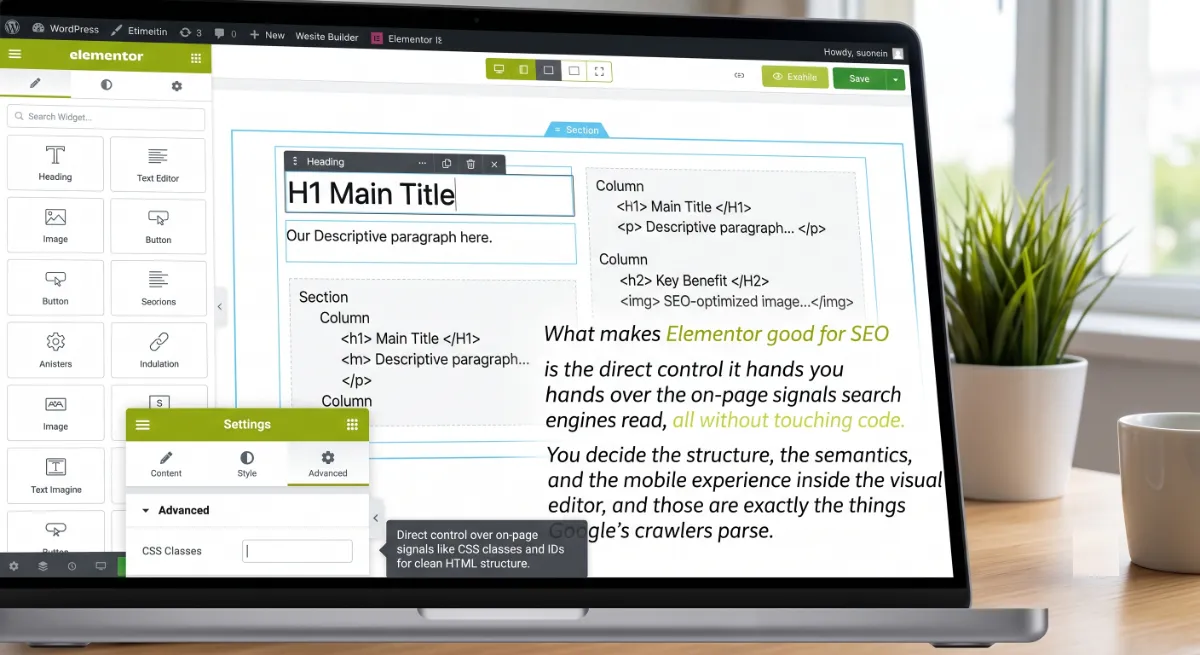
These are the features that make Elementor good for SEO in your favor:
- Clean, semantic HTML. Elementor is one of the few visual builders written to clean code standards, so crawlers can read your page hierarchy.
- Full heading control. You set one H1 per page and a logical H2 and H3 structure visually, which is core on-page SEO.
- Image alt text and internal links. Both are editable right in the editor, no code required.
- Mobile-first design. Custom breakpoints and per-device controls matter because Google indexes the mobile version of your site first.
- Theme Builder templates. One template keeps structure consistent across every post or product, which is great for technical SEO at scale.
- SEO plugin integration. Rank Math and Yoast plug straight into the editor, so you optimize content without leaving Elementor.
That combination is genuinely strong, and it is the core of what makes Elementor good for SEO. Still, the same flexibility can be turned against you, which is where most problems start.
Where Elementor Can Hurt Your SEO
Elementor can hurt your SEO in exactly one area: performance. The builder adds extra CSS, JavaScript, and HTML wrappers, and if you over-build a page, it gets slow and heavy enough to fail Core Web Vitals, which are a Google ranking signal. This, not the builder itself, is the real reason some Elementor sites underperform, and it is the one thing that can stop Elementor good for SEO from being true.
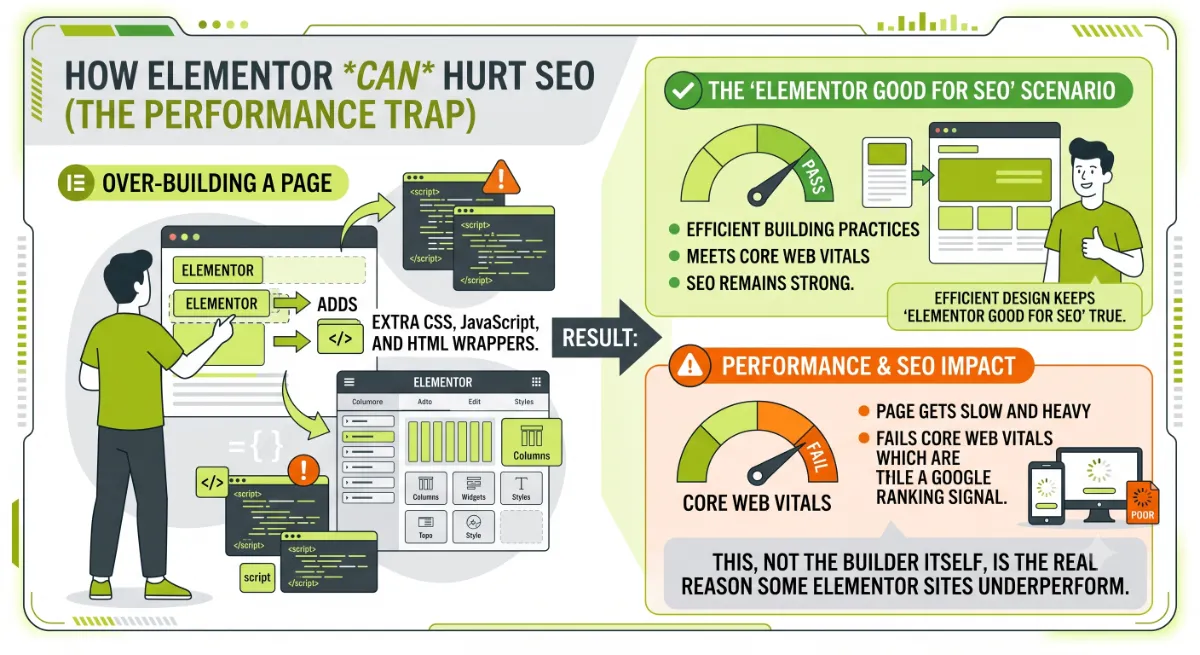
The usual culprits are deeply nested layouts, sometimes called “Divitis,” too many widgets and addon packs, heavy animations, and large unoptimized images. Each one inflates your DOM and slows rendering, which drags down LCP and INP. The fix is straightforward: move to Flexbox Containers, which can cut DOM size noticeably, enable Elementor’s performance features, optimize images, and add caching. Handle performance and you remove the single biggest threat to your rankings, which is what keeps Elementor good for SEO over time.
There is one more gap to understand, and it is the one that catches people off guard.
What Elementor Doesn’t Do for SEO
Elementor does not handle the technical SEO layer at all, and assuming it does is the most common mistake people make. Elementor builds your page; it does not write your meta titles, generate schema markup, create an XML sitemap, or manage redirects. It provides effectively zero native structured data on its own.
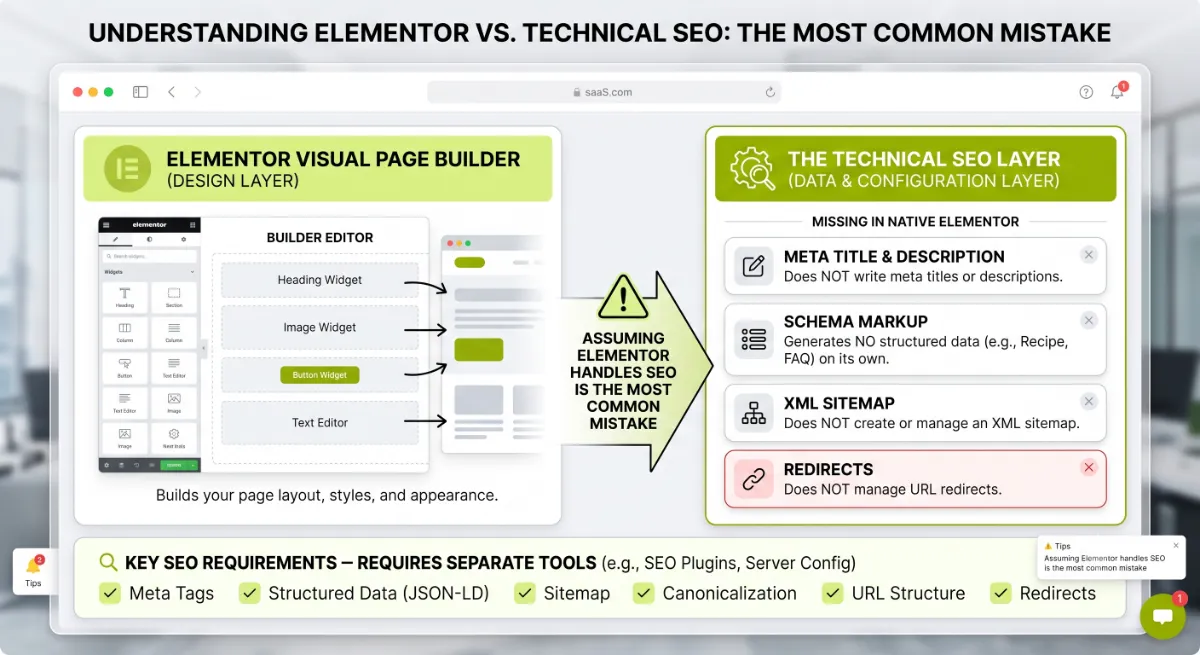
This is why an SEO plugin is mandatory, not optional. Install Rank Math, which integrates directly into the Elementor editor, and you get the entire missing layer: editable meta titles and descriptions, canonical URLs, noindex controls, automatic XML sitemaps, and 13-plus schema types you can configure per page without leaving the builder. Yoast and SEOPress do the same job well. Adding that layer is what makes Elementor good for SEO in real practice.
Once you understand the division of labor, making your site rank-ready is just a checklist.
How to Make Elementor Good for SEO
To make Elementor good for SEO, build it in three layers, what I call the Elementor SEO Stack: a plugin layer, a performance layer, and an on-page layer. Each layer handles a different job, and covering all three is what makes Elementor good for SEO in practice. Miss one and you leave results on the table.
Here is the stack, in order:
- Plugin layer. Install Rank Math or Yoast. Set meta titles and descriptions, turn on the sitemap, enable schema, and configure breadcrumbs and canonicals.
- Performance layer. Use Flexbox Containers, enable Elementor’s performance features, compress images to WebP or AVIF, and add caching so you pass Core Web Vitals.
- On-page layer. Set one clear H1, a logical heading structure, descriptive alt text, internal links to related pages, and genuinely useful content that matches search intent.
Pro tip: Build the stack in this order. A plugin with no performance work still loses on Core Web Vitals, and fast pages with no plugin never get their meta and schema read. All three layers earn their place.
Run that stack and the answer to is Elementor good for SEO becomes a clear yes for your site specifically. The three layers together are what make Elementor good for SEO, not the builder alone.
Not sure your Elementor site is set up to rank?
I audit Elementor sites across all three layers and fix what is holding them back. See my WordPress development service.
What Most People Get Wrong
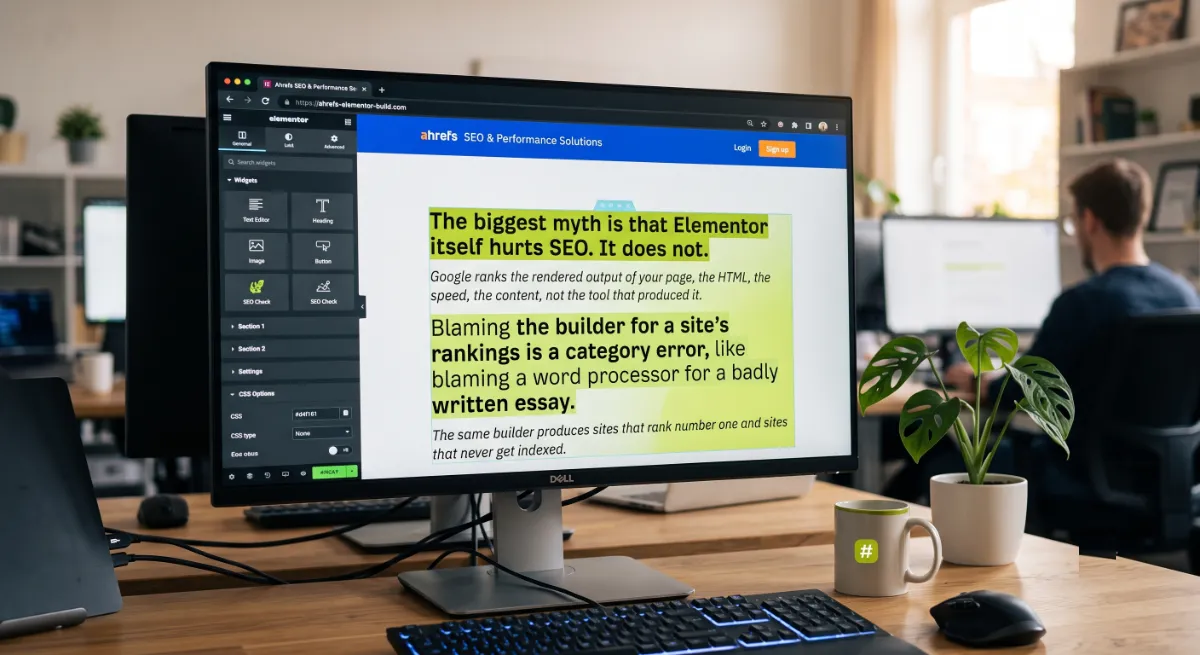
The biggest myth is that Elementor itself hurts SEO. It does not. Google ranks the rendered output of your page, the HTML, the speed, the content, not the tool that produced it. Blaming the builder for a site’s rankings is a category error, like blaming a word processor for a badly written essay. The same builder produces sites that rank number one and sites that never get indexed.
Here is the observation from years of client work: the Elementor sites that ranked were never the ones with the fewest widgets. They were the ones with an SEO plugin configured and Core Web Vitals handled. The builder was never the deciding variable. So the honest answer to is Elementor good for SEO is yes, but it is conditional on you doing the setup. Setup, not the tool, is what makes Elementor good for SEO, and that is true of every platform, not just Elementor.
When the setup gets complex, when schema, performance, and content all need to line up across a large site, that is the moment a specialist earns their fee. Get the fundamentals right and Elementor competes with anything, which is exactly why is Elementor good for SEO deserves a yes.
Built a great-looking Elementor site that just won’t rank?
Nine times out of ten it is a missing layer, not the builder. I find it and fix it. See my WordPress development service or book a free call.
Frequently Asked Questions
Is Elementor good for SEO?
Is Elementor good for SEO? Yes, when it is configured correctly. It outputs clean, semantic HTML, gives you control over headings, alt text, and mobile layouts, and integrates with SEO plugins. It can rank as well as a hand-coded site, but only if you handle performance and add an SEO plugin.
Does Elementor slow down your website and hurt rankings?
It can, if you over-build pages with too many widgets, heavy animations, or large images. That extra weight can fail Core Web Vitals, which is a ranking signal. Using Flexbox Containers, Elementor’s performance features, image compression, and caching keeps an Elementor site fast and rank-ready.
Do I need an SEO plugin with Elementor?
Yes. Elementor builds your pages but does not generate meta titles, schema markup, XML sitemaps, or redirects. An SEO plugin like Rank Math or Yoast supplies that entire technical layer and integrates directly into the Elementor editor, so the two work together rather than conflicting.
Does Elementor support schema markup?
Not natively. Elementor provides essentially no built-in structured data. You add schema through an SEO plugin, and Rank Math, for example, lets you configure 13-plus schema types per page from inside the Elementor editor, producing clean JSON-LD that helps you earn rich results.
Is Elementor better or worse for SEO than Gutenberg?
Neither is inherently better for SEO. Gutenberg is lighter by default, while Elementor gives you more design control and the same SEO plugin support. A well-optimized Elementor site and a well-optimized Gutenberg site can both pass Core Web Vitals and rank equally. Setup decides the outcome.
Does Google penalize sites built with Elementor?
No. Google does not penalize page builders. It evaluates the rendered page: its speed, structure, mobile usability, and content. If those are good, an Elementor site ranks. If they are poor, it does not, regardless of which tool built it.
Which SEO plugin is best for Elementor?
Rank Math is the popular choice for Elementor because it is lightweight, integrates into the editor, and offers strong schema controls. Yoast SEO and SEOPress also integrate well. Any of the three supplies the meta, schema, and sitemap layer Elementor does not handle on its own.
When should I hire a professional for Elementor SEO?
Hire a professional when your site looks great but will not rank, when Core Web Vitals keep failing, or when schema and technical SEO need to line up across many pages. A specialist audits all three layers and fixes the gap. My WordPress development service covers exactly this.
Conclusion
So, is Elementor good for SEO? Yes, with one honest condition: you have to set it up. Elementor gives you clean code, full on-page control, and seamless SEO plugin support, which is a strong foundation. Your only real risk is performance, and your only real gap is the technical layer an SEO plugin fills. Build the three-layer stack of plugin, performance, and on-page, and an Elementor site ranks with anything on the web. That stack is the real answer to is Elementor good for SEO. Start with an SEO plugin today, fix your Core Web Vitals next, and bring in help when the setup outgrows a checklist.
Want an Elementor site that is fast, clean, and built to rank?
I build and optimize Elementor sites with SEO baked in from the first layer. Book a free call or browse my recent project portfolio.
The exact three-layer setup I use to make any Elementor site rank-ready: plugin, performance, and on-page, step by step.
Get it free →This article was last reviewed and updated in June 2026 to reflect the latest Elementor SEO features and best practices.